Writers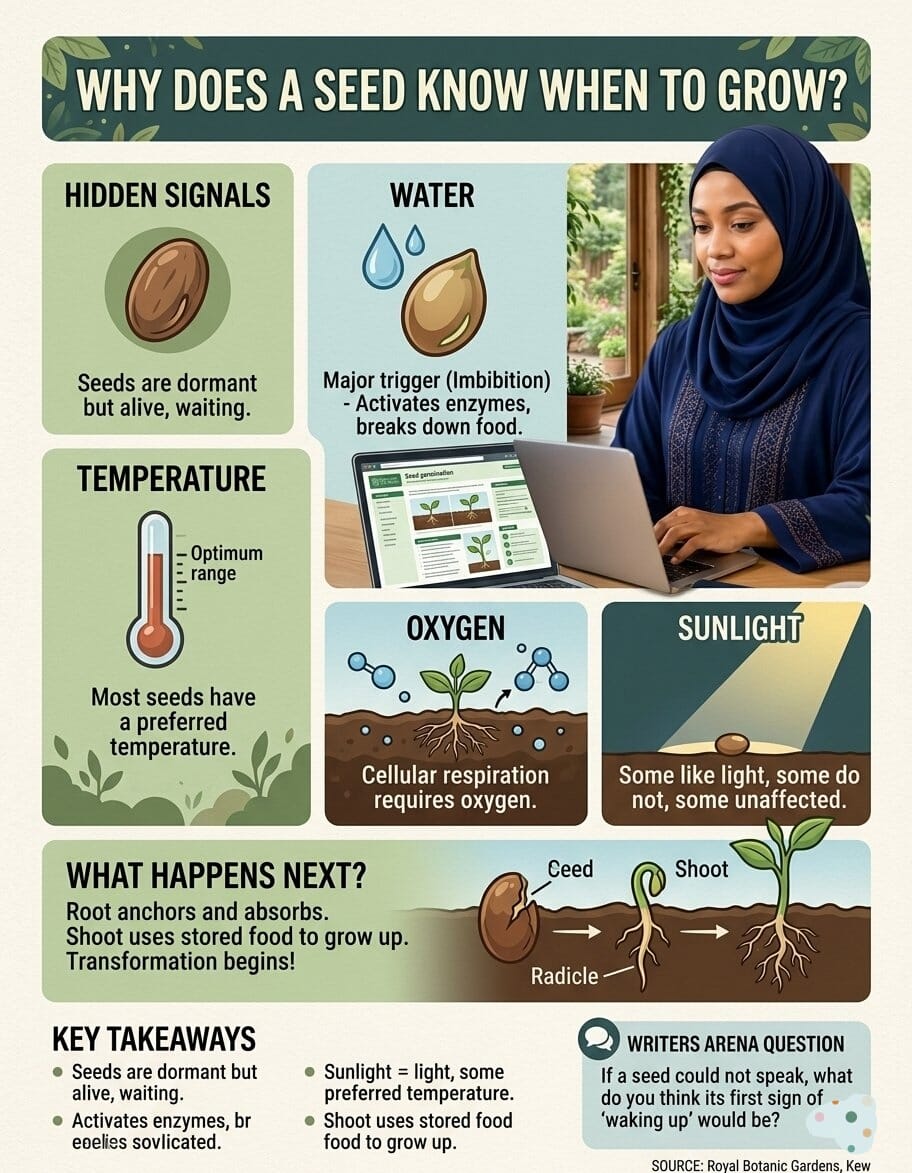
The Hidden Signals That Wake a Tiny Seed
Put a dry seed in your hand and look at it closely.
It looks as if nothing could possibly come from it.
No leaves, no roots, no movement.
Yet, that seed could turn out to hold a living plant waiting for a few conditions to be met before it grows.
What does the seed know as a sign to start growing?
The answer lies in one of the most fascinating, yet simple, biological processes.
A seed does not think about the weather or look at a calendar.
It senses the conditions in its environment.
WATER: one of the main triggers for many seeds when it comes to germinating.
A dry seed can stay in this dormant state for long periods of time.
When water is available in sufficient supply, the seed swells with water (imbibedion).
The seed's internal systems kick into an action, initiating enzymes to breakdown stored food.
It's almost like the seed has been waiting for somebody to flip a switch.
TEMPERATURE: another important trigger for many seeds.
Most seeds have preferred temperatures they like to germinate at.
If the weather is too cold or too hot for a particular seed species, crucial chemical reactions won't happen, or worse, crucial structures will be damaged.
The seed is taking advantage of its environment, not by looking at it, but by reacting to it.
OXIGEN: after germination has begun, the new plant will need food in order to grow and survive.
One way food gets broken down in cells is through cellular respiration - a process that generally requires oxygen.
This is also why over-watered soil is generally unhealthy for plants (the spaces in between roots gets filled with water, displacing air).
A seed may have water, but that doesn't mean the environment is right for germination.
SUNLIGHT: now one of the most interesting parts of germination.
Not every seed is the same when it comes to reacting to light.
Some like light, some don't like light, and some are pretty much unaffected by it.
The plants have different strategies for survival based on the environments they live in.
A small seed buried below dirt that reacts to light is a great example of a plant taking advantage of the conditions it's in.
WHAT HAPPENS NEXT?
Once the seed detects the necessary conditions for it to germinate, the transformation is absolutely amazing.
The seed coat cracks open and a root begins to grow out (in many common plants).
This root will begin to grow downwards and act as an anchor for the new plant, along with gathering water and minerals.
The shoot of the plant will grow upwards and the food stored in the seed will power this growth until the plant can create its own food via photosynthesis.
A seemingly inactive seed has now grown into a plant.
IT'S NOT REALLY "KNOWING"
When we talk about a seed "knowing" when to grow, we're really speaking in terms of humans.
The seed doesn't have a brain, it simply responds to certain conditions.
Chemical reactions, enzymes, and hormones along with temperature, moisture, light, and other triggers can play a role in determining whether or not a seed will germinate.
This is an important distinction.
Sometimes science will use these terms, like sense, respond, or know, but it doesn't mean the same thing in the context of biology that it would in everyday conversation.
WHY DOES THIS MATTER?
The study of plant seeds is important to several fields; agriculture, horticultural, forestry, and conservation biology to name a few.
Farmers need to know when a seed should be planted, researchers need to know how to store a seed so it won't germinate (when trying to conserve plant species), and gardeners need to know that tossing a seed in the ground doesn't mean it will automatically grow into a plant.
SUNLIGHT: a small, fascinating lesson about patience.
For days, weeks, maybe even months - nothing may seem to be happening.
But just because nothing is happening on the surface, doesn't mean that nothing is happening below the surface.
It's an important reminder that sometimes we shouldn't judge a book by its cover...or in this case, judge a seed by its seemingly inactive state.
QUICK QUESTIONS
Can a dry seed be alive? Yes.
Does every seed require sunlight to germinate? No.
Why does a seed need water? Water helps power many of the processes needed for germination and growth.
Does a seed have a brain? No.
KEY TAKEAWAYS
-Seeds can be dormant (inactive), yet still alive.
-Water is a major trigger for many seeds.
-Temperature and oxygen can affect a seed's ability to germinate.
-Different seeds react to light differently.
-Stored food powers a seeds early growth.
-A seed responds to its trigger(s), not necessarily "knowing" it needs to grow.
CONCLUSION
A seed can seem like one of the most basic elements of life.
But what few people realize is that contained within that seed is an incredible biological system waiting for the right conditions to be met.
When water, temperature, oxygen, and other factors come into play, dormancy is broken and growth begins.
The next time you see a small seed, remember: what looks like inactivity, is simply life waiting for the right moment to begin.
WRITERS ARENA QUESTION
If a seed could not speak, what do you think its first sign of "waking up" would be?
SOURCE
Royal Botanic Gardens, Kew - Seed Information Database and plant science resources. [https://www.kew.org/](https://www.kew.org/)