 Writers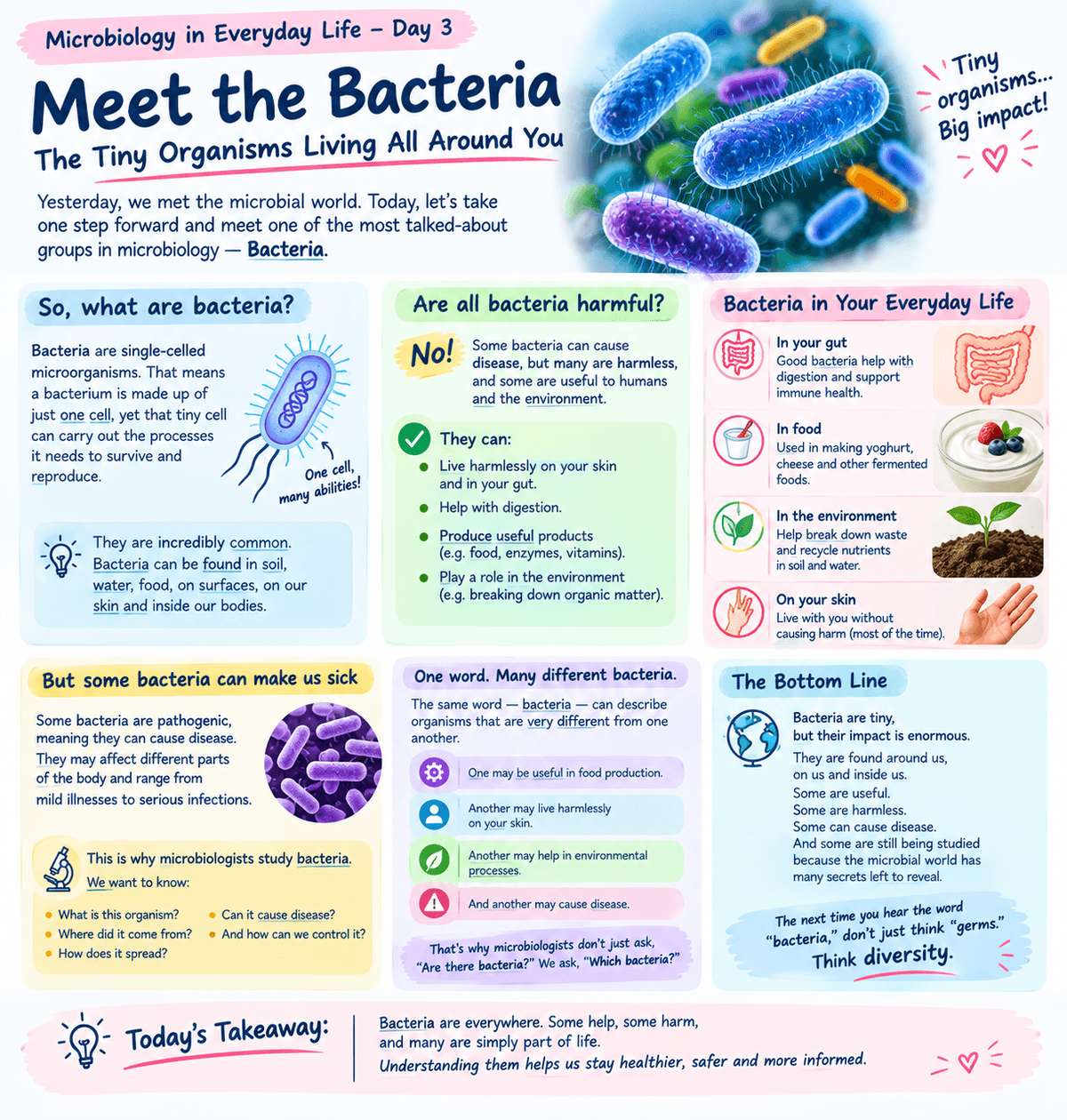
MICROBIOLOGY IN EVERYDAY LIFE — DAY 3
Meet the Bacteria: The Tiny Organisms Living All Around You
Yesterday, we met the microbial world.
We discovered that microorganisms are not just one big group called “germs.” There are different types, and each has its own characteristics.
Today, let's take just one step forward.
Let's meet one of the most talked-about groups in microbiology:
Bacteria.
You have probably heard the word hundreds of times.
“Wash your hands. There are bacteria.”
“Don't eat contaminated food. It may contain bacteria.”
“Take antibiotics for bacterial infections.”
But what exactly are bacteria?
So, what are bacteria?
Bacteria are single-celled microorganisms.
That means a bacterium is made up of just one cell, yet that tiny cell can carry out the processes it needs to survive and reproduce.
And they are incredibly common.
Bacteria can be found in soil, water, food, on surfaces, on our skin and inside our bodies. In fact, humans live alongside huge communities of microorganisms every day.
You don't have to visit a laboratory to encounter bacteria.
You already do.
Are all bacteria harmful?
This is probably the first misconception we need to clear up.
No.
Some bacteria can cause disease, but many bacteria are harmless, and some can be useful to humans and the environment.
Think about the bacteria living in your gut.
Your digestive system is home to a complex community of microorganisms. These communities interact with your body and can contribute to normal health. Scientists call the community of microorganisms living in a particular environment a microbiota, while the broader microbial ecosystem and its genetic material are often discussed as the microbiome.
So when we hear “bacteria,” we shouldn't automatically picture something attacking the body.
Sometimes, bacteria are simply living alongside us.
Bacteria are also involved in our food
Now let's bring this closer to home.
Have you ever eaten yoghurt?
Microorganisms are involved in making it.
Certain bacterial cultures are used during yoghurt production to ferment milk. Fermentation changes the properties of the food and gives yoghurt its familiar taste and texture.
So that yoghurt you had for breakfast may actually be one of your simplest everyday encounters with microbiology.
And it doesn't stop there.
Microorganisms are used in the production of many foods and food ingredients.
That is one reason microbiology is important to the food industry.
But some bacteria can make us sick
Now we have to look at the other side.
Some bacteria are pathogenic, meaning they have the ability to cause disease.
Depending on the organism, bacterial infections can affect different parts of the body and may range from relatively mild illnesses to serious infections.
This is why microbiologists study bacteria so carefully.
We want to know:
What is this organism?
Where did it come from?
How does it spread?
Can it cause disease?
And how can we control it?
These questions may sound like laboratory questions, but the answers can affect everyday life from food safety and clean water to infection prevention and healthcare.
The interesting part?
The same word bacteria can describe organisms that are very different from one another.
One bacterium may be useful in food production.
Another may live harmlessly on your skin.
Another may help participate in environmental processes.
And another may cause disease.
That's why microbiologists don't simply ask, “Are there bacteria?”
We ask:
“Which bacteria?”
Because identification matters.
TODAY'S MICROBIOLOGY TAKEAWAY
Bacteria are tiny, but their impact is enormous.
They are found around us, on us and inside us.
Some are useful.
Some are harmless.
Some can cause disease.
And some are still being studied because the microbial world has many secrets left to reveal.
The next time you hear the word “bacteria,” don't just think “germs.”
Think diversity.
That's where microbiology gets interesting.
NEXT: How do bacteria actually look and why do microbiologists care about their shapes?
