 Writers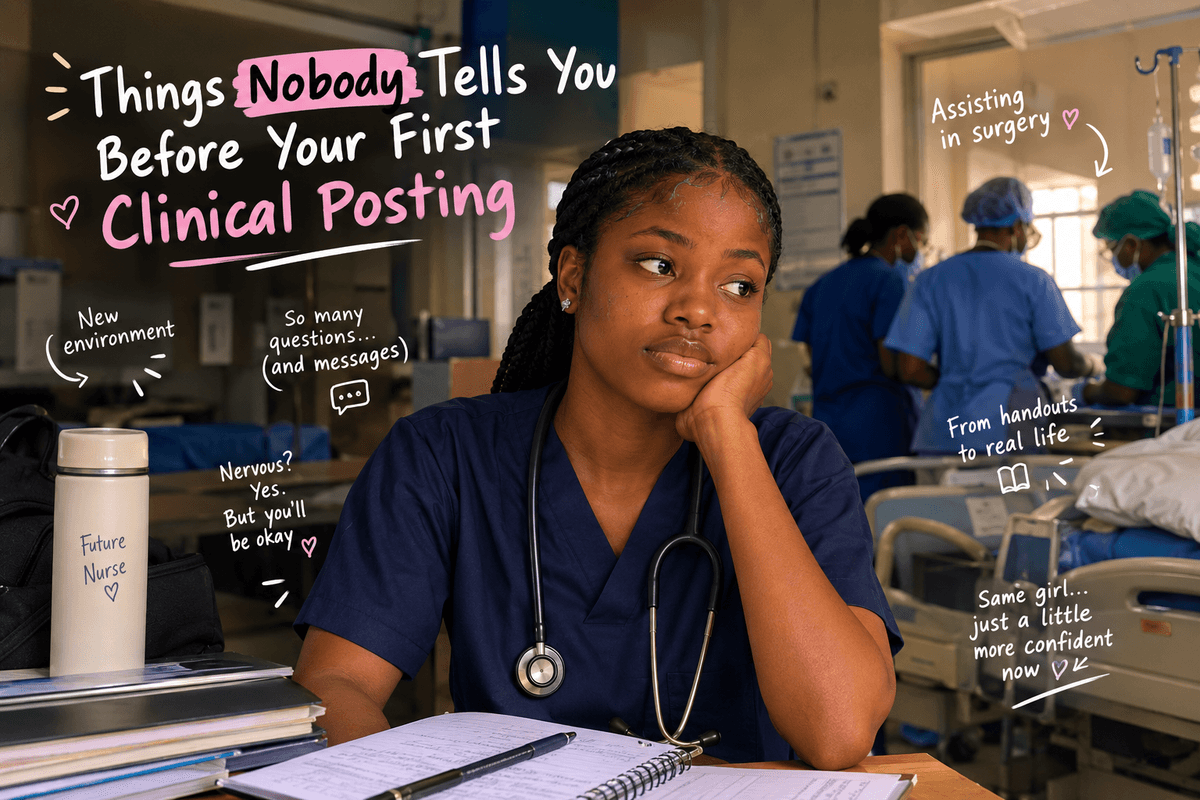
Things Nobody Tells You Before Your First Clinical Posting
Everyone talks about clinical posting like it is just another part of school. You hear things like, “Just pay attention,” “Go and learn,” and “You will get used to it.” But nobody really tells you what it feels like when you actually start.
The Environment Is Different
One of the first things that surprised me was the environment. You can read about a hospital or health facility in your notes, but being physically there is completely different.
Suddenly, you are surrounded by patients, health workers, supervisors and other students, and you are expected to understand how everything works. At first, I was just trying to figure things out without looking completely lost.
Clinical posting makes you realize that school and the clinical environment are two very different worlds.
Nobody Tells You How Confusing the Beginning Can Be
When it is your first time, even simple things can become confusing.
You may find yourself sending messages just to ask questions because you don't know exactly what you are supposed to do or where you are supposed to be. You are trying to understand the routine, communicate properly and make sure you are not missing anything.
And honestly, it can be overwhelming.
You Will Be Scared of Making Mistakes
Another thing nobody tells you is how much you can overthink your actions.
You may know the theory, but when it is time to actually do something, you suddenly start thinking, “What if I do this wrongly?”
That fear is normal, especially when you are still learning. Clinical posting teaches you to observe carefully, ask questions and learn from people who have more experience. With time, the things that once made you nervous start becoming more familiar.
Assisting During Surgery Is A Completely Different Experience
One experience that really stood out to me was assisting during a surgery.
Reading about surgery is one thing, but actually being there is another experience entirely. Seeing how everything is organized and watching the health workers perform their roles made me understand why practical experience is so important.
It was an experience that I will definitely remember because it showed me that healthcare is not just about knowing information. It is also about knowing how to apply that information in a real situation.
Handouts Don't Tell You Everything
This is probably one of the biggest lessons clinical posting has taught me.
A handout can explain how to give an injection, but clinical posting helps you understand what those instructions actually look like in practice.
You can read the steps repeatedly, but watching a procedure being done and eventually learning under proper supervision gives you a different kind of understanding.
That is when some of the things you struggled to imagine in class finally start making sense.
Clinical Posting Builds Confidence Slowly
Your first posting might make you nervous, confused or even tired, but you gradually start getting better.
You learn how to communicate with patients. You learn how to observe. You become more comfortable asking questions. You begin to understand procedures that once seemed complicated.
Most importantly, you start realizing that you actually know more than you thought you did.
Clinical posting is not always easy, but it is one of those experiences that reminds you why practical learning matters. It takes the things you have been reading in your handouts and puts them right in front of you.
And maybe that is the biggest thing nobody tells you before your first clinical posting: you are not just going there to learn healthcare—you are also learning how to become confident in yourself.