 Writers
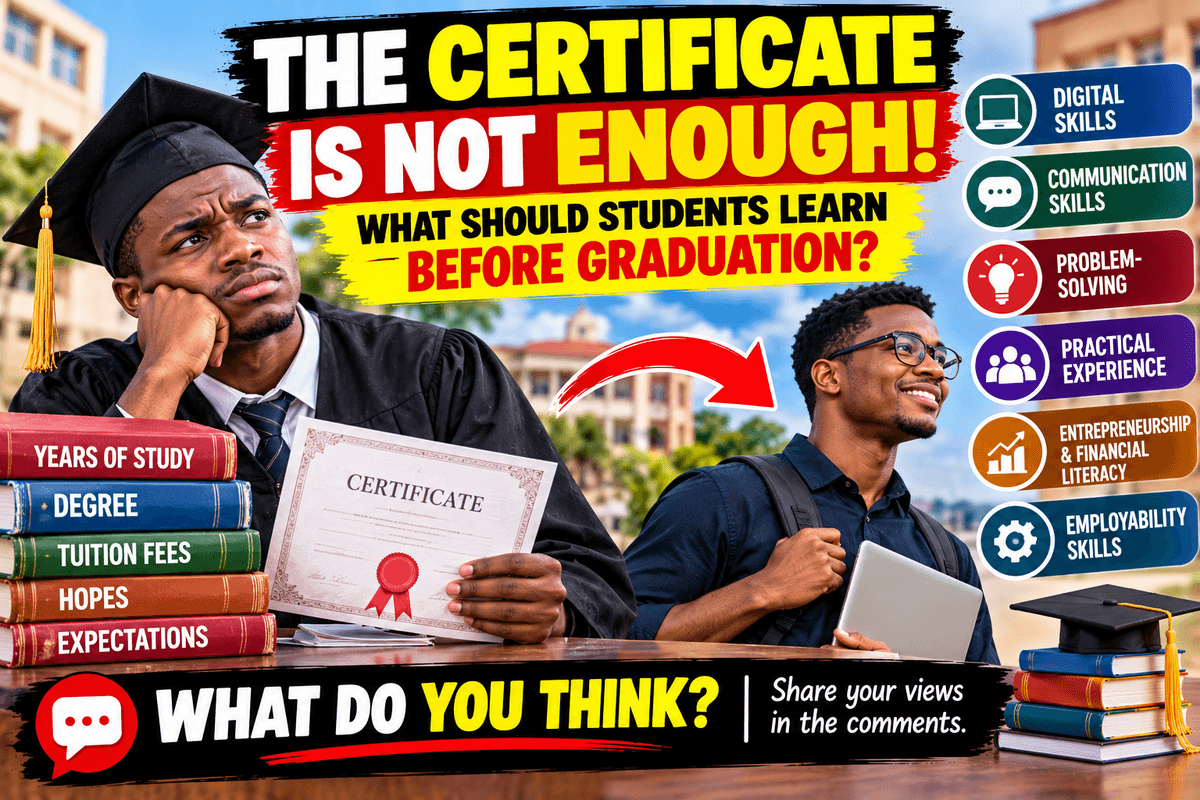
The Certificate Is Not Enough: What Should Students Learn Before Graduation?
Imagine two graduates who finished university with similar qualifications. One has a certificate but little practical experience, while the other has developed communication skills, learned how to solve problems, gained digital knowledge and participated in practical projects.
Both have spent years studying, but when an employment opportunity appears, their preparation may be different.
This raises an important question: Is a university certificate enough to succeed in today's world, or must students learn additional skills before graduation?
Education remains one of the most valuable investments a person can make. It provides knowledge, develops critical thinking and opens doors to professional opportunities. However, the world of work is changing, and academic qualifications are not always the only things employers consider.
1. The Importance of Practical Skills
Classroom knowledge is important, but students also need opportunities to apply what they learn.
A student studying business could benefit from learning how to prepare a business plan, manage records and understand basic financial statements. A student studying communication could gain experience in public speaking, writing and digital content creation.
Similarly, students in the social sciences could develop research, data analysis, report writing and project management skills.
These abilities can help graduates demonstrate what they can do beyond what appears on their certificates.
2. Digital Skills Are Becoming Increasingly Valuable
Technology has changed how people learn, communicate, work and conduct business.
Depending on their career goals, students may benefit from learning spreadsheet applications, digital research, online collaboration, data analysis, graphic design, programming or digital marketing.
They do not need to master every digital skill. Instead, they should identify the tools and abilities relevant to their chosen fields.
Digital competence can also help graduates explore opportunities beyond traditional office employment, including remote work, freelancing and entrepreneurship.
However, digital skills do not guarantee employment. They are most useful when combined with sound knowledge, practical experience and the ability to solve real problems.
3. Communication and Problem-Solving Matter
Imagine an employee who has excellent academic qualifications but cannot communicate ideas clearly, work effectively with colleagues or handle disagreements professionally.
That employee may find some workplace responsibilities challenging.
Communication, teamwork, critical thinking and problem-solving are valuable across many professions.
Students can begin developing these skills through group assignments, presentations, volunteering, research projects and participation in community activities.
Learning how to work with people is just as important as learning how to complete tasks independently.
4. Students Should Start Preparing Before Graduation
One mistake students sometimes make is waiting until they graduate before thinking seriously about their careers.
Career preparation can begin much earlier.
Students can research their preferred professions, identify common entry-level requirements, seek internships, volunteer with relevant organisations and undertake projects that demonstrate their abilities.
They can also develop a professional CV and learn how to prepare for interviews.
These steps may improve their readiness for employment, although they cannot eliminate the broader challenges of limited job opportunities and intense competition.
The goal is to graduate with both academic knowledge and evidence of useful abilities.
5. Does This Mean Certificates Are No Longer Important?
Absolutely not.
Many professions require specific academic qualifications, and some careers cannot be pursued without the appropriate degree or professional training.
A certificate can demonstrate that someone has completed a recognised programme of study. Additional skills can strengthen that foundation, but they do not replace qualifications where those qualifications are legally or professionally required.
The real lesson is that education and practical skills should complement each other.
A student should not neglect academic work in pursuit of digital skills, just as a student should not assume that obtaining a degree automatically removes the need for continuous learning.
Conclusion: Prepare for More Than Graduation Day
Graduation is an important milestone, but it is not the end of learning.
Students who combine academic knowledge with practical experience, communication skills, digital competence and a willingness to keep learning may be better prepared to navigate different career opportunities.
Educational institutions also have a responsibility to connect classroom learning with practical realities, while employers can contribute by providing internships, training and entry-level opportunities.
Ultimately, the purpose of education should be to help people develop the knowledge and abilities they need to contribute meaningfully to society.
A certificate can open a door, but what you know, what you can do and how willing you are to learn can influence what happens next.
LET'S DISCUSS!
If you could recommend three skills every Nigerian student should learn before graduation, what would they be?
Would you choose digital skills, communication, entrepreneurship, financial literacy, research, vocational training or something else?
And do you think universities are doing enough to prepare students for life after graduation?
Share your opinion in the comments. Your contribution could help another student prepare for the future.