Writers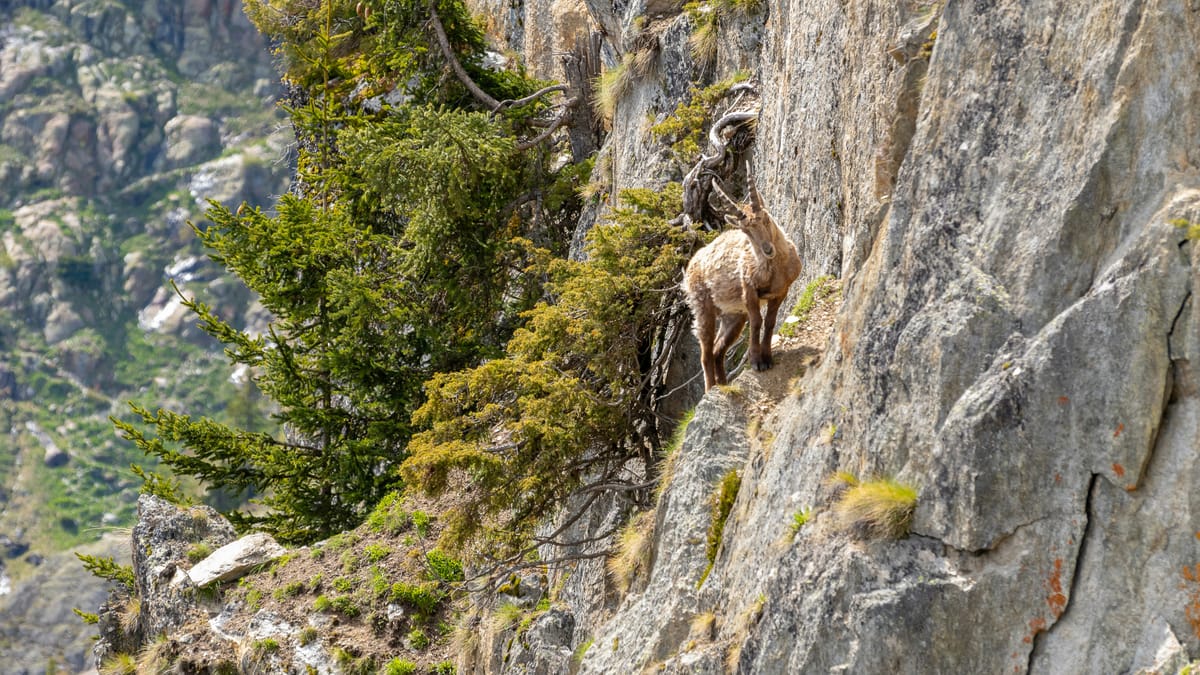
The Ibex: The Goat That Lives on the Mountain
The Alpine ibex (Capra ibex) is a fascinating animal that is remarkably adapted to life in steep, rocky mountains. It lives mainly in the European Alps, often at elevations around 1,600–3,200 metres, and its specialized hooves help it grip uneven rock and steep slopes. Its home is not the gentle pasture where ordinary goats might graze, but a world of steep cliffs, rocky slopes, alpine meadows and rugged mountain ridges.
What Does the Ibex Eat on the Mountain?
The Alpine ibex is a herbivore, meaning it feeds on plants rather than other animals. Its diet changes depending on what vegetation is available at different elevations and seasons.
In the warmer months, when the mountain slopes become greener, ibex commonly feed on:
- Alpine grasses
- Herbs and wildflowers
- Leaves
- Shoots and young plants
- Mosses and lichens
- Shrubs and other mountain vegetation
During summer, they can move to higher elevations where fresh grasses and herbs grow among the rocky slopes. They spend considerable time grazing and feeding on vegetation.
Winter makes survival more difficult. Snow covers much of the vegetation, so ibex may move to lower, less snow-covered areas and eat whatever plants remain accessible, including woody plants, shrubs, dry grasses, and other available vegetation.
What's particularly interesting is that the ibex doesn't need a lush green field to survive. Its environment is rugged and sometimes extremely sparse, yet it has adapted to search out the vegetation available among the rocks and mountain slopes.High above the forests, where the air is thinner and the mountains rise sharply toward the sky, lives an animal that seems almost perfectly designed for the impossible.
What makes the ibex particularly remarkable is its ability to move across terrain that would appear dangerous and nearly impossible to other animals. Its deeply split hooves have hard outer edges and softer inner pads, giving it remarkable footing on rough, steep surfaces.
The male ibex is especially recognizable by its enormous, backward-curving horns, which can grow to around one metre in length. Females also have horns, although theirs are considerably smaller.
The mountain that looks like an obstacle to us becomes a pathway for the ibex. The rocks that seem unstable become places where it can stand. The steepness that might make another creature turn back becomes part of its ordinary world.
The Ibex and the Cycle of Life
Life on the mountain does not end with survival; it continues through reproduction. Like other mammals, the ibex reproduces and gives birth to living young, continuing its kind from one generation to another.
For the Alpine ibex, the breeding season usually occurs during the colder months, particularly from late autumn into early winter. After mating, the female(DOE) carries her young for approximately five to six months. When spring arrives and the mountain begins to produce fresh grasses, herbs, and other vegetation, she gives birth, most commonly to a single kid.
The timing is significant. Spring provides the young ibex with greater access to food as they begin their lives in the demanding mountain environment. Even at a young age, the kid must gradually learn to navigate the rocky slopes and steep terrain that will become its home.
Generation after generation, the ibex continues to live, reproduce, and raise its young among the rocks, demonstrating nature's remarkable ability to sustain life even in places that appear harsh and unforgiving.
The ibex reminds us that nature does not give every creature the same environment, or the same abilities. Some creatures are equipped for places others cannot survive.
And perhaps that is one of the quiet lessons hidden within nature: sometimes what looks like a difficult place is also the place for which something has been uniquely equipped.