Writers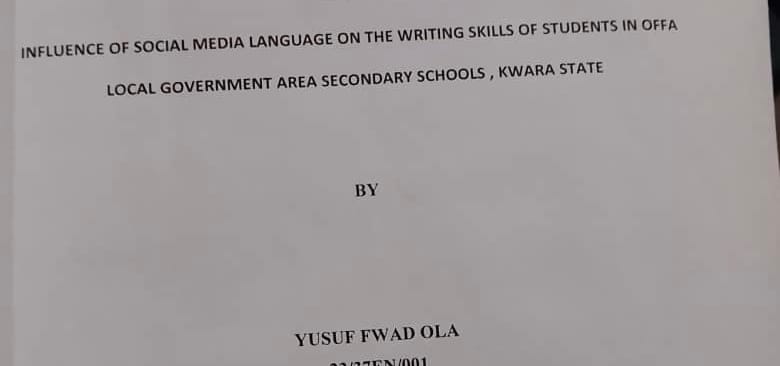
In a world where communication happens within seconds, social media has changed the way people write, speak, and express themselves. From WhatsApp messages to Facebook comments, TikTok captions, and online discussions, people have developed different ways of communicating quickly. Abbreviations such as “u” instead of “you,” “ur” instead of “your,” “pls” instead of “please,” “bc” instead of “because,” and “idk” instead of “I don’t know” have become common, especially among students and young people.
Although these expressions may seem harmless and convenient, an important question deserves our attention: Are we becoming better communicators, or are we gradually sacrificing effective communication for convenience?
As a writer, I believe that the ability to communicate effectively is one of the most valuable skills anyone can develop. Whether you are a student writing an examination, a graduate preparing a job application, a business owner communicating with customers, or a young person expressing an opinion, your ability to choose the right words and arrange them correctly matters.
Is Abbreviation a Convenience or a Communication Barrier?
There is nothing inherently wrong with using abbreviations in informal conversations. Language naturally changes with time, and digital communication encourages speed. Expressions such as “LOL,” “BRB,” and “BTW” may serve useful purposes in casual interactions.
However, a problem arises when people become so accustomed to these shortened expressions that they struggle to communicate properly without them. The real issue is not simply using abbreviations; it is allowing informal digital habits to replace the practice of standard writing.
For instance, a student who constantly writes “I don’t knw wat to do” in informal chats may eventually become less attentive to spelling and sentence construction if they rarely practise writing correctly. This does not mean that every student who uses abbreviations will develop poor writing skills. Rather, it highlights the importance of knowing when informal language is appropriate and when standard English is required.
A message sent to a friend is different from an academic assignment, an official letter, a professional email, or a research project. Each situation demands a different level of formality and attention to language.
The ability to communicate effectively includes knowing not only what to say, but also how, when, and where to say it.
How Excessive Abbreviations Can Affect Students' Writing Skills
Writing is a skill developed through consistent practice. Students improve by learning new vocabulary, constructing meaningful sentences, observing grammatical rules, reading different texts, and correcting their mistakes.
When students rely excessively on shortened forms, they may reduce opportunities to practise these essential skills. If a learner constantly substitutes complete words with shortened expressions, they may become less attentive to spelling and formal sentence structure, particularly when they do not distinguish between informal chatting and academic writing.
Another concern is vocabulary development. Effective writing requires more than knowing a few familiar expressions. It requires the ability to select precise words that communicate ideas clearly. A student who wants to write a persuasive essay, an interesting story, or a well-developed research paper must learn how to explain ideas fully rather than depend on compressed expressions.
For example, compare these two statements:
“Dis method is nt gud bc it affects students writing.”
“This method is not effective because it may negatively affect students’ writing skills.”
The second sentence is clearer, more appropriate for formal writing, and easier to use in an academic discussion. It communicates the idea in a more polished manner.
The difference is not merely the number of letters used. It reflects the writer’s attention to clarity, correctness, and the demands of the situation.
The Connection Between Writing and Speaking
Many people think writing and speaking are completely separate skills. Although they differ in important ways, they are closely connected through vocabulary, grammar, sentence formation, and the ability to organise thoughts.
When you write regularly, read widely, and learn how to express your ideas in complete sentences, you build resources that can also support your spoken communication. You become more familiar with words, sentence patterns, and ways of explaining complex ideas.
Likewise, practising clear speech can help you organise your thoughts before putting them on paper.
However, using abbreviations in text messages does not automatically mean that someone will speak poorly. Speaking ability also depends on listening, pronunciation, vocabulary, confidence, and opportunities to practise. The important lesson is that students should not allow the convenience of digital communication to replace deliberate practice in either speaking or writing.
Imagine a student who can communicate effortlessly through emojis, slang, and shortened messages but struggles to explain an opinion during a class presentation. The solution is not to condemn social media. Instead, the student needs to develop a wider range of communication skills that work in both informal and formal settings.
Why Effective Writing Matters.
Beyond the classroom, writing influences how people present themselves to the world. Employers may assess an applicant's communication skills through a CV, cover letter, or written assessment. Lecturers evaluate assignments partly through the clarity and organisation of students’ ideas. Businesses depend on written communication to attract high level customers, explain services, and build trust.
For aspiring authors(like me), journalists, content creators, and academic researchers, the importance of writing is even greater. Their work depends on their ability to communicate ideas in a way that informs, persuades, entertains, or inspires readers.
As a creative and academic writer, I understand that good writing is not simply about using complicated vocabulary or making sentences unnecessarily long. It is about expressing ideas clearly, choosing appropriate words, maintaining coherence, and considering the needs of the reader.
A simple sentence written correctly is often more powerful than a complicated sentence filled with grammatical errors. Similarly, a well developed paragraph can communicate more effectively than several hurried lines whose meaning is unclear.
Every student who wants to become a better writer should therefore understand that effective writing is a gradual process. It requires patience, practice, feedback, and a willingness to learn from mistakes.
Practical Ways to Improve Your Writing and Speaking
Improving your communication skills does not require abandoning social media. It requires using it wisely and developing habits that strengthen your command of language.
1. Practise writing complete words. Make it a habit to spell words correctly when writing assignments, formal messages, applications, and professional content. Even during informal conversations, occasionally practising standard writing can help reinforce good habits.
2. Read beyond social media posts. Read books, newspapers, academic articles, essays, short stories, and well-written online publications. Reading exposes you to different sentence structures, vocabulary, writing styles, and ways of presenting arguments.
3. Write something every day. You can write a short article, a personal reflection, a summary of what you have learnt, or an opinion on any issue. Consistent practice helps you discover your weaknesses and improve gradually.
4. Learn to edit your work. After writing, review your spelling, punctuation, grammar, sentence structure, and paragraph organisation. Ask yourself whether your message is clear and whether another person can understand it without unnecessary difficulty.
5. Practise speaking with complete thoughts. Explain what you have learnt, participate in discussions, read passages aloud, and practise giving short presentations. These activities can help you organise your thoughts and become more comfortable expressing your ideas.
6. Understand your audience. Informal language may be acceptable when chatting with friends, but academic writing and professional communication require greater attention to standard conventions. Learn to adjust your language to suit the situation.
7. Welcome correction. Do not feel ashamed when someone identifies an error in your writing or speech. Constructive correction is an opportunity to learn. The goal is not to appear perfect but to become better than you were yesterday.(“Aim for progression not perfection” -Zach Diamond_Rules🎵 )
Conclusion:
Social media has created exciting opportunities for communication, creativity, learning, and self-expression. It allows students to share ideas, discover information, and connect with people across the world. Nevertheless, the freedom to communicate quickly should not come at the expense of developing essential language skills.
Abbreviations have their place in informal communication, but they should not become a substitute for learning to write correctly and express ideas fully. Students must understand that convenience and competence are not the same thing. Sending a message quickly does not necessarily mean communicating effectively.
If you want to become a confident speaker, a skilled writer, a successful student, or a professional who can communicate ideas convincingly, invest in your language development. Read more, write more, practise speaking, and learn to recognise the difference between casual digital expressions and standard English.
As a writer, my message is simple: Do not allow the habit of shortening your words to limit your ability to expand your ideas. Your words are tools, and the more effectively you learn to use them, the more confidently you can communicate your thoughts to the world.
In the end, the goal is not to stop using social media language entirely. It is to ensure that when the situation demands clarity, precision, and professionalism, you have the skills to deliver them.
Write with intention. Speak with confidence. Learn continuously. Let your words reflect the quality of your thoughts.
By Yusuf Fwad Ola | Creative, Content and Academic Writer