Writers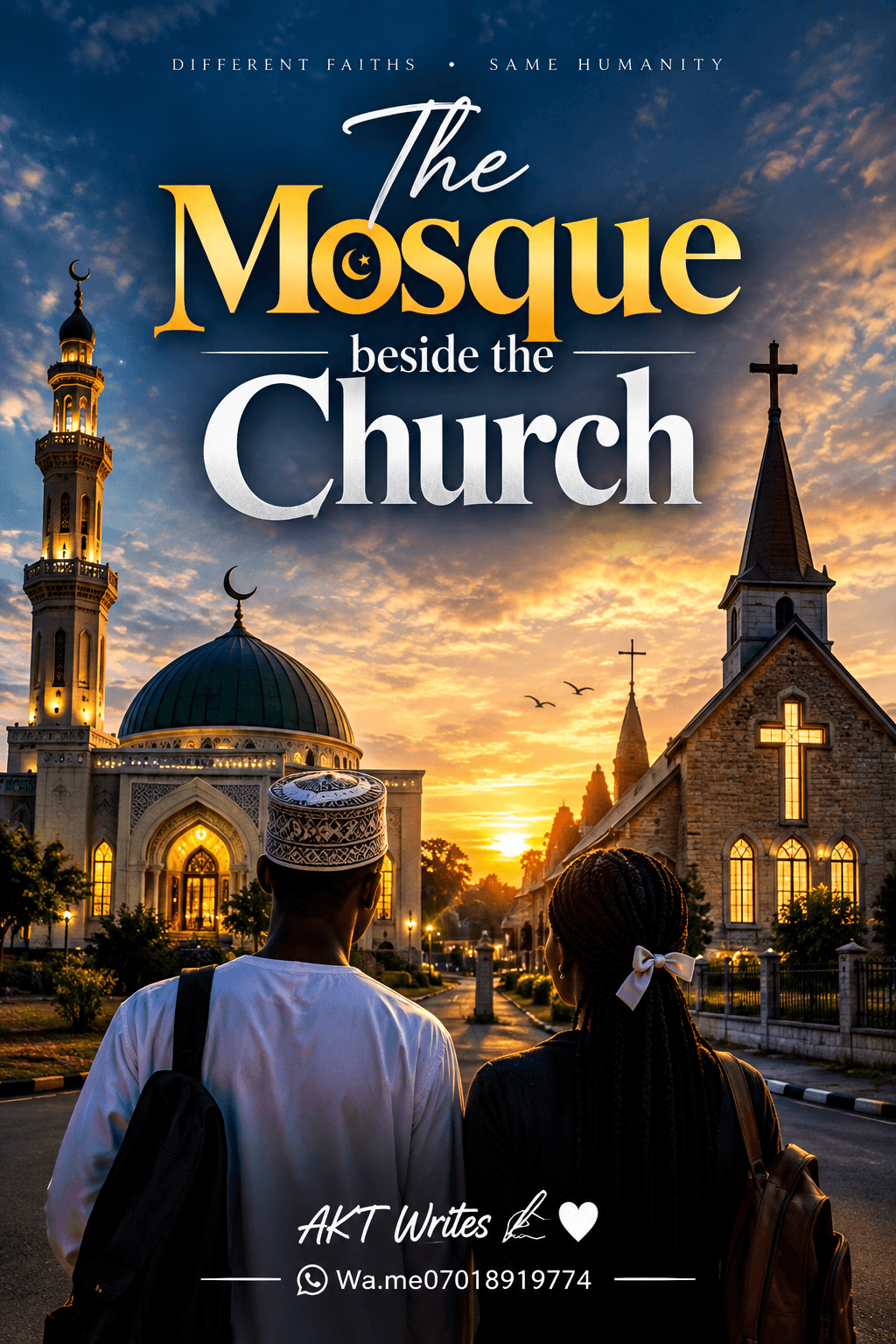
THE MOSQUE BESIDE THE CHURCH
AKT Writes ✍️
Poem
Treading the path with my companion,
With a mind free of opinion.
Two innocent minds willing to explore,
Who came from separate customs and lore.
Walking the same road with no diversion,
A long one-way road free of oppression.
Suddenly, upon two paths we came,
How we got here—no one to blame.
Thus the origin of what will later be our problems,
Deeply rooted in ideological emblems.
One path led where the crescent stood,
The other where the holy cross looked good.
We paused at the junction, confused and afraid,
Wondering why the friendship we built should fade.
“You cannot walk with me,” one voice said,
“And perhaps you shouldn't,” the other replied instead.
Not because the road had suddenly changed,
But because the names of our faiths had rearranged.
What once was simply you and me,
Became what the world insisted we must be.
You saw a Muslim; I saw a friend,
But fear whispered, “This is where friendships end.”
Yet beneath the garments, beneath every creed,
Beat hearts that could hurt, forgive, and bleed.
And though our prayers took different directions,
Could love not survive our imperfections?
Then something strange happened that very day—
We heard two calls rising not far away.
A bell rang loudly; the Adhan filled the air,
Two different sounds, yet both carried a prayer.
We looked at each other, and suddenly knew:
Perhaps the road was never meant to divide us in two.
For heaven may hear different voices below,
But kindness is a language all hearts know.
So we walked on—not as copies, but as friends,
Learning that difference need not mean an end.
And there, where the two sacred buildings stood,
We finally understood what humanity could:
A mosque beside a church is not a contradiction;
It is a picture of coexistence, not division.
---
THE MOSQUE BESIDE THE CHURCH
The first thing Daniel heard that morning was the Adhan.
The second was the church bell.
He stopped walking.
For a moment, he thought he was dreaming.
The call to prayer floated gently through the cool morning air, while almost simultaneously, the church bell answered from across the narrow street.
Allahu Akbar…
Dong… dong…
Daniel looked to his right.
There stood a magnificent mosque, its golden dome catching the first rays of sunlight. Its minaret rose proudly into the sky, and the crescent moon at its peak seemed to watch over the quiet street.
Then he looked to his left.
A beautiful old church stood there, its stone walls glowing beneath the morning sun. A tall cross rested above its roof, and coloured glass windows reflected the rising light.
Between them was a single road.
And walking down that road was Daniel.
Beside him was Aisha.
They had been friends since childhood.
Their friendship had never needed an explanation. They studied together, shared lunch, argued over football, laughed at the same silly jokes and helped each other through difficult days.
Daniel knew Aisha was Muslim.
Aisha knew Daniel was Christian.
Neither had ever considered it a problem.
Until they grew older.
People began asking questions.
“Can a Christian and a Muslim really be close friends?”
“Does your religion permit that?”
“Be careful. People are not always what they seem.”
Slowly, the questions became walls.
The friendship that had once been effortless began to require explanations.
Then came the day their families discovered how close they had become.
The arguments began.
Daniel was told that Aisha's faith was different.
Aisha was warned that Daniel belonged to a different religious tradition.
Nobody asked them what they had actually learned from one another.
Nobody asked about the years they had spent helping each other.
Everyone simply saw two labels.
Christian.
Muslim.
One afternoon, after a particularly painful argument, Aisha called Daniel.
“Let's meet at the old road,” she said.
He knew exactly where she meant.
It was the road between the mosque and the church.
When Daniel arrived, Aisha was already there.
She looked exhausted.
“I think this is where we stop,” she said quietly.
Daniel stared at her.
“Why?”
“Because everyone says we shouldn't continue.”
“And what do you say?”
She didn't answer.
At that exact moment, the mosque began its call to prayer.
Then, almost as if responding, the church bell rang.
They both looked toward the two buildings.
For the first time, they noticed something they had taken for granted for years.
The mosque had stood beside the church for decades.
They shared the same street.
The same sunrise.
The same rain.
The same evening breeze.
When storms came, both buildings got wet.
When the sun rose, both were illuminated.
Neither had ever tried to destroy the other.
Neither had moved away because the other existed.
Daniel smiled sadly.
“Maybe we've been looking at this the wrong way.”
Aisha looked at him.
“How?”
“We've been asking which building is right to stand on this street.”
She waited.
“Maybe the better question is why the street has room for both.”
Aisha smiled.
And suddenly, the problem became smaller.
Their faiths had not disappeared.
Their differences had not vanished.
They were still Christian and Muslim.
They would still pray differently.
They would still have traditions the other might not understand completely.
But perhaps understanding did not require becoming identical.
Perhaps friendship was not about erasing differences.
Perhaps it was about refusing to let differences erase humanity.
Years later, the old road became known throughout the town as Harmony Street.
The mosque remained beside the church.
Children walked between them every morning on their way to school.
During celebrations, neighbours visited one another.
When someone was sick, nobody asked which faith they belonged to before offering help.
When a family lost a loved one, the entire street mourned.
And whenever the Adhan rose into the morning sky and the church bell answered, people smiled.
Because they had learned something the world often forgets:
Different prayers can rise from different lips and still come from hearts longing for peace.
One evening, Daniel and Aisha stood once again on that familiar road, older now, watching the sunset paint the sky gold.
Aisha turned to him.
“Do you remember when we thought this road was dividing us?”
Daniel smiled.
“Yes.”
“And now?”
He looked at the mosque.
Then at the church.
Then at the road between them.
“No,” he said. “Now I think it was always trying to teach us something.”
“What?”
Daniel took a slow breath.
“That being different doesn't have to mean being enemies.”
The evening call to prayer began.
The church bell followed.
And beneath the golden sky, neither sound drowned the other.
They simply shared the same air.
The mosque remained beside the church.
And perhaps that was the most beautiful sermon the street had ever preached.
Not that we must believe the same thing.
Not that we must walk the same path.
But that even when our paths are different, we can still choose to walk the road of humanity together.
THE END.