Writers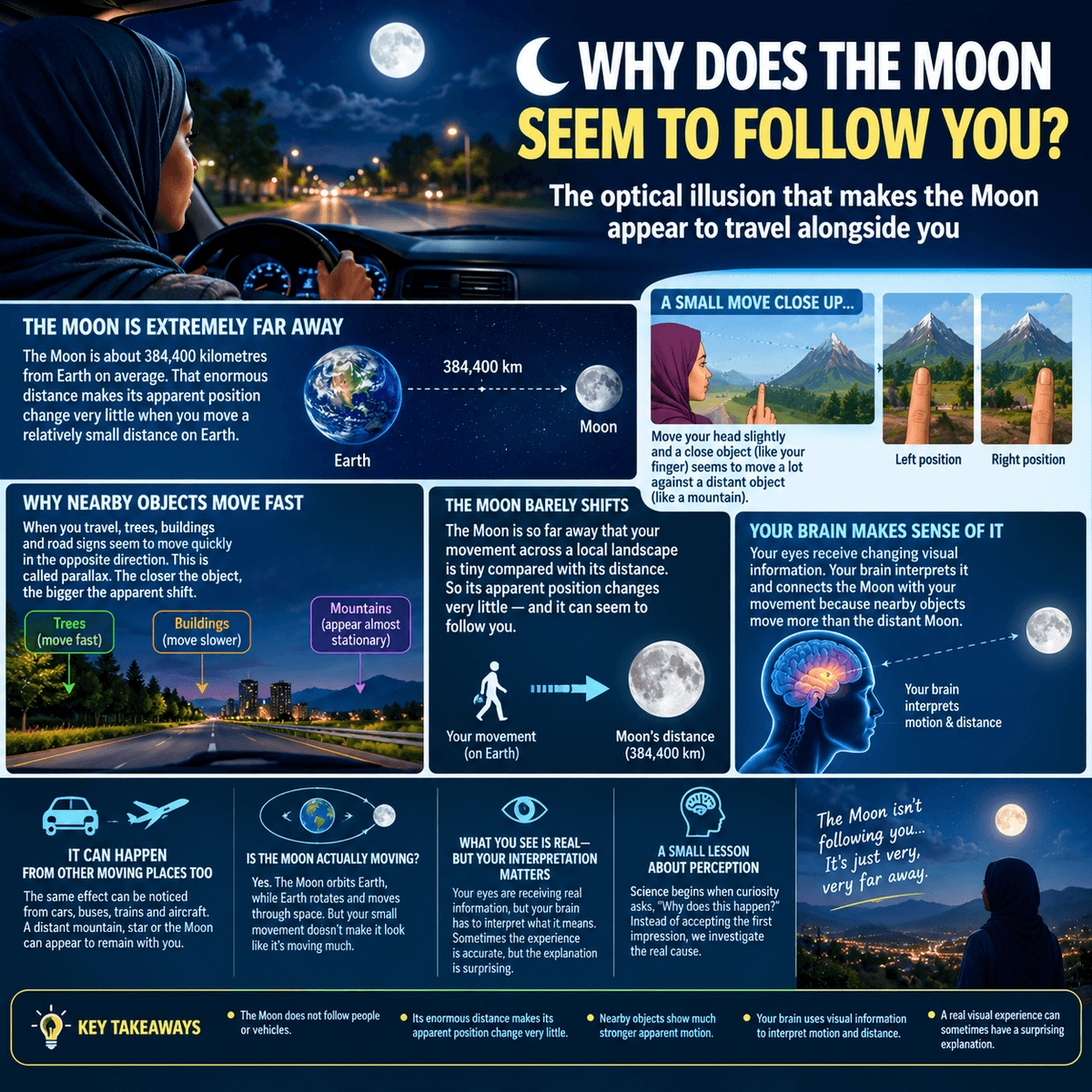
The optical illusion that makes the moon appear to travel alongside you
You are riding in a car at night.
Trees rush past you.
Buildings seem to move quickly in the opposite direction
Then you glance up
The moon is still there
You drive a few streets
Peek up again
It seems to have followed you
You turn another corner
There it is again
Is the moon actually following you? No, but the reason it seems as if it is has to do with perspective and the distance between you and the moon
Let's explore this strange optical illusion!
ASTRONOMY 101: THE MOON'S DISTANCE FROM EARTH
The first thing we should talk about is just how far away the moon is
The moon is, on average, 384,400 kilometres from Earth
This distance has a huge effect on how the moon appears to you on a cloudy night.
Try holding your finger close to your face while looking at something far away
Now slowly move your head from side to side
You'll notice that your finger seems to move quickly compared to the object in the distance
This is the same concept that applies to why the moon seems to follow you.
🚗 CAR RIDE POV: WHY DO TREES SEEM TO MOVE FASTER?
Now, let's look out the back window of the car and try to see this in motion.
A tree that's a few feet away from you seems to zoom backwards relative to a building that's a mile away
In fact, everything seems to move faster the closer it is to you
Things that are extremely far away seem to move comparably slower
This is called PARALLAX.
In short,
it is the apparent movement of an object from one point of view compared to another
The closer an object is to the viewer, the more it will appear to move as the viewer moves.
The farther an object is, the less it will appear to move
The moon is very, very far away, so its apparent movement from your point of view is super tiny compared to objects that are near you.
Your brain interprets that super tiny amount of movement as a lack of movement altogether
Thus creating the illusion of the moon riding alongside you.
🧠 YOUR BRAIN: CONSTANTLY INTERPRETING THE MOVEMENTS AROUND YOU
Your eyes are constantly sending signals to your brain about the changing environment around you
Your brain, in turn, does its best to register where everything is located and how fast it appears to be moving
Something has to give when the objects around you are all moving at very different speeds
If everything around you appeared to move at the same speed, nothing would seem to change! That's not very interesting, is it?
Your brain tries to register things like distance and speed by the differing apparent movements of objects around you
So when the things around you move much faster than something further away, your natural reaction is to think of the distant object as a companion on your journey.
That's why the moon seems to travel with you!
👉 TRY THIS SIMPLE EXPERIMENT TO ILLUSTRATE THE MOON ILLUSION
Hold your finger up to your right eye
Now look at the far wall or a tree in your yard
Without moving your head, switch the eye you're using to look at the object with
Now move your head to the right and left
Once you've done that a few times, try moving your head faster
Notice how your finger seems to move faster compared to the object in the distance.
Now, imagine that object in the distance being millions of times further away
See how the perceived movement of that object now changes?
This is essentially what's happening when you look at the moon and see it appear to ride along with you as you move around
MOON MOVEMENT FROM DIFFERENT VEHICLES
You don't have to be walking on the road to experience this neat optical illusion.
I've seen this happen to people while riding in cars, buses, and yes, even airplanes!
A distant mountain or star can appear to move at a slower speed than objects closer to you
The faster nearby objects move, the more their apparent speed contrasts with the slow movement of things in the distance
IS THE MOON ACTUALLY MOVING?
Yes!
But most of that movement is not relative to you
The moon is constantly orbiting the Earth, and the Earth is constantly rotating in space
While these large-scale movements are happening, you're not moving fast enough across the terrain for the moon to appear to move much at all from your point of view
Again, it's all about relative distance and apparent speed.
👀 WHAT YOU SEE IS REAL BUT YOUR INTERPRETATION OF IT MAY NOT BE
So, what we're basically saying is: the moon does appear to stay still while you move, but the reason for this has less to do with the moon and more to do with the apparent relative speed of objects around you.
The thing that makes this so cool is that your brain is trying to interpret something that is happening in real life, but your interpretation of it is not quite correct at first
Something that appears to be happening can be very different than the mechanism by which it happens.
A LITTLE LESSON ON HUMAN PERCEPTION
The moon teaches us a great lesson about human perception.
The phenomenon of the moon riding along with you is a prime example of our tendency to see something, but not to process why that thing is happening.
A person can stare at a phenomenon their whole lives and never be able to explain it.
The scientific method helps us to explain things. If something seems to be happening, we ask,"Why is this happening?" instead of "That's so cool, I wish I knew why!"
❓ QUICK REFERENCE QUESTIONS AND ANSWERS
Is the moon actually following you?
No, it isn't really following you, but it appears to do so because of its enormous distance from you
What is the name for the apparent change in position of an object?
Parallax is the apparent change in position of an object from one point of view to another
Why does the apparent change in position happen?
The apparent change in position, or parallax, happens because of the relative distance between the observer and the observed
Does the moon really move?
Yes, the moon moves, but not in the way most people seem to interpret it.
It moves in an orbit around the Earth, which is moving in space.
Can you see the same thing happen with stars?
Yes, you can!
Things that are very, very far away can seem to move much slower than things that are near to you.
KEY TAKEAWAYS
• The moon does not actually follow you or anyone else.
• The reason why the moon seems to follow you has to do with its large distance from you
• Objects that are further away from you seem to move slower than objects that are near to you
• Your brain tries to interpret the apparent movements of objects around you by using relative speed and distance
• Something that happens can sometimes be observed one way but have a mechanism that explains it another way
CONCLUSION
The next time you see the moon riding alongside you on a drive at night, take a moment to observe the world around you.
The trees are flying by! Buildings are whizzing past you! Roads and road signs are zipping by in all directions!
But the moon? It stays right there.
Not following you, just watching the world go by.
It's an interesting experience to have, and the best part is that it has to do with simple science.
It has to do with parallax, the contrast of apparent speed of objects around you, and the way your brain interprets the world.
QUESTION TO THINK ABOUT
What are some other things that you've seen in life that seem to have strange, inexplicable phenomena behind them?
SOURCE
NASA - Solar System Exploration: The Moon
https://science.nasa.gov/moon/