 Writers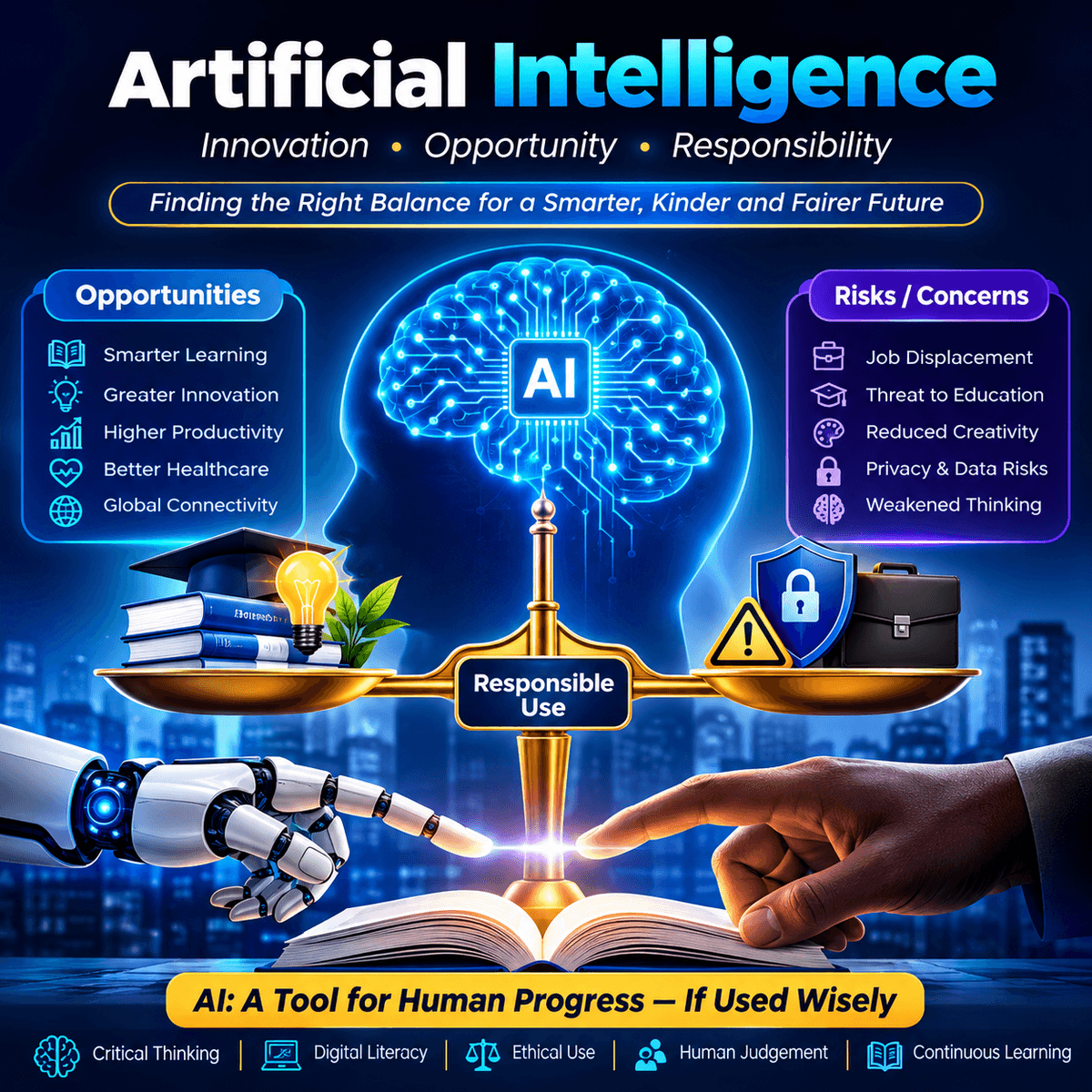
After considering the fears surrounding AI, it is important to avoid moving to the opposite extreme.
AI should not be treated as either a miracle that can solve every problem or a monster that must be rejected completely.
Like many powerful technologies, its value depends largely on how people use it.
A knife can prepare food or cause harm. Electricity can power a hospital or become dangerous when poorly handled. Social media can connect people or spread destructive information.
The existence of risk does not automatically make a technology useless.
The answer is responsible use.
1. Let AI Assist, Not Control You
The first principle of responsible AI use is simple:
Remain in control.
Do not allow AI to make every decision for you.
It can provide suggestions, alternatives and possibilities, but the final judgment should remain with the human user.
Ask yourself:
Does this answer make sense?
Is the information accurate?
What are the consequences of acting on it?
Does this reflect my values and purpose?
These questions keep the human being at the centre of the process.
2. Verify Important Information
Never assume that every AI-generated response is automatically correct.
Check important facts using credible sources. Where necessary, consult professionals, official documents, textbooks, research papers or qualified experts.
The more serious the consequence of an error, the more important verification becomes.
AI should be treated as a helpful assistant, not an unquestionable authority.
3. Protect Your Privacy
Users should also be careful about the information they provide to AI systems.
Personal information, passwords, financial details, confidential business documents, private conversations and sensitive records should not be carelessly entered into AI tools.
Convenience should never eliminate common sense.
Before sharing information with any digital service, consider what you are providing, why you are providing it and how it may be handled.
4. Do Not Allow Convenience to Destroy Your Skills
One of the greatest dangers of AI is not that it will become intelligent.
It is that humans may become less willing to think.
If AI can write, will we stop learning to write?
If AI can calculate, will we stop understanding mathematics?
If AI can generate ideas, will we stop observing the world?
If AI can answer questions instantly, will we lose the patience to investigate?
These are questions worth asking.
Technology should reduce unnecessary labour while preserving valuable human abilities.
The goal should be augmentation, not intellectual surrender.
5. Use AI Ethically
Ethics must remain at the centre of AI use.
Do not use AI to deceive people, impersonate others, spread false information, manipulate vulnerable individuals or commit academic or professional misconduct.
The fact that technology makes something possible does not automatically make it right.
Human beings must continue to distinguish between what we can do and what we should do.
6. Preserve Human Relationships
AI can communicate with us, but it cannot replace every human relationship.
A generated message may be convenient, but there are moments when someone simply needs a real conversation.
A machine can generate words of encouragement, but genuine human presence remains valuable.
A person experiencing grief, loneliness or deep emotional difficulty may need compassion from another human being rather than merely another automated response.
Technology should bring people closer together, not make us comfortable with emotional isolation.
7. Develop Skills That AI Cannot Easily Replace
As AI continues to evolve, people should invest in qualities that remain deeply human: critical thinking, emotional intelligence, leadership, communication, adaptability, creativity, ethical judgment, empathy and the ability to build meaningful relationships.
The future belongs not simply to people who know how to use AI.
It will belong to people who know when to use it, when not to use it, and how to question what it produces.
The Balance We Need
The controversy surrounding AI will probably continue for many years. Some fears will prove justified. Others will eventually disappear as society adapts. New challenges will also emerge that we cannot fully predict today.
But one principle should remain constant:
AI should serve humanity, not replace human responsibility.
We should neither worship technology nor fear it blindly.
We should learn it.
Question it.
Use it wisely.
Regulate it where necessary.
And, above all, remain responsible for what we do with it.
AI can help a student learn, but the student must still seek understanding.
It can help a writer communicate, but the writer must still have something meaningful to say.
It can help a designer create, but the designer must still possess vision.
It can help a business become more efficient, but the business must still value people.
It can provide information, but humans must still pursue truth.
Perhaps the greatest lesson in the AI conversation is that technological advancement does not remove human responsibility; it increases it.
The more powerful our tools become, the more carefully we must consider how we use them.
AI does not have to be the enemy of humanity. Neither should humanity become a servant of AI.
There is a healthier middle ground: human beings using intelligent technology with wisdom, discipline, creativity and responsibility.
That is the balance we should pursue.
The future should not be about choosing between humans and machines.
It should be about building a future where technology makes human beings more capable without making them less human.