 Writers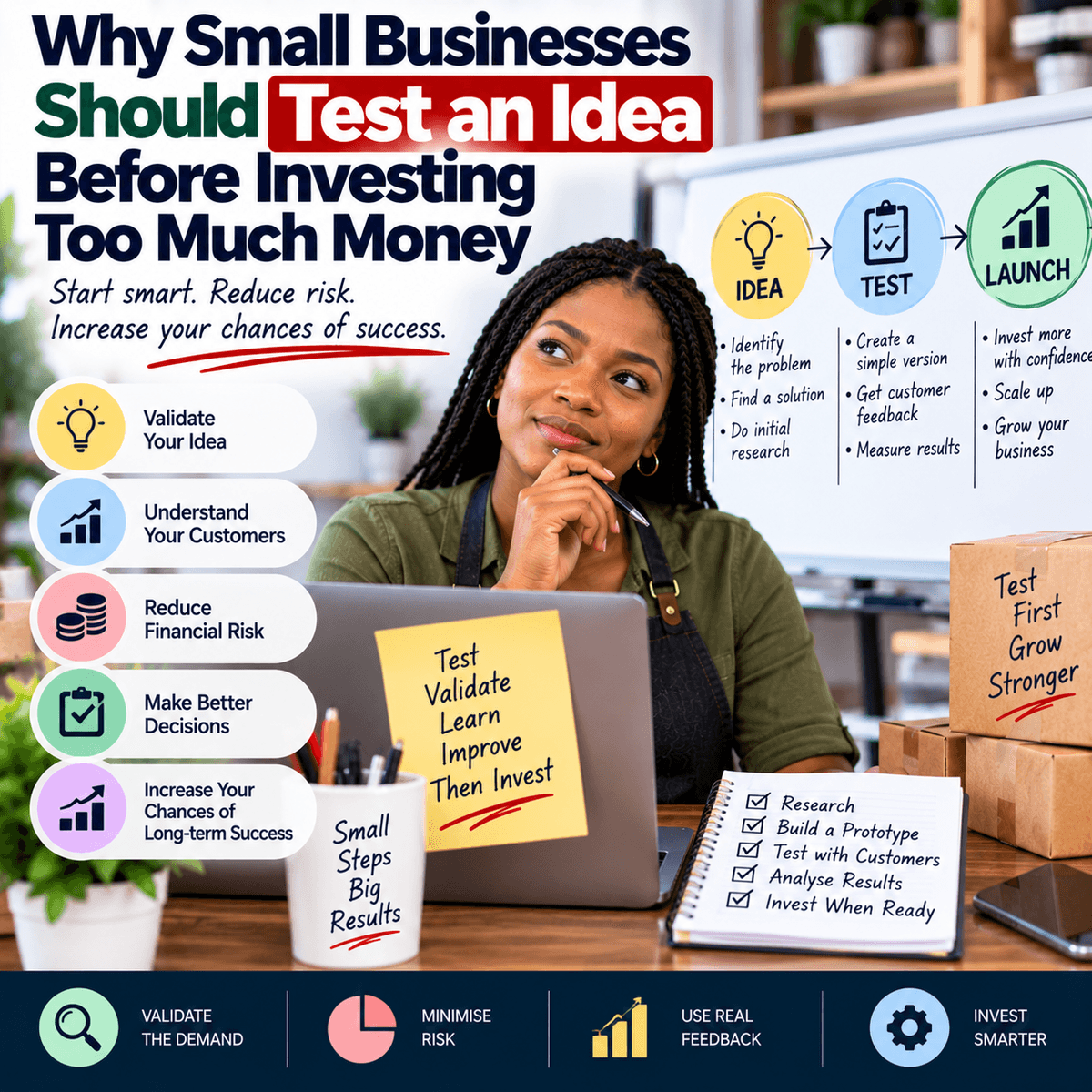
Starting a new business idea can be exciting, especially when you believe customers will like what you want to sell. That excitement can make it tempting to spend a large amount of money immediately. You may want to rent a big shop, order large quantities of products, buy expensive equipment, employ several workers, print thousands of packages or spend heavily on advertising before making your first sale. The problem is that believing an idea will work is different from knowing that customers are willing to pay for it. A product may receive positive comments from friends and family but struggle when introduced to paying customers. People may say they like an idea without being willing to spend money on it. This is why small businesses can benefit from testing an idea before making a large investment. Testing simply means starting on a limited scale so that you can see how real customers respond. Instead of ordering 1,000 units of a new product, you might begin with 50 or 100 units. Instead of opening several locations immediately, you might start with one location or sell online first. A service business can offer a new service to a small group of customers before spending heavily on equipment or staff. The aim is not to avoid taking risks completely because every business involves some level of uncertainty. The aim is to learn as much as possible before committing money that may be difficult to recover. A small test can show whether customers are interested, what they are willing to pay, what they like, what they dislike and what needs to change. This information can be more useful than assumptions made before the business reaches the market.
A good business test should focus on real customer behaviour rather than compliments alone. Imagine that you want to start selling a particular type of packaged food. You show photographs to twenty friends and almost everyone says it looks good. That feedback may encourage you, but it does not prove that twenty people will buy it at your intended price. A stronger test would involve producing a small quantity and offering it for sale to the type of customers you hope to serve. You can then record how many people actually buy, which version they choose, how much they are willing to pay and whether they return to buy again. The same principle applies to services. If you want to start a cleaning service, for example, you could begin by serving a limited number of homes or offices. Pay attention to the questions customers ask, the amount of time each job takes, transportation costs, supplies used and complaints received. You may discover that customers want a service slightly different from the one you originally planned. You might also find that the price you intended to charge is too low to cover your costs or too high for the market you are targeting. These lessons are easier and cheaper to handle while the business is still small. Testing does not mean giving everything away for free. Free users may behave differently from paying customers. If your goal is to build a business, part of the test should usually involve finding out whether people will actually pay. Even a small number of genuine sales can provide useful information about demand, pricing and customer expectations.
Testing can also prevent a business from spending heavily on things customers do not value. New business owners sometimes focus on what is visible before confirming whether the main offer works. They may spend a large amount on office decoration, branding, packaging or equipment because these things make the business feel established. Some of these expenses may eventually be necessary, but timing matters. Suppose you spend most of your starting capital importing a large quantity of a new product because you believe it will sell quickly. After the products arrive, customers complain that the size is unsuitable, the price is too high or another version is more useful. You are then left with money tied up in stock that is difficult to sell. If you had started with a smaller quantity, the same lesson would still be disappointing, but the financial damage could be much lower. A test can also reveal problems in the way the business operates. You may discover that delivery takes too long, packaging gets damaged during transportation, suppliers are unreliable or the cost of serving customers is higher than expected. These are valuable lessons because a business needs more than customer interest to succeed. It also needs a practical way to deliver its product or service consistently. When you start small, you can correct these problems before they affect hundreds of customers. This can protect your money and your reputation. Customers who have a poor experience during a large launch may not return, while a smaller test gives you room to improve the process before reaching a wider audience.
For testing to be useful, you need to decide what you want to learn and keep simple records of the results. Do not rely only on memory or general feelings such as “people seem interested.” Write down useful figures. How many people saw the offer? How many asked questions? How many bought? Which product or service did they choose? What price did they pay? How much did it cost you to provide each order? How many customers came back? What complaints appeared repeatedly? These numbers do not need to be complicated, but they can help you separate assumptions from actual results. Customer feedback is also useful, especially when you ask clear questions. Instead of asking only, “Do you like it?” ask what they found useful, what caused difficulty, what they would change and whether the price seemed reasonable. Pay particular attention when several customers raise the same issue. One complaint may reflect an individual preference, but repeated complaints can point to something worth investigating. At the same time, do not change the entire business every time one person makes a suggestion. Look for patterns and compare feedback with actual buying behaviour. Testing should also have a reasonable period or target. For example, you might decide to sell a limited number of units over one month and then review the results. If demand is strong and the numbers make financial sense, you can consider increasing your investment. If the results are weak, you can investigate why before spending more. Sometimes the idea needs improvement rather than abandonment. A different price, target customer, package size, sales channel or service process may produce a better result.
Testing an idea before investing heavily is not a sign that you lack confidence in your business. It is a way of using your money carefully and allowing customers to provide information before you make bigger commitments. Successful testing does not guarantee that a business will continue to succeed because markets, costs, competitors and customer preferences can change. However, it can reduce avoidable mistakes at the beginning. Start with the smallest practical version of your idea that allows customers to understand its value and pay for it. Observe what happens, record your costs and sales, listen to useful feedback and improve the offer where necessary. If the evidence is encouraging, expand gradually rather than increasing expenses simply because the first few customers responded positively. Make sure your suppliers, operations, cash flow and customer service can handle growth. If the test performs poorly, do not automatically respond by spending more money on advertising. First determine whether the problem is awareness, pricing, product quality, customer need, location, delivery or another part of the business. Sometimes stopping or changing an idea early can save money that can be used for a better opportunity. Small businesses often have limited capital, which makes careful decisions especially important. You do not need to have every answer before starting, but you should avoid making the most expensive version of a decision before you have enough information. Test the idea, learn from real customers, improve what needs to change and invest more when the results give you a sound reason to do so. This approach allows a business to grow based on evidence rather than hope alone.
