Writers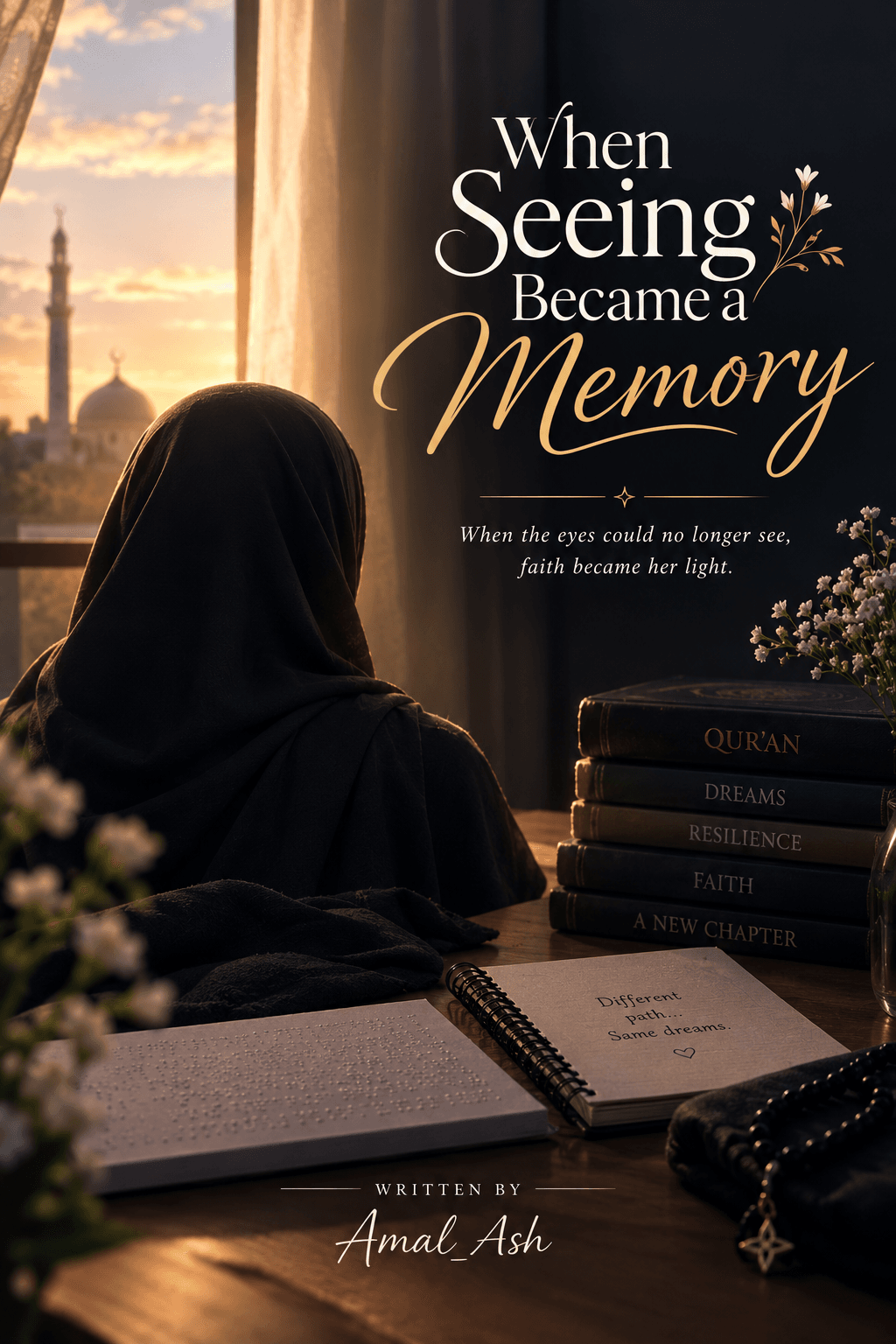
When Seeing Became a Memory
When the eyes could no longer see, faith became her light.
There was a time when Ilham knew the world in the ordinary way a child does: through faces, colours, familiar places, and the effortless confidence of being able to look around and understand what she saw.
She was a cheerful, outgoing girl, surrounded by her brother and sister. Their childhood was uncomplicated in the way childhood often is. She went to school, made friends, laughed freely, and occupied herself with the small things that made her happy. Nothing suggested that the course of her life was about to change.
When Ilham was about to enter Year 4, she changed schools.
It was in that new school that her teachers began to notice a decline in her academic performance. They saw a child who appeared to be struggling with work she had previously been capable of handling. Without knowing the reason, they concluded that she was not keeping up academically and decided to take her back a year.
The decision must have been difficult for a child who knew, somewhere within herself, that she was capable of more.
What nobody yet understood was that Ilham was not struggling because she lacked intelligence.
She simply could not see properly.
The writing on the board was becoming increasingly difficult for her to distinguish. Even her own notes were unclear. In Mathematics, a 3 could look like a 5. In other subjects, an S could appear to be a C.
To those around her, it looked like poor performance.
To Ilham, it was an increasingly confusing world in which the things she was expected to read no longer appeared as they should.
Eventually, her parents and teachers discovered the problem. She was taken to an optician, and after the examination, the family was told that she needed surgery.
They placed their hope in that operation.
Perhaps that was the hardest part of what followed: believing that the surgery would restore what was being lost, only to discover that the outcome was not what they had prayed for.
The operation was carried out, and the family was told that it had been successful. Yet Ilham's vision did not improve as they had hoped. Instead, her condition became worse.
Gradually, the world she had once known through sight became inaccessible to her.
She could no longer identify people by their faces. She learned to recognize them by their voices instead. Colours became something she could no longer reliably distinguish. She could not tell what colour of clothes she was wearing, nor could she tell whether her clothes were properly arranged or wrinkled.
The changes were not confined to what she could see.
They began to affect who she was.
Ilham had once been extroverted. She enjoyed conversations, company and the ease of moving confidently among other people. But as her vision deteriorated, her confidence began to erode with it.
She became more withdrawn.
The girl who had once been comfortable around people started keeping to herself. She became conscious of needing assistance with things others could do without thinking. She became uncertain in situations that had once been ordinary.
It was not that she had suddenly stopped being cheerful.
Rather, the circumstances surrounding her had changed so profoundly that her personality began to retreat with them.
The world had become less familiar, and she had become less certain of her place in it.
Still, she had to continue.
Primary school did not pause because her sight was failing. Lessons continued. Tests continued. Expectations remained.
She had to learn while navigating a world she could no longer see clearly.
Then, one morning, another frightening incident occurred.
Ilham wanted to go outside to get something. Unaware that a motorcycle was approaching, she stepped into its path and was hit. She lost consciousness, and those around her were thrown into panic.
She was taken to the hospital.
Alhamdulillah, the injuries were minor. She had injuries to her knee and elbow, but nothing more serious.
For her family, however, the incident must have been another reminder of how vulnerable she had become.
Then came JSS1.
And with it came a loss far greater than anything she had yet experienced.
Her father died.
Ilham cried.
Her mother cried.
Her siblings cried.
Grief entered a home that had already been forced to adjust to so much change.
Losing a parent is a kind of absence that cannot simply be explained. A familiar voice is gone. A presence that once formed part of everyday life is suddenly missing. For Ilham, who was already learning to navigate life without her sight, the loss added another weight to an already difficult journey.
Yet she continued.
Perhaps one of the most remarkable things about Ilham's story is that she did not allow hardship to completely silence her determination.
Whenever she returned home from school, she studied even when she was tired.
She worked.
She persisted.
She kept moving forward.
By the time she reached JSS3, her mother made another important decision. Ilham was taken to a resource centre for blind students, where she spent a year learning skills that would help her become more independent.
Her formal schooling was interrupted for that year.
Once again, she found herself behind her classmates.
But the year was not wasted.
At the resource centre, she learned how to carry out everyday tasks more independently. She learned how to navigate a computer keyboard. She learned beadwork and other practical skills.
More importantly, she began learning something that no examination could measure: how to live confidently in a world that was not designed around her limitations.
When the programme ended, she returned to school.
But she returned to a different academic reality.
Her classmates had moved ahead while she had spent a year acquiring skills necessary for her independence. She now had to catch up.
And she did.
She became a diligent student, determined not to let another obstacle decide how far she could go.
She prepared for her Junior WAEC examinations and passed.
During this period, Ilham had a close friend named Amir, who was a year ahead of her.
Their friendship became particularly meaningful to her. Amir helped her with many things and supported her academically, especially in Mathematics and other subjects where she needed additional help.
Their relationship was less like an ordinary friendship and more like that of siblings who happened not to share the same parents.
For someone whose life had increasingly required her to learn independence, having someone who willingly stood beside her was significant.
Then came another goodbye.
Ilham discovered that the school was closing down.
She was devastated.
She knew she would be leaving behind more than classrooms and teachers. She was leaving memories, familiar surroundings and people who had become part of her life.
But one person stood out above the rest.
Amir.
The thought of leaving him hurt.
She moved to another school, but she struggled to settle in. The new environment was very different from what she had known, and she did not particularly like it. Nevertheless, she had no choice but to endure.
She eventually entered the Commercial department, with hopes of becoming an accountant.
She also dreamed of owning a restaurant.
And there was another dream that mattered deeply to her:
memorizing the Qur'an.
Despite everything that had happened to her, Ilham still had ambitions. Her circumstances had changed, but her desire to build a meaningful life had not disappeared.
Academically, she continued to perform well. She was often coming second in her class.
But while she was progressing in school, something else was quietly breaking her heart.
Amir had become distant.
The friend who had once helped her with Mathematics and other subjects no longer spoke to her as he once had. Eventually, he cut off communication completely.
For Ilham, it was difficult to understand how someone who had once been so close could become so distant that it felt as though they had never known each other.
Some endings do not come with arguments or explanations.
Sometimes, a friendship simply becomes silence.
And silence can hurt more than words.
Ilham continued with her education. She studied, attended classes and held on to the dreams she had carried for years.
Eventually, she sat for her final examinations.
She did not know that the result waiting for her would become another painful chapter.
She did not pass.
But she does not know yet.
At the time the result was released, Ilham was away from home, pursuing another dream; the memorization of the Qur'an.
Her mother saw the result before she did.
And she wept.
Not because she had stopped believing in her daughter, but perhaps because she knew how hard Ilham had fought to get that far.
She knew what her daughter had endured.
She knew about the years of struggling to see, the surgery, the loss of her sight, the accident, the death of her father, the interruption of her education, the year spent learning independence, the struggle to catch up, the friendships she had lost, and the dreams she continued to carry despite everything.
Now there was another disappointment.
And her mother did not know how to tell her.
Perhaps she wondered how to put such painful news into words without making her daughter feel as though all her efforts had been for nothing.
But perhaps the result is not the end of Ilham's story.
Perhaps it is only another unexpected turn in it.
For years, Ilham has had to adjust to a life she never chose.
She did not choose to lose her sight.
She did not choose to fall behind her classmates.
She did not choose to lose her father.
She did not choose for her schooling to be interrupted.
She did not choose for a friendship that meant so much to her to disappear.
And yet, at every stage, she found a way to continue.
Her story is not simply about blindness.
It is about what happens when life takes away the things we thought we could rely on, and asks us to discover what remains.
Ilham once saw the world through her eyes.
Now she experiences it differently.
She recognizes people through their voices. She has learned skills that allow her to live more independently. She has continued her education despite interruptions. She has remained ambitious despite circumstances that could easily have discouraged her.
And perhaps most importantly, she has held on to her faith.
Her desire to memorize the Qur'an remains.
That dream is significant because it represents something her circumstances could not take away: her determination to keep seeking something greater than herself.
Maybe some of her dreams will take a different route.
Maybe becoming an accountant will require a path she never imagined.
Maybe owning a restaurant will take longer than she hoped.
Maybe the life she once pictured for herself will not unfold exactly as she imagined.
But a changed path is not necessarily a destroyed future.
There are things the eyes can see, and there are things they cannot.
Eyes can recognize faces, distinguish colours and read words from a board.
But eyes cannot measure courage.
They cannot measure patience.
They cannot measure faith.
And they certainly cannot determine a person's worth.
Ilham's sight may have changed the direction of her life, but it has not erased the person she is.
Somewhere along the way, the cheerful girl who once moved through the world without hesitation became quieter. She lost a part of the confidence she once carried so naturally.
But she also discovered another part of herself, the part that could endure.
The part that could learn again.
The part that could begin again.
The part that could keep walking even without knowing exactly where the road would lead.
And perhaps that is what makes her story so painful and so beautiful at the same time.
She cannot see what tomorrow holds.
Neither can any of us.
The difference is that Ilham has been forced to learn that truth in a way most people never have to.
Yet she continues to move forward.
She continues to learn.
She continues to dream.
And she continues to hold on to Allah.
Perhaps seeing is not only about having sight.
Perhaps sometimes, it is about having enough faith to take the next step when the road ahead is hidden.
Ilham may never get back the world she once saw.
But that does not mean there is nothing left for her to discover.
There are still dreams ahead.
There is still knowledge to pursue.
There is still the Qur'an to memorize.
There is still a future she has not met.
And there is still a story being written.
A story that did not end when seeing became a memory.
Author's Note
This is a real-life story based on Ilham's experiences. Her name and certain identifying details may be changed to protect her privacy.
The purpose of this story is not to present Ilham as someone who should be pitied, but to share the journey of a young girl whose life was altered by circumstances beyond her control and who continues to find ways to move forward.
Her story reminds us that disability may change the way a person experiences the world, but it does not diminish their intelligence, dignity, dreams, or worth.
Sometimes, the people we think have lost the most are the ones who teach us the deepest meaning of resilience, faith, and hope.