 Writers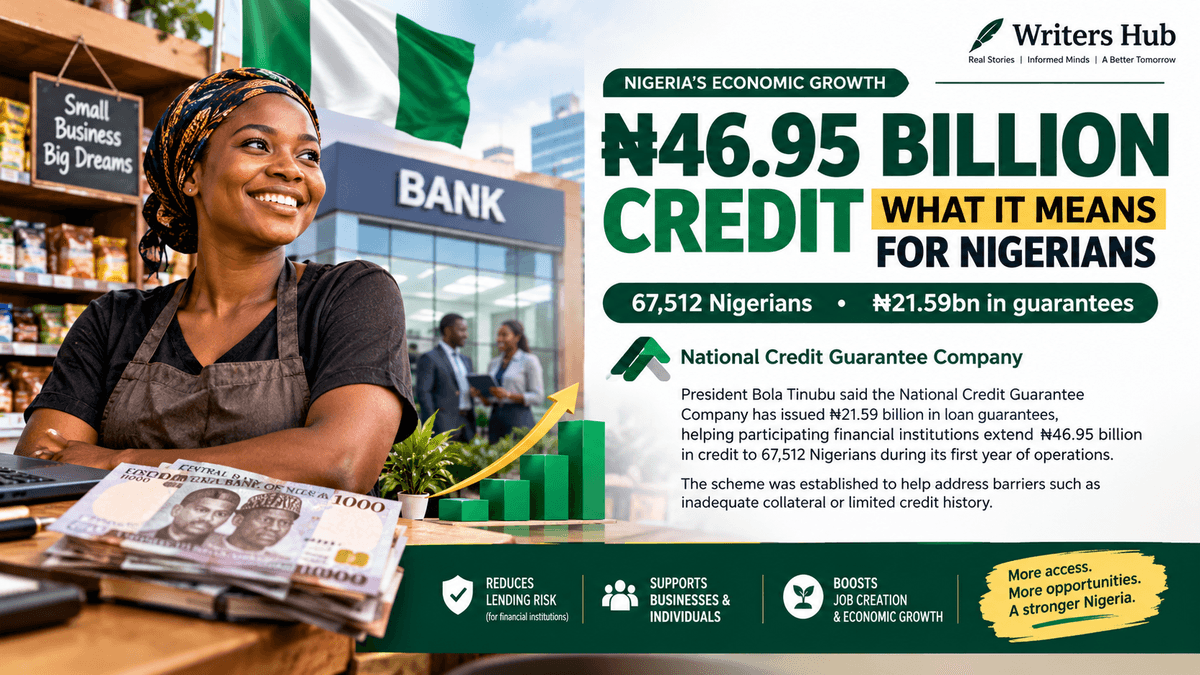
₦46.95 Billion Credit: What It Means for Nigerians
By Kareem Usman
Nigeria’s access to credit has received fresh attention following the announcement that ₦46.95 billion in credit has been extended to 67,512 Nigerians through the National Credit Guarantee Company (NCGC).
President Bola Ahmed Tinubu disclosed the figure on Monday, September 28, 2026, while marking the first year of the NCGC’s operations. According to the President, the company has issued ₦21.59 billion in loan guarantees, helping participating financial institutions provide significantly more credit to Nigerians. (Trending News)
The development is important because access to affordable credit remains a major challenge for many Nigerians, particularly small-business owners and entrepreneurs who may struggle to provide the collateral traditionally demanded by financial institutions.
What Is the National Credit Guarantee Company?
The National Credit Guarantee Company was established to help reduce some of the barriers preventing individuals and businesses from accessing loans.
One of the major problems facing borrowers is collateral. A business may have a good idea, customers and the potential to grow, but still struggle to obtain financing because its owner does not have enough property or other assets that a financial institution can accept as security.
Limited credit history can also make borrowing more difficult.
The credit guarantee system is designed to help address some of these challenges by providing guarantees that reduce the risk faced by participating financial institutions. (Trending News)
Where Does the ₦46.95 Billion Come From?
It is important to understand that the ₦46.95 billion is credit extended through participating financial institutions, while the ₦21.59 billion represents guarantees issued by the NCGC.
In simple terms, the guarantee mechanism is intended to give lenders additional confidence to provide financing to eligible borrowers.
The reported figure therefore does not mean that every Nigerian has received money directly from the Federal Government. Rather, the NCGC works with participating financial institutions to support access to credit.
The programme has so far reached 67,512 Nigerians, according to the President’s announcement. (Trending News)
Why Small Businesses Are Important
Small and medium-sized businesses are a major part of Nigeria’s economic activity. From food sellers and fashion designers to farmers, transport operators, technology businesses and service providers, millions of Nigerians depend on small enterprises for their livelihoods.
However, many businesses operate with limited working capital.
A trader who wants to increase stock may need additional financing. A fashion designer may need a better sewing machine. A farmer may require money for inputs. A laundry operator may need equipment to increase capacity.
Without access to finance, many businesses remain small even when there is demand for their products and services.
Credit can provide an opportunity for such businesses to expand, employ workers and increase production.
What Could This Mean for Ordinary Nigerians?
If credit becomes easier to access under properly structured programmes, individuals and businesses could have more opportunities to invest in productive activities.
For entrepreneurs, financing could help with equipment, inventory, expansion or working capital.
For financial institutions, guarantees can potentially reduce some lending risks and encourage greater participation in sectors where traditional lending requirements have previously excluded potential borrowers.
However, access to credit should not be confused with free money.
Loans must normally be repaid according to agreed terms, including applicable interest and charges. Anyone considering borrowing should therefore understand the repayment schedule, total cost of the loan and consequences of default before accepting an offer.
The Bigger Economic Picture
The significance of the programme goes beyond the ₦46.95 billion figure.
If credit reaches productive businesses and individuals, it can contribute to business expansion, job creation and increased economic activity.
But the effectiveness of any credit programme will ultimately depend on how accessible, transparent and sustainable it is.
Nigerians will want to know who qualifies, which financial institutions participate, what the interest rates are, how applications are assessed and whether the programme reaches businesses that genuinely struggle to obtain conventional financing.
These questions are important because the headline figure alone does not show how the money is distributed across sectors, locations or categories of borrowers.
A New Opportunity, but With Responsibility
The first-year figures from the NCGC show that the credit-guarantee model is already supporting lending on a significant scale.
The challenge going forward will be ensuring that more eligible Nigerians can access financing while maintaining responsible lending and repayment practices.
For entrepreneurs, the message is straightforward: credit can provide an opportunity to grow, but it should be used carefully and for activities capable of generating sustainable returns.
For Nigeria’s economy, the bigger question is whether programmes such as the NCGC can help transform access to finance into stronger businesses, more jobs and greater economic participation.
With ₦46.95 billion already extended to 67,512 Nigerians, the next phase will be about how far that opportunity can reach.