Writers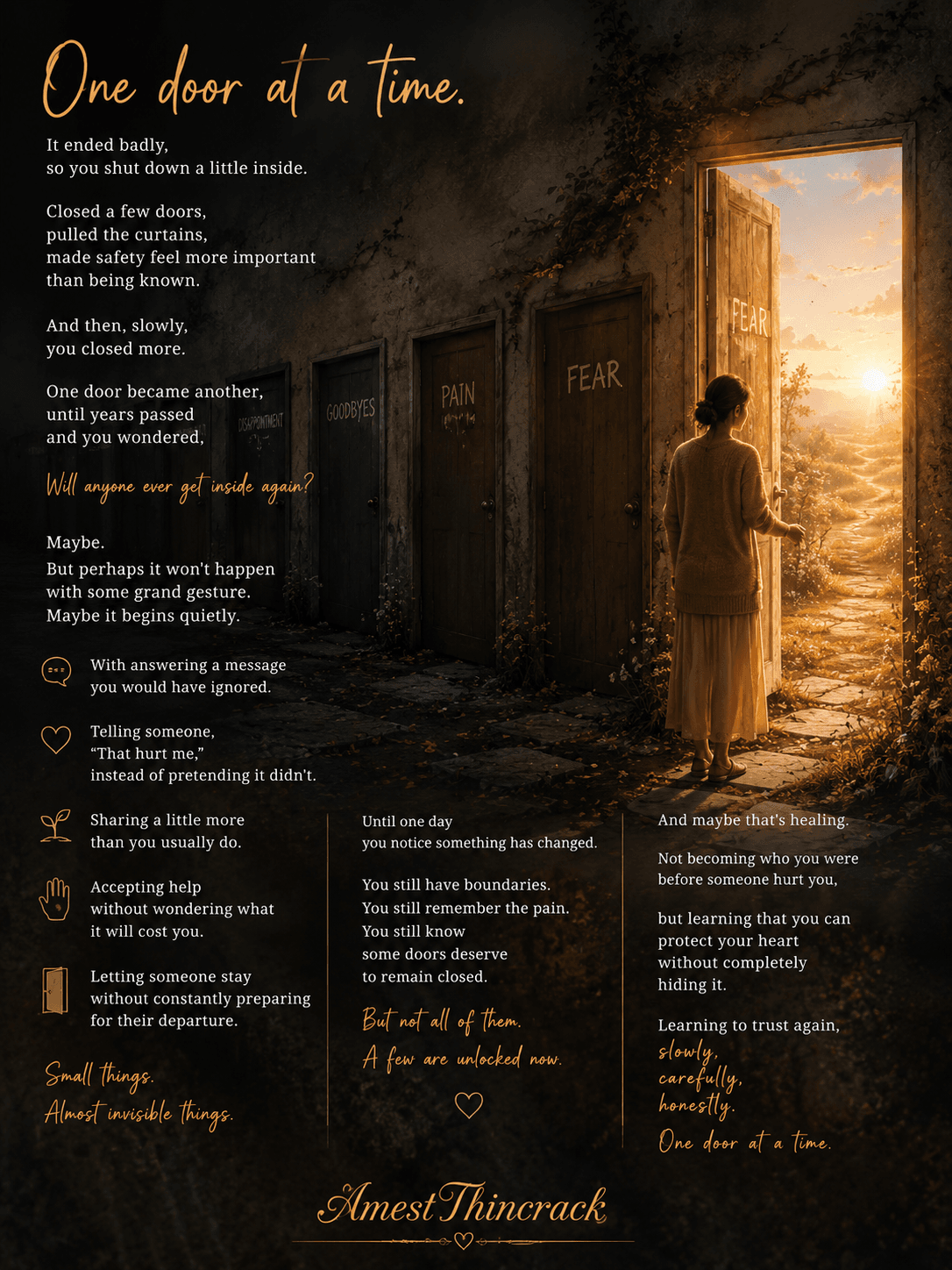
It ended badly.
Maybe that is where the story always begins.
Not with the closing of the door, but with the moment you realized you had to close it.
Something happened. Someone hurt you. A relationship ended in a way you never imagined it would. A friendship you trusted became a source of disappointment. Someone you thought would stay chose to leave. Perhaps you were betrayed, misunderstood, abandoned, lied to, or simply loved in a way that kept hurting you.
Whatever it was, it changed something.
Not everything.
Just something.
You still woke up the next morning. You still went to work. You still answered messages, laughed at jokes, made plans, went about your life. From the outside, perhaps nothing looked different.
But somewhere inside you, a door quietly closed.
At first, you probably didn't even call it a door.
You called it being careful.
You told yourself you had learned your lesson.
You said you weren't going to make the same mistake twice.
And honestly, you had every right to be careful.
When something hurts badly enough, your mind naturally starts looking for ways to prevent it from happening again. You begin noticing things you once ignored. You become more observant. You question people's intentions. You stop giving everyone the benefit of the doubt.
You learn to listen differently.
You learn to leave sooner.
You learn not to explain yourself so much.
You learn that not everyone deserves access to the softest parts of you.
And some of those lessons are good lessons.
They save you.
They teach you boundaries. They teach you discernment. They remind you that love is not supposed to require you to abandon yourself. They show you that being kind does not mean being endlessly available, and being forgiving does not mean repeatedly placing yourself in the same position to be hurt.
So you close one door.
And for a while, you feel better.
Safer.
Quieter.
You don't have to wonder what someone is thinking because you don't let them get close enough to matter.
You don't have to worry about being disappointed because your expectations become smaller.
You don't have to fear someone leaving because you stop allowing anyone to become important enough for their absence to hurt.
It feels like peace.
At least at first.
Then another door closes.
Perhaps someone new comes into your life, but something they do reminds you of someone from your past.
You notice a familiar pattern.
A familiar silence.
A familiar inconsistency.
A familiar feeling.
And before the person has even had the chance to show you who they are, you have already started backing away.
Not because they necessarily did anything wrong.
But because your heart remembers.
It remembers what happened last time.
So another door closes.
Then another.
Years can pass like this.
Quietly.
Almost without your permission.
You become good at protecting yourself.
Very good.
You know how to disappear when things become uncomfortable. You know how to say, "I'm fine," when you are anything but fine. You know how to keep conversations on the surface. You know how to be friendly without becoming vulnerable. You know how to care without letting anyone know how much you care.
You become independent.
Strong.
Self-sufficient.
People admire you for it.
They say, "You don't need anybody."
And perhaps you smile because they don't understand that needing nobody was never really the goal.
You just got tired of needing people who didn't know how to handle your heart.
There is a difference.
A big one.
You didn't stop wanting connection.
You stopped believing connection was safe.
And that is where things become complicated.
Because the walls that once protected you can eventually become the same walls that keep good things out.
You may not notice it immediately.
You simply find yourself saying no more often.
No to invitations.
No to new friendships.
No to conversations that might become deeper.
No to opportunities to be known.
No to people who are trying to get close.
Sometimes you don't even know why you're saying no.
You just know that distance feels easier.
There is comfort in distance because distance gives you control.
If nobody gets close, nobody can disappoint you.
If nobody knows the vulnerable parts of you, nobody can use them against you.
If you never expect anything from anyone, you never have to experience the pain of watching those expectations collapse.
So you tell yourself that you are content.
And maybe sometimes you genuinely are.
There is nothing wrong with enjoying your own company. There is nothing wrong with having boundaries. There is nothing wrong with becoming selective about who gets access to you.
The problem begins when protection becomes a prison and you forget that you are the one holding the key.
You start wondering why nobody knows you deeply.
Why nobody checks on you in the way you secretly wish they would.
Why relationships never seem to move beyond the surface.
Why you feel lonely even when you are surrounded by people.
Why you crave closeness and then pull away the moment it becomes possible.
And perhaps one night, in the quietest part of yourself, you finally ask the question you've been avoiding.
"Will anyone ever get inside again?"
It's a frightening question.
Because you don't just wonder whether someone else will find their way in.
You wonder whether you will let them.
After all, you have spent years building this place.
You know every wall.
Every locked door.
Every hiding place.
You know exactly where the cracks are, and you know how to cover them.
You have become so familiar with protecting yourself that vulnerability can feel almost irresponsible.
But maybe healing isn't about throwing every door open.
Maybe that is too much to ask.
Maybe healing is much smaller than that.
Maybe it begins with one unlocked door.
Just one.
It might be as simple as answering a message instead of ignoring it because you are afraid of becoming attached.
It might mean accepting an invitation even though staying home feels safer.
It might mean telling someone, "That hurt me," instead of pretending you don't care.
It might mean saying, "I need help," without feeling weak for needing it.
It might mean allowing someone to show up for you without immediately wondering what they will eventually want in return.
It might mean telling someone a little more about yourself than you normally would.
Not everything.
Just a little.
Enough to let them see something real.
And then waiting.
Watching.
Learning.
Because trust doesn't have to be a leap.
Sometimes trust is a series of tiny steps.
You don't have to hand someone the whole key to your heart on the first day.
You can give them a moment.
Then another.
You can let them earn another room.
You can watch what they do with the little pieces of you that you have entrusted to them.
Do they listen?
Do they respect your boundaries?
Do their actions match their words?
Do they make you feel like you have to perform for their affection?
Do they punish you for saying no?
Do they disappear whenever things become inconvenient?
Or do they stay consistent?
Do they give you room to breathe?
Do they respect the things you are not ready to share?
Do they make closeness feel less like a threat and more like a choice?
These things matter.
Because opening your heart again does not mean becoming careless.
It means becoming discerning without becoming completely closed.
There is a difference between saying, "Nobody can be trusted," and saying, "Trust must be earned."
There is a difference between being available to everyone and allowing the right people to come closer.
There is a difference between having walls and having boundaries.
Walls say, "Nobody gets in."
Boundaries say, "You may come closer, but you must treat what you find here with care."
Maybe you need boundaries now.
Maybe you need them because you have learned the hard way what happens when you don't.
Keep them.
You don't have to become the person you were before you were hurt.
That person may have been open, but perhaps they didn't yet know how to protect themselves.
You can become someone different.
Someone softer and wiser.
Someone who can love deeply without abandoning herself.
Someone who can trust without ignoring red flags.
Someone who can forgive without reopening every door.
Someone who can say, "I care about you," and still say, "This is not okay with me."
That is a different kind of strength.
And perhaps, over time, something unexpected happens.
You begin to notice that not everyone is trying to hurt you.
Someone keeps their word.
Someone respects your no.
Someone remembers the little things you say.
Someone notices when you are quiet.
Someone doesn't rush you when you pull back.
Someone gives you space without making you feel abandoned.
Someone stays consistent even when there is nothing to gain from doing so.
At first, you may not know what to do with that.
You might question it.
You might wait for the other shoe to drop.
You might think, "They're being nice now, but eventually..."
And that's okay.
Healing doesn't require you to trust immediately.
You are allowed to be cautious.
You are allowed to watch.
You are allowed to take your time.
The important thing is that fear doesn't make every decision for you.
Because sometimes, after being hurt, we begin treating every new person like they are guilty of an old person's crimes.
We make someone pay for wounds they didn't create.
We leave before they have done anything wrong because someone else once left us.
We distrust kindness because someone once used kindness as a disguise.
We question consistency because inconsistency became what we expected.
And without meaning to, we can push away the very people who might have shown us something different.
That doesn't make you a bad person.
It makes you human.
But at some point, healing asks us to become honest with ourselves.
Not every closed door is protecting you anymore.
Some are simply keeping you alone.
That realization can sting.
Because it means you have to take responsibility for what happens next.
You can't control who hurt you.
You can't rewrite the past.
You can't make people become who you needed them to be.
But you can decide what their actions are allowed to mean about your future.
Someone leaving does not mean everyone leaves.
Someone betraying you does not mean everyone is unfaithful.
Someone failing to love you properly does not mean you are difficult to love.
A friendship ending does not mean friendship is impossible.
A relationship breaking does not mean intimacy is dangerous forever.
Sometimes the lesson isn't "Never open your heart again."
Sometimes the lesson is, "Open it more wisely next time."
And perhaps that's where the hope lives.
Not in pretending that the past didn't hurt.
Not in convincing yourself that everyone is good.
Not in waiting for one extraordinary person to come along and magically undo years of fear.
The hope is in you.
In the small choices you make.
In the moment you decide to answer instead of disappear.
In the conversation where you finally tell the truth.
In the friendship you allow to grow slowly.
In the boundary you communicate instead of silently resenting someone.
In the apology you accept because you can see genuine change, not because you're afraid of losing the person.
In the help you finally allow someone to give you.
In the laughter that surprises you because you realize you haven't felt that light in a while.
These moments may not feel like healing when they happen.
They may feel ordinary.
But they are not.
Every time you choose connection without abandoning your discernment, you are teaching your heart something new.
Every time you allow someone to show you who they are instead of assuming you already know, you are creating room for trust.
Every time you protect yourself without completely shutting yourself away, you are finding a better balance.
And maybe one day you'll notice that something has changed.
You still have boundaries.
You still remember.
You still know what heartbreak feels like.
You still know there are people you will never allow close again, and that's okay.
Some doors should stay closed.
Some relationships belong in the past.
Some people don't deserve another opportunity.
Healing does not mean reopening every door.
It means learning which doors need to remain closed and which ones were only closed because you were afraid.
And maybe, after all those years, you'll discover that a few doors are no longer locked.
Not wide open.
Just unlocked.
Enough for someone to knock.
Enough for you to decide whether to answer.
Enough for sunlight to get through.
And perhaps that's all you need at first.
You don't have to rush toward vulnerability.
You don't have to become fearless.
You don't have to trust everyone.
You don't even have to know exactly what comes next.
You only have to leave a little room for the possibility that life can still surprise you.
That there are people you haven't met yet.
Conversations you haven't had.
Friendships you haven't experienced.
Places you haven't gone.
Versions of yourself you haven't discovered.
There is still so much life beyond the doors you closed.
And maybe the goal isn't to tear down the walls.
Maybe the goal is to build a home within yourself that feels safe enough that you no longer need walls around every part of it.
A home where you can be alone without being lonely.
Where you can love without losing yourself.
Where you can walk away when something is wrong without believing you have to walk away from everyone.
Where you can say yes without fear and no without guilt.
Where trust is not blindly given, but slowly built.
Piece by piece.
Day by day.
Person by person.
Door by door.
Perhaps one morning you'll realize you are not standing behind all those locked doors anymore.
You are standing in the hallway.
And that may not sound like much.
But it is.
Because the hallway means you are moving.
It means you are no longer hiding in one room, convinced that the safest life is the smallest one.
You are looking around.
You are deciding.
You are choosing.
And maybe somewhere ahead, there is a door you haven't opened yet.
You don't know what is on the other side.
You don't know who you might meet there.
You don't know whether it will lead to love, friendship, a new beginning, or simply another part of yourself you forgot existed.
But for the first time in a long time, you don't feel the need to know.
You simply place your hand on the handle.
You breathe.
And you remember that being hurt taught you how to protect yourself.
But it does not have to teach you how to stop living.
So you turn the handle.
Not all the way.
Just enough.
And let a little light in.
Then tomorrow, maybe a little more.
That's how trust returns sometimes.
Not dramatically.
Not all at once.
But through tiny acts of courage that nobody else may ever notice.
A message answered.
A truth spoken.
A boundary respected.
A hand accepted.
A laugh shared.
A little vulnerability.
A little patience.
A little faith.
Until one day, you look back and realize you have opened more doors than you thought you could.
And perhaps the most beautiful part is this:
You didn't become who you were before the hurt.
You became someone wiser.
Someone who knows that softness is not weakness.
Someone who understands that boundaries are not loneliness.
Someone who knows that caution and hope can exist in the same heart.
Someone who can remember what happened without allowing it to dictate everything that happens next.
Someone who can say,
"Yes, I was hurt."
"Yes, it changed me."
"Yes, there are doors I will never open again."
"But not every door has to stay closed."
And maybe that's enough.
Maybe healing isn't becoming fearless.
Maybe it is learning that fear can sit beside you without always being allowed to drive.
Maybe trust isn't believing that nobody will ever hurt you again.
Maybe trust is knowing that if someone does, you will be able to recognize it, protect yourself, walk away if you need to, and still refuse to let one person's choices convince you that the whole world is unsafe.
You can protect your heart without burying it.
You can be careful without becoming unreachable.
You can remember without remaining trapped.
And you can open again.
Slowly.
Carefully.
Honestly.
One small step.
One quiet choice.
One unlocked door.
One person who proves, through time and consistency, that they can be trusted.
One moment where you choose not to run.
One moment where you realize you are not as afraid as you used to be.
Until eventually, you stop counting the doors.
You simply live.
And perhaps, somewhere along the way, you realize that the life you were so afraid to lose by opening your heart again was the very life waiting patiently on the other side.
You just had to open the door.
One door at a time.