Writers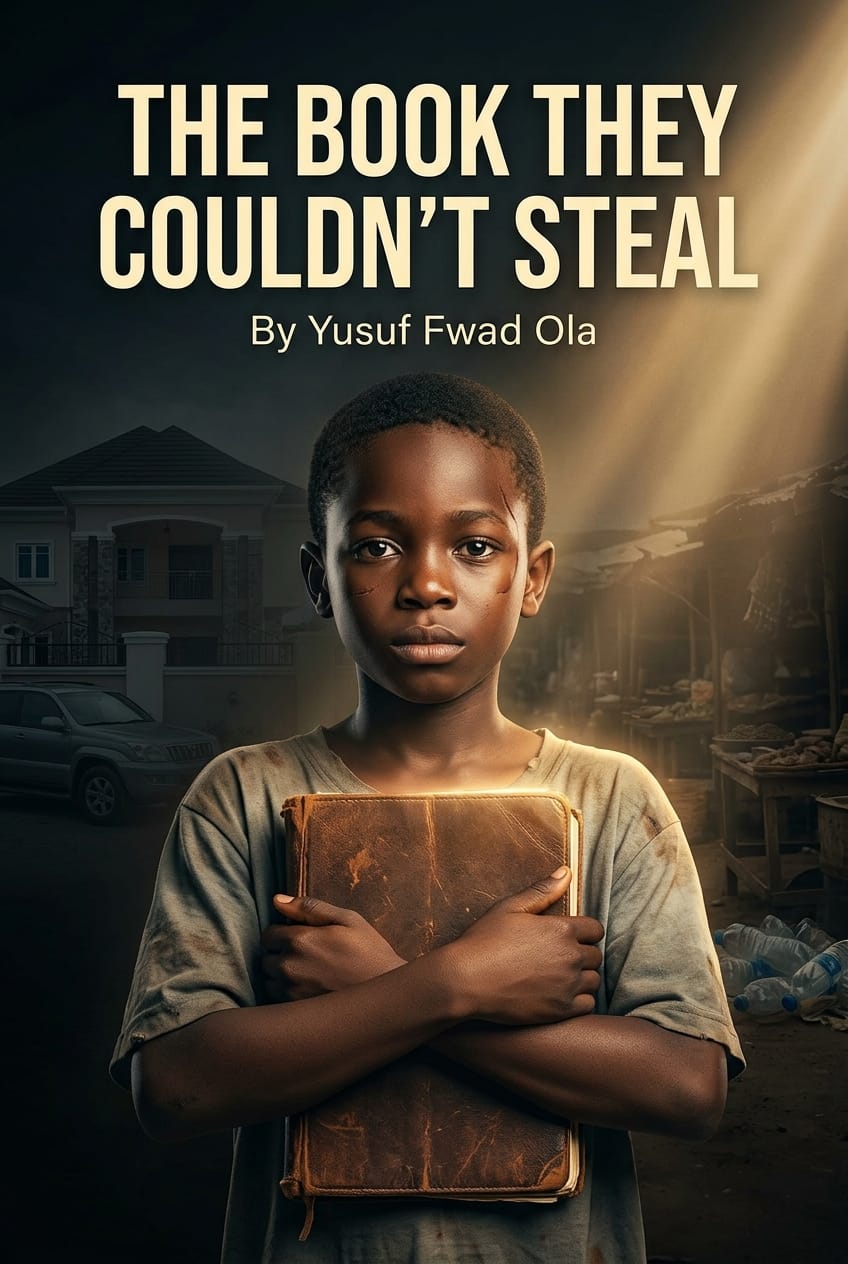
It took Suleiman three more days after leaving the clinic before he finally worked up the courage to open the notebook.
He waited until his mother had fallen asleep on their shared mattress, the small room lit only by a flickering candle, his bandaged head still throbbing faintly whenever he moved too quickly. He sat cross-legged on the floor, the leather notebook resting in his lap, and for a long moment simply stared at the cover, his fingers hesitating over the edge.
Baba Yakubu's words echoed in his mind. "Maybe everything you need to survive what's coming next in your life is sitting inside those pages."
Finally, he opened it.
The first several pages were exactly what he expected — his father's business notes, records of routes and fuel costs, reminders about maintenance schedules for the buses. Suleiman flipped through them quickly, his heart sinking slightly, wondering if Baba Yakubu had been wrong, if this really was nothing more than an old businessman's ledger.
But halfway through the notebook, the entries changed.
The handwriting grew looser, more personal, less like business notes and more like a private conversation between a father and the son he clearly worried he might not live long enough to raise into manhood. Suleiman realized, with a chill running down his spine, that his father must have sensed something like some fragility in his own health, some fear of an ending arriving sooner than expected, long before that Thursday afternoon at the motor park.
Suleiman, one entry read, dated nearly a year before his father's death, if you are reading this and I am no longer there to explain it to you myself, then something has happened, and I am sorry — sorrier than any words in this notebook can properly say. But listen to me carefully, because everything I am about to tell you matters more than you can currently understand.
Suleiman's hands trembled as he continued reading.
Family is complicated, son. Some of the people who share our blood love only what our name can give them, not the name itself. If I am gone, watch carefully who comes forward first with grief on their lips and calculation in their eyes. They will come. I have seen it happen to other men before me, men who built things only to have them stripped away by relatives the moment they were no longer there to defend what they built.
I cannot stop this from happening if it happens. I am only a man, and men do not control what other men choose to do once we are no longer standing between them and what they want. But I can leave you something they will never think to take, because they will never understand its value the way you will.
The next several pages contained something Suleiman had never expected not just words of comfort, but detailed, practical guidance. His father, apparently anticipating exactly the kind of betrayal that eventually occurred, had written down the location of a small, separate savings account opened quietly under Suleiman's name alone, one that none of the relatives had known to search for because it wasn't tied to the main business accounts they had drained. The amount wasn't large enough to have saved them from poverty entirely, but it existed, untouched, waiting.
There were also letters, dozens of them, dated across several years, clearly written for Suleiman to read at different stages of his life. Letters about handling money wisely. Letters about the importance of education, "the one inheritance no relative can ever legally take from you, no matter how many papers they force your mother to sign." Letters about resilience, about character, about the difference between a man who inherits comfort and a man who builds his own, "which is, in the end, the far stronger kind of man to become."
And near the very end, one final entry that Suleiman read over and over again that night, tears falling freely onto the worn pages, until he had memorized every word.
If you are reading this as a grown man, then I am proud of whoever you have become, because I know your mother raised you with the same strength she has always carried quietly inside her. But if you are reading this as a boy, still young, still afraid, still struggling then hear me clearly, Suleiman. Whatever they take from you, whatever this world strips away in my absence, they cannot take what is written in these pages, and they cannot take what you choose to build with it. A man is not what he owns. A man is what he builds after he has lost everything. Remember that, and you will never truly be poor, no matter what your pockets look like.
Suleiman closed the notebook slowly, his chest tight with an emotion too complicated to name — grief and comfort and anger and hope all tangled together at once.
His father had known. Somehow, impossibly, he had known that this exact moment might come, and he had prepared for it in the only way available to him — not with more money, which could be stolen, but with words, which could not.
The next morning, Suleiman told his mother about the notebook, about the hidden account, about everything he had read. She wept when she heard it — not entirely from sadness, but from something that looked, for the first time in three years, dangerously close to hope.
"Your father," she said quietly, holding the notebook against her own chest for a long moment before handing it back, "was preparing you for a battle he knew he might not survive to fight beside you."
The money in that account, once they finally accessed it through careful, quiet effort with a sympathetic bank official Baba Yakubu helped connect them with, wasn't enough to reclaim the buses or the buildings or the life they'd lost. But it was enough for something else entirely — something that would matter far more in the long run.
It was enough to send Suleiman back to school.
He had no idea, sitting in that small room with the notebook once again pressed against his chest, that returning to school after nearly two years away would introduce him to a teacher whose single sentence would eventually reshape the entire direction of his life — and that the scar now forming above his left ear, the one he still deeply resented, was about to become something else entirely: not a mark of shame, but the beginning of a story the whole city would one day want to hear.