Writers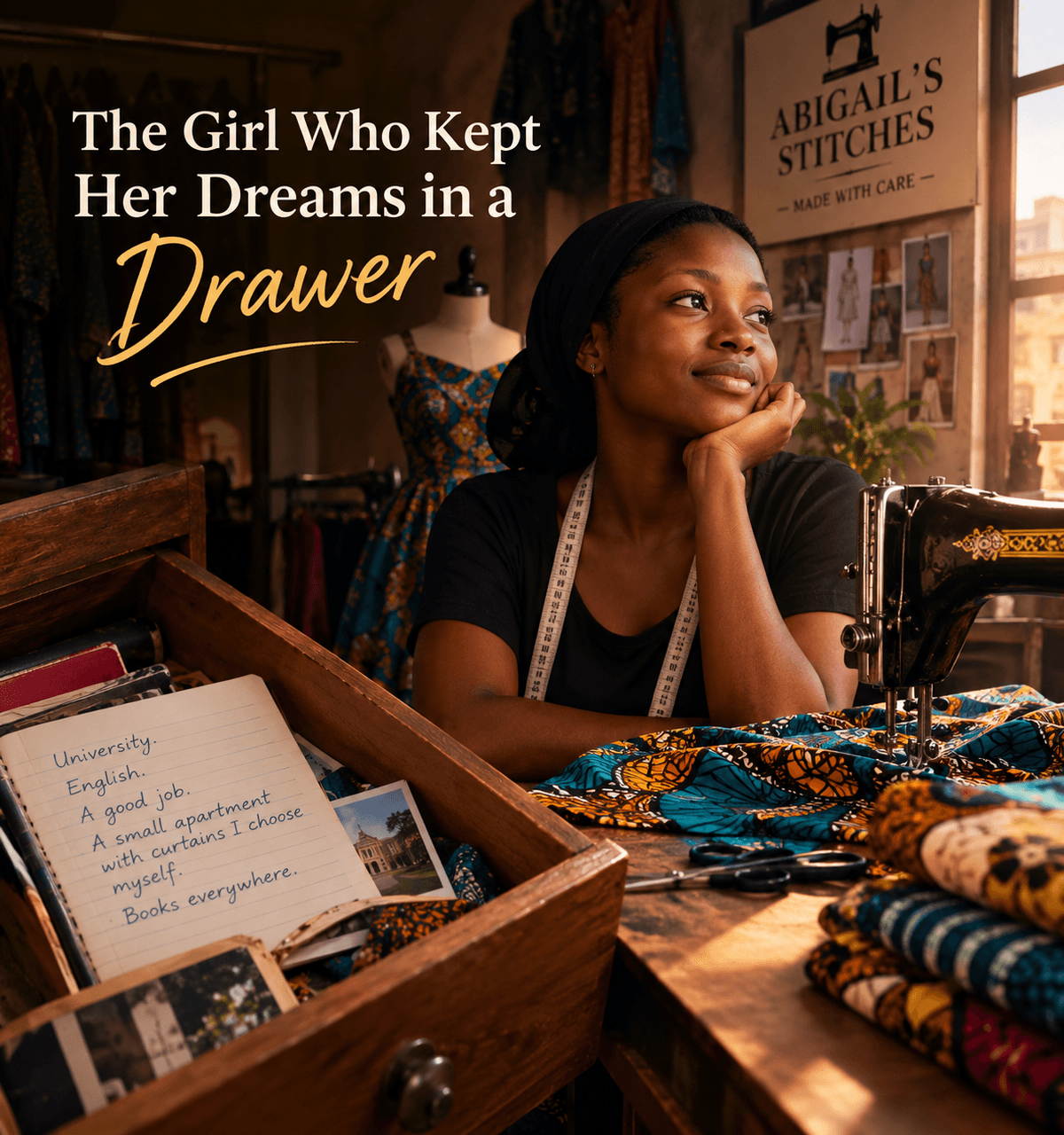
Abigail kept her dreams in the top drawer of her wooden wardrobe.
In an old exercise book, she had written: University. English. A good job. A small apartment with curtains I choose myself. Books everywhere.
At eighteen, she believed the future was waiting for her.
Then the money ran out.
Her father's provisions shop began losing customers, while her mother's food business struggled with rising ingredient prices. Bills piled up. One evening, her father came home early, removed his sandals and sat on the bed.
“We have to think about what we can afford now,” he said.
Abigail understood.
University became something nobody mentioned.
She watched her friends prepare for entrance exams and discuss departments and school fees. She smiled, but inside, something went quiet.
Eventually, Abigail stopped talking about university.
Instead, she joined a small tailoring shop down the street.
At first, she hated it.
The shop was hot and noisy, smelling of fabric dust and machine oil. Needles pricked her fingers. She struggled with the sewing machine and ruined two pieces of fabric.
“Your hands are too stiff,” Mama Efe, the tailor, told her. “Stop fighting the machine. Let it work with you.”
Abigail wanted to cry.
She had imagined carrying textbooks across a university campus. Instead, she was learning to measure a woman's waist.
Some evenings, she returned home exhausted and opened the drawer. Her exercise book was still there. She stared at the words University. English. Then she shut the drawer.
Months passed and gradually, Abigail began seeing possibilities in cloth. She learned to cut neatly, adjust measurements, make dresses and repair worn clothes. She discovered that she loved choosing colours and watching fabric become something beautiful.
One Saturday, a neighbour asked her to sew an Ankara dress. Abigail was terrified.
When the woman returned, she turned before the mirror and smiled.
“You made this?”
Abigail nodded.
“It’s beautiful.”
The woman paid her and recommended her to two friends. Two became five. Five became ten. Ten became twenty.
Soon, Abigail was sewing from a corner of her family home. Her mother's dining table became a cutting table, and her father's old phone became her business phone. She photographed her finished clothes and posted them online. The orders grew steadily again, both within and outside the country.
Years later, Abigail had her own tailoring shop.The sign outside read:
ABIGAIL'S STITCHES — MADE WITH CARE.
One afternoon, she watched two young apprentices struggle with a sewing machine. She laughed softly. Colourful fabrics, finished dresses and customer photographs filled the walls.Her university dream had not disappeared. It had taken a different path.
That evening, Abigail returned home and opened the old drawer. The exercise book was still there, waiting. She read the words she had written at eighteen and smiled. Then she added one sentence:
I became someone I am proud of.
She closed the book—not because the dream was dead, but because she had learned that sometimes a dream must wait while another teaches you how to survive.