 Writers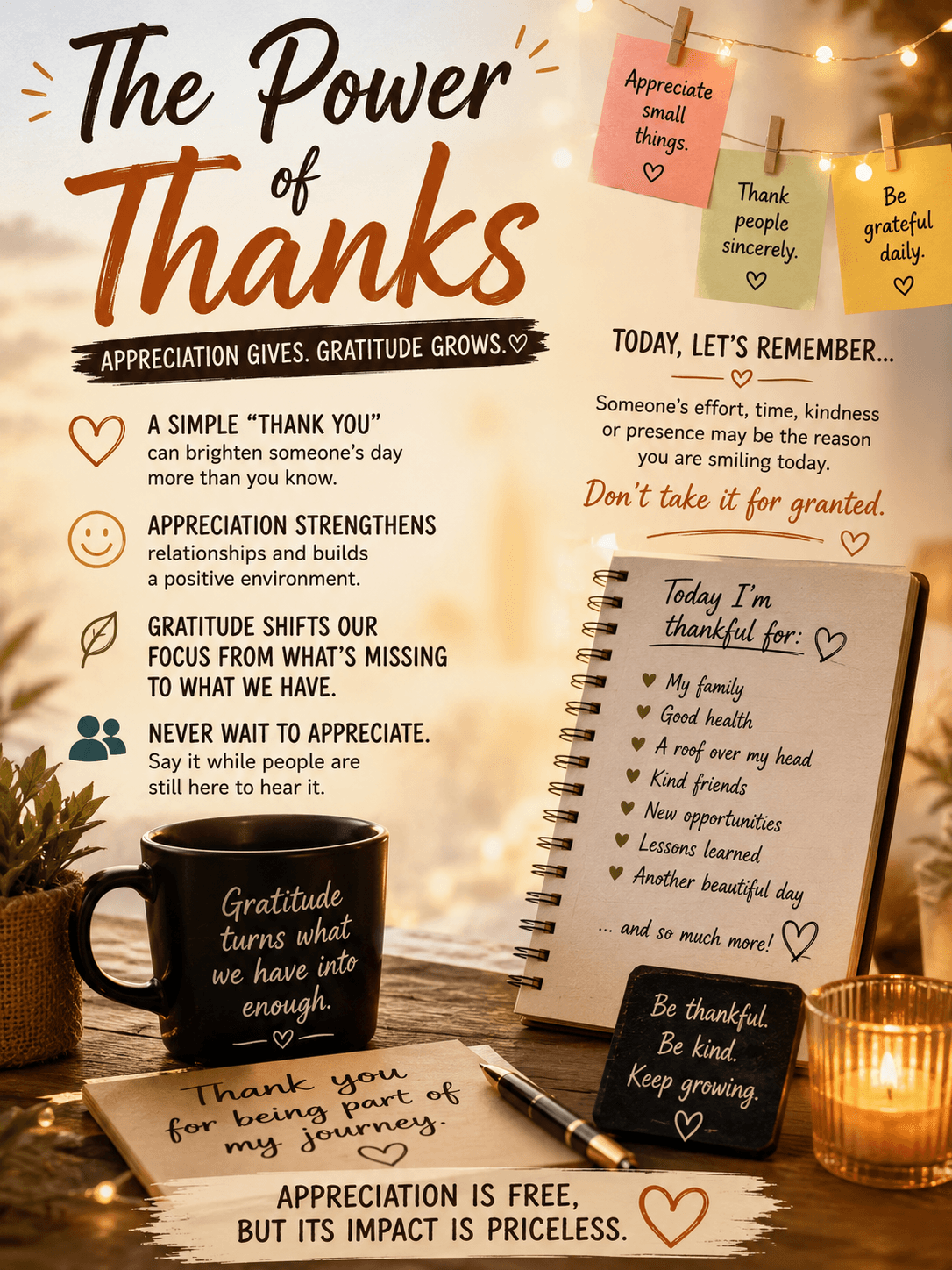
THE POWER OF A SIMPLE “THANK YOU”.
There are some words we say so often that we stop noticing how much they mean.
“Thank you.”
Two ordinary words.
Yet sometimes, hearing them from the right person can change the way you feel about an entire day.
Think about the last time someone genuinely appreciated something you did.
Maybe someone noticed that you had been helping them.
Maybe a friend thanked you for showing up when things were difficult.
Maybe someone simply looked at you and said, “I really appreciate you.”
It feels different when you know they mean it.
And that is what makes appreciation so powerful.
We often notice what people fail to do more quickly than what they actually do.
Someone forgets to call, and we remember it.
Someone doesn't respond to our message, and we notice.
Someone makes a mistake, and we talk about it.
But the person who consistently checks on us, supports us, cooks for us, teaches us, listens to us or quietly makes life easier can become so familiar that we stop acknowledging their effort.
Sometimes familiarity makes us forget gratitude.
We assume they know.
“They already know I appreciate them.”
Maybe they do.
But hearing it still matters.
A mother may know that her child loves her, but hearing “Thank you, Mum” can still mean something.
A teacher may know that their students value them, but being told “You made this easier for me” can stay with them for years.
A friend may know that you care, but receiving a message that says, “Thank you for being there,” can remind them that their effort was not invisible.
Appreciation tells people:
“I noticed.”
And sometimes that is all someone needs to hear.
There is also something interesting about gratitude: it doesn't only affect the person receiving it.
Research has found a consistent relationship between gratitude and psychological well-being, although researchers are careful to note that gratitude is not a magic solution and that the size of its effects can vary. A large 2025 meta-analysis covering 145 studies across 28 countries found small overall improvements in well-being from gratitude interventions
So perhaps gratitude is less about pretending that life is perfect and more about training ourselves to notice what is good while still acknowledging what is difficult.
That distinction matters.
Being grateful doesn't mean you cannot complain about something that genuinely needs to change.
It doesn't mean accepting mistreatment.
It doesn't mean saying, “At least I'm alive,” every time something hurts.
And it certainly doesn't mean ignoring real problems.
You can be disappointed and grateful.
You can be tired and grateful.
You can want more from life and still appreciate what you have now.
Those things can exist together.
Sometimes we think appreciation has to be reserved for big things.
A new job.
A graduation.
A wedding.
A birthday.
A major financial breakthrough.
But life is mostly made up of small things.
A meal waiting for you when you get home.
Someone checking whether you arrived safely.
A friend sending you a message at exactly the moment you needed one.
Someone sharing their notes with you.
A stranger holding a door open.
A sibling helping with something you couldn't handle alone.
A person praying for you without telling you.
A peaceful morning.
A body that allows you to get out of bed and continue your day.
These things can become invisible simply because they happen repeatedly.
Maybe that is why we need to practise noticing.
Not because everything is perfect.
But because not everything is terrible either.
And there is another side to appreciation that I think we sometimes overlook.
Say it while people are still here to hear it.
Don't wait until someone's birthday to tell them they matter.
Don't wait until they leave your life before acknowledging what they contributed.
Don't wait until someone is sick before telling them how much their presence means to you.
Don't make people guess whether their efforts matter.
If someone has helped you, say thank you.
If someone has encouraged you, tell them.
If someone has made your life easier, acknowledge it.
If someone has taught you something valuable, let them know.
Appreciation costs very little, but its absence can sometimes cost relationships much more.
And perhaps we should extend that habit beyond people.
Sometimes, before asking God for the next thing, we can pause and acknowledge what we already have.
Before complaining about the food, remember that you have food.
Before complaining about the journey, remember that you have somewhere to go.
Before worrying about tomorrow, acknowledge that you made it through today.
Gratitude doesn't remove our desire for improvement.
It simply prevents our desire for more from making us blind to what is already present.
Maybe that is the real power of appreciation.
It doesn't necessarily change the situation.
It changes what we notice about the situation.
And sometimes, that is enough to change the way we experience our lives.
So today, think of three people whose efforts you may have taken for granted.
Don't just think about them.
Tell them.
Send the message.
Make the call.
Say the words.
“Thank you.”
“I appreciate you.”
“You made a difference.”
“You may not realise it, but what you did mattered to me.”
You never know how much someone may need to hear those words.
And while you're at it, don't forget to appreciate yourself for the distance you've travelled too.
Not because you have everything figured out.
Not because you have achieved everything you want.
But because you're still learning, still growing and still moving.
Sometimes life becomes richer when we stop asking only,
“What am I still missing?”
and begin asking,
“What do I already have that deserves to be appreciated?”
That question can change a lot.