Writers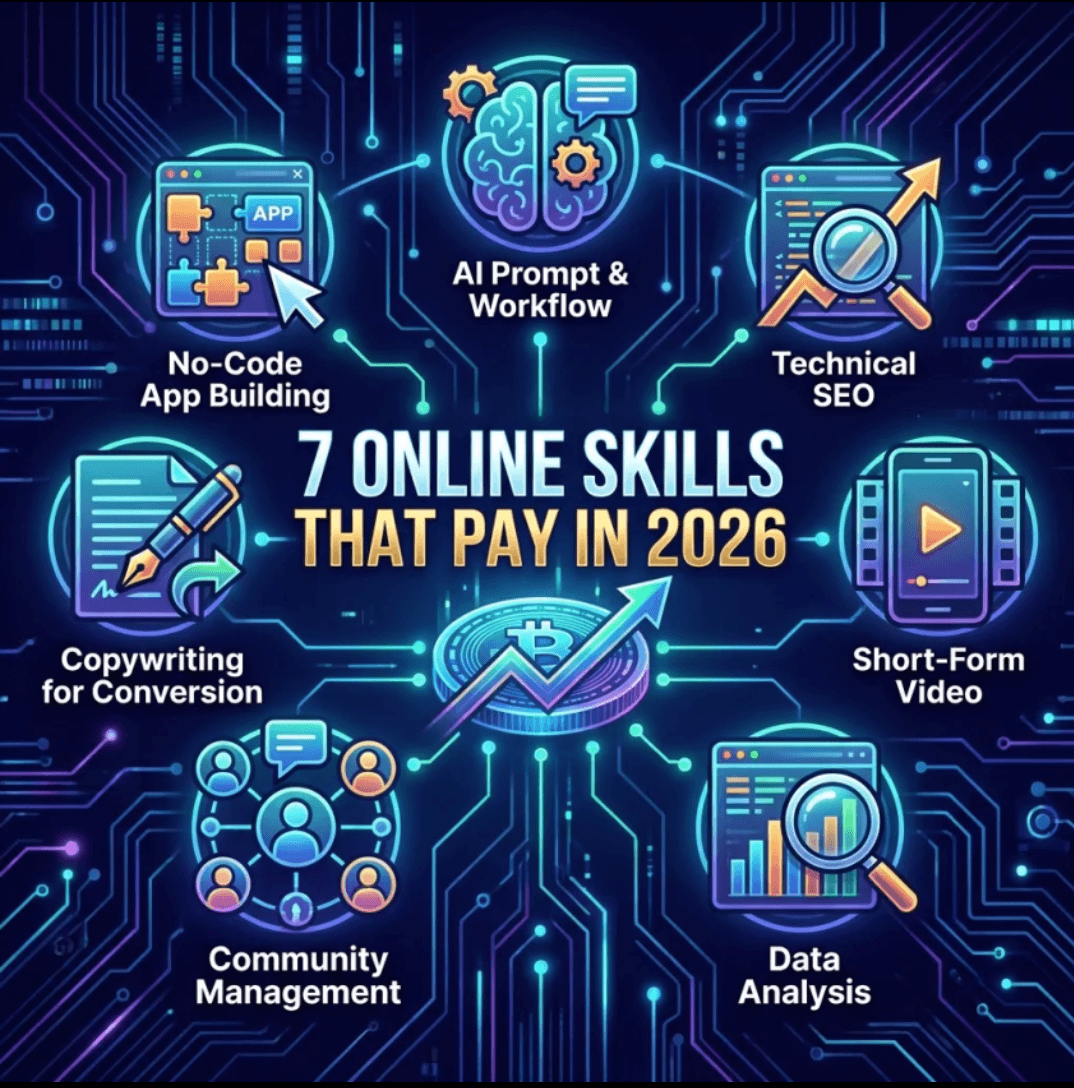
The online job market doesn't reward talent alone anymore it rewards specific, in-demand skills that businesses are actively short on. You don't need a degree or years of experience to start. What you need is a skill that solves a real problem for someone willing to pay for it.
Below are seven skills that are currently paying well online, along with what they actually involve and how people are using them to earn money in 2026.
1. AI PROMPT ENGINEERING AND WORKFLOW DESIGN
As more companies integrate AI tools into daily operations, they need people who know how to get consistent, useful results out of them. This isn't about typing clever questions into a chatbot but it's about designing repeatable workflows: prompt templates, automation chains, and quality checks that make AI tools reliable for business use.
For example, a marketing agency might hire someone to build a system that turns a client brief into five ad variations, checks them against brand guidelines, and formats them for Meta Ads Manager all with minimal manual input. Freelancers offering this kind of workflow design are charging project rates rather than hourly ones, because the value is in the system, not the time spent.
If you're starting out, get hands-on with tools like ChatGPT, Claude, and Zapier or Make (for automation), and build a few sample workflows you can show as a portfolio.
2. TECHNICAL SEO AND CONTENT STRATEGY
Search engines have changed how they rank content, and generic "write 10 blog posts a month" SEO no longer performs the way it used to. What's in demand now is technical SEO; site speed, structured data, crawlability combined with content that's genuinely useful and well-organized.
A small e-commerce store, for instance, might pay someone to audit their site structure, fix indexing issues, and rework product pages so they answer real customer questions instead of just listing specs. This kind of work requires understanding both the technical side (using tools like Screaming Frog or Google Search Console) and the writing side.
People who can do both tend to earn more, because businesses don't want to hire two separate specialists for a task that overlaps.
3. SHORT FORM EDITING
Short-form video isn't slowing down, and most creators and small businesses don't have time to edit their own clips. Video editors who can turn raw footage into tight, well-paced content for TikTok, Instagram Reels, or YouTube Shorts are in steady demand.
This isn't just about cutting clips together. Editors who understand pacing, captions, hooks in the first three seconds, and platform-specific formatting get repeat clients. A local business owner might pay a freelance editor a monthly retainer to turn weekly raw footage into five to ten short videos.
Tools like CapCut, Adobe Premiere pro, or DaVinci Resolve are common starting points, and many editors build their first clients by offering to edit a sample video for free or at a low rate.
4. DATA ANALYSIS FOR SMALL BUSINESSES
Big companies have data teams. Small businesses usually don't; but they still generate data through sales platforms, ad accounts, and customer lists, and they often don't know what to do with it.
Someone who can pull data from tools like Shopify, Google Analytics, or a CRM, and turn it into a simple, readable report like "here's where you're losing customers" or "this product category is your best margin" provides real, immediate value. You don't need a data science background for this. Comfort with spreadsheets, basic SQL, and a tool like Google Data Studio (now Looker Studio) can be enough to start.
5. COMMUNITY MANAGEMENT
As more brands rely on niche online communities — Discord servers, Slack groups, private forums — someone needs to actually run them. Community managers keep conversations active, moderate content, welcome new members, and often act as the bridge between a brand and its most engaged customers.
This role pays because it takes real time and consistency, not because it's flashy. A course creator or software company might hire a part-time community manager to handle their Discord server: answering questions, organizing events, and flagging recurring complaints to the product team.
If you're active in online communities already and understand how to keep a group engaged without it feeling forced, this is a skill you may already be halfway to having.
6. COPYWRITING FOR CONVERSION
General content writing is common, but copywriting that's built to convert is a narrower and better-paid skill. The difference is that conversion copywriting is judged by results: does the email get opened, does the page lead to a sale.
For example, a SaaS company launching a new feature might hire a copywriter specifically to write the email sequence announcing it, because a well-structured sequence can noticeably affect signups. This kind of work usually pays more than general blog writing, partly because the output is easier to measure.
Learning copywriting fundamentals — audience research, clear structure, a strong call to action — and studying real campaigns (not just theory) is the fastest way to get good at this.
7. NO CODE APP AND AUTOMATION BUILDING
Not everyone who needs a simple app or internal tool wants to hire a software developer. No-code platforms like Bubble, Airtable, and Glide let people build functional apps, internal dashboards, and automated workflows without writing traditional code.
Someone who's fluent in these tools can, for example, build a small business a customer booking system, or set up an automation that moves new leads from a website form directly into a CRM and sends a follow-up email. This kind of work sits between "developer" and "consultant," and it's paid accordingly — often as a project fee rather than an hourly rate.
None of these skills require starting from scratch with a formal course. The more practical path is usually: pick one skill, build two or three small sample projects (even for free, for a friend's business or your own), and use those as proof when you start looking for paid work.
The skills on this list share one thing in common; they solve a specific, visible problem for a business. That's ultimately what determines whether a skill pays: not how trendy it sounds, but whether someone is willing to pay to have that problem solved.