 Writers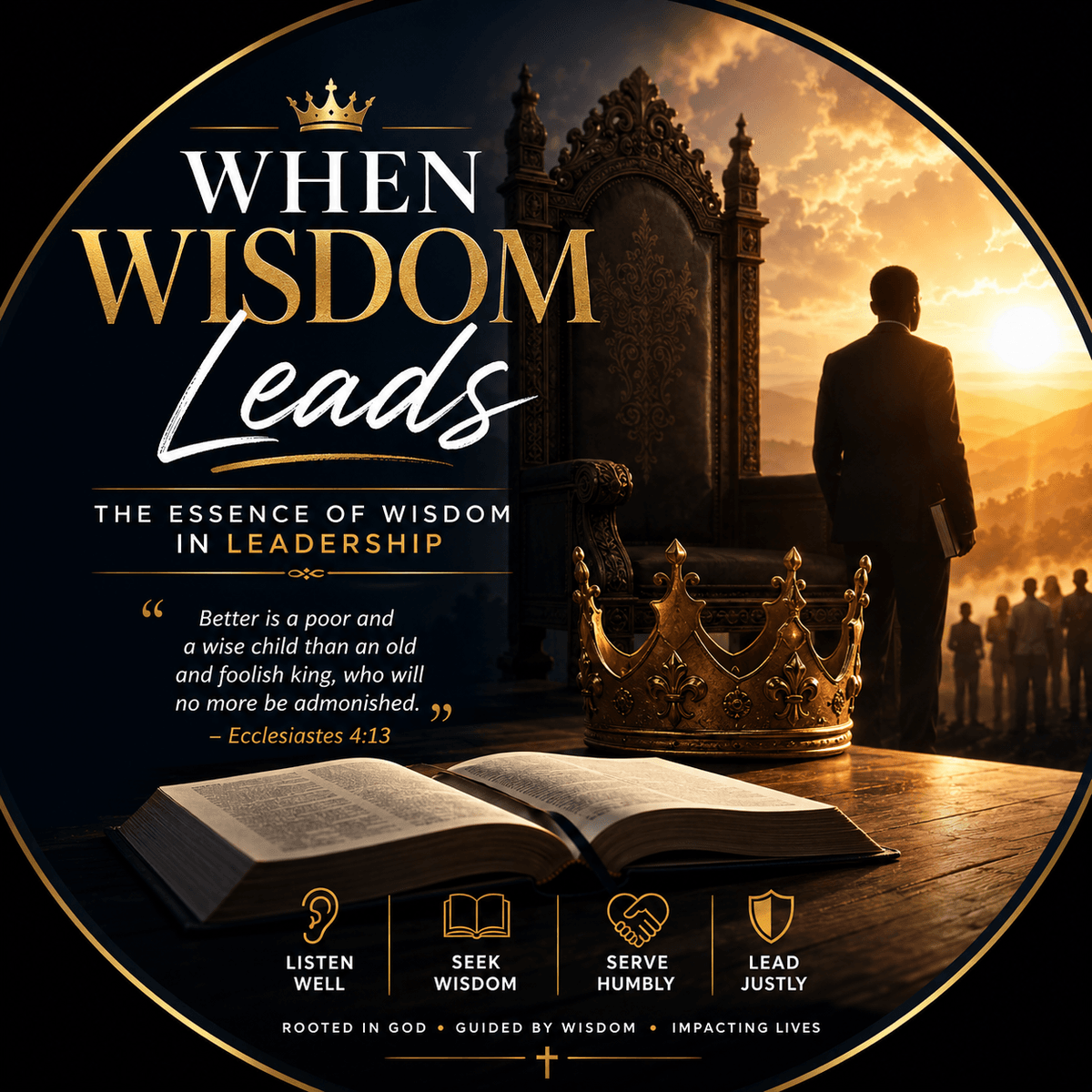
“Better is a poor and a wise child than an old and foolish king, who will no more be admonished.” Ecclesiastes 4:13 (KJV)
Leadership is one of the most significant responsibilities a person can be entrusted with. Whether it is leadership in a family, church, organisation, business, community, or nation, the decisions of a leader rarely affect the leader alone. Behind every decision are people whose lives may be encouraged, redirected, protected, or even wounded by the way authority is exercised.
Unfortunately, leadership is often measured by position rather than character. We are easily impressed by titles, wealth, age, education, influence, and public recognition. We sometimes assume that the person occupying the highest position must automatically be the wisest person in the room. Scripture, however, challenges that assumption.
Ecclesiastes 4:13 presents a striking comparison between a poor but wise child and an old but foolish king. The child has little to boast about in terms of social status, wealth, or experience. The king, on the other hand, possesses authority, recognition, and years of experience. Yet Scripture declares the wise child to be better.
Why?
Because position without wisdom can become dangerous, while wisdom can give value to a person who appears insignificant in the eyes of society.
The problem with the king in this passage was not simply that he was old. His greatest problem was that he had become unwilling to listen to correction. He had reached a stage where his position had apparently become more important to him than the wisdom he needed to exercise that position properly.
That is a dangerous place for any leader to reach.
A leader who cannot receive correction eventually becomes vulnerable to his own mistakes. When someone begins to believe that being in authority means being incapable of being wrong, the door to pride has already begun to open.
Leadership requires humility because no leader knows everything.
There will always be situations we have never encountered, perspectives we have never considered, and people who may see something we have failed to notice. A wise leader does not interpret every correction as disrespect. Instead, he understands that correction can become a pathway to improvement.
Proverbs 12:15 says:
“The way of a fool is right in his own eyes: but he that hearkeneth unto counsel is wise.”
There is a significant difference between confidence and stubbornness. A confident leader can make decisions and stand by his convictions, but a wise leader remains humble enough to reconsider when presented with genuine counsel.
Sometimes wisdom is not demonstrated by how much a leader speaks, but by how carefully he listens.
This principle applies to every form of leadership. A father can lead his household and still listen to his wife and children. A pastor can shepherd a congregation and remain open to the counsel of mature believers. A business owner can direct an organisation while recognising that an employee may have an idea he has overlooked. A community leader can possess authority without assuming that every solution must come from him.
Wisdom does not always come from the person with the highest title.
That is one of the powerful lessons contained in Ecclesiastes 4:13. The wise child may not possess the throne, but he possesses something the king desperately needs: the willingness to learn.
Growing older does not automatically make a person wiser. Likewise, occupying a leadership position for many years does not necessarily make someone a better leader. Experience can become a great teacher, but only when a person is humble enough to learn from it.
Some people accumulate years without accumulating wisdom. They repeat the same mistakes, reject every attempt to correct them, blame others whenever things go wrong, and interpret honest disagreement as rebellion. Eventually, such leadership becomes isolated because people no longer feel safe enough to tell the truth.
This is why wise leaders must deliberately create an environment where honest counsel is welcomed.
A leader who surrounds himself with people who constantly praise him may feel powerful, but he may actually be becoming weaker. If everyone around a leader is afraid to tell him the truth, he may eventually become the last person to discover what is really happening around him.
Scripture places great value on wise counsel. Proverbs 15:22 says:
“Without counsel purposes are disappointed: but in the multitude of counsellors they are established.”
There is strength in listening.
There is maturity in asking questions.
There is humility in admitting, “I may have missed something.”
And there is wisdom in learning from people whose experiences and perspectives differ from ours.
True leadership, therefore, is not simply about having people who follow us. It is also about becoming the kind of person who deserves to be followed.
A leader's character will eventually speak louder than his title.
People may obey someone because of his authority, but they willingly follow someone they trust. Authority can compel obedience, but character inspires confidence. A position may give someone influence, but only integrity can sustain that influence for the long term.
This is why wisdom is essential in leadership.
Wisdom teaches a leader that people are not merely instruments for achieving personal ambitions. They are human beings with hopes, fears, families, struggles, abilities, weaknesses, and dreams. Every decision made by a leader can have consequences beyond the walls of the office in which that decision was made.
The higher the position, the greater the responsibility.
Leadership is therefore not merely a privilege; it is stewardship.
Jesus demonstrated this principle perfectly. Although He possessed unmatched authority, He did not use His position to oppress those He came to lead. Instead, He served them. Mark 10:45 says:
“For even the Son of man came not to be ministered unto, but to minister, and to give his life a ransom for many.”
Christ shows us that genuine leadership is not primarily about being served; it is about serving. It is not about protecting one's ego but about accepting responsibility. It is not about demanding loyalty while refusing accountability.
A wise leader understands that authority is temporary, but the impact of leadership can last for generations.
Therefore, the question every leader should regularly ask is not merely, “How many people are following me?” but “What kind of people are becoming because of my leadership?”
Am I making people stronger or weaker?
Am I creating room for growth or encouraging dependence?
Do people feel safe enough to tell me the truth?
Can I accept correction without becoming defensive?
Does my leadership reflect humility, justice, integrity, and compassion?
Most importantly, am I allowing God to shape the wisdom with which I lead?
Proverbs 9:10 reminds us:
“The fear of the LORD is the beginning of wisdom: and the knowledge of the holy is understanding.”
Biblical wisdom is more than intelligence. It is the ability to apply knowledge in a way that honours God and benefits people. A person can be highly educated and still make destructive decisions. Someone can be extremely talented and yet lack the character necessary to handle influence responsibly.
Wisdom brings knowledge under the government of character.
May we therefore never become so comfortable in our positions that we stop learning. May we never become so celebrated that we become unreachable. May we never become so experienced that we believe we have nothing left to learn.
Whether we lead a family, a church, a business, a ministry, an organisation, or simply influence a few people around us, may we remember that leadership is a trust.
A title may give us a position, but wisdom teaches us how to use it.
The world does not merely need more leaders. It needs leaders who can listen, leaders who can learn, leaders who can accept correction, leaders who can serve, and leaders who understand that authority without character can become destructive.
May God give us the wisdom to lead without pride, the humility to receive correction, the courage to make difficult but righteous decisions, and the heart to serve the people entrusted to us.
For ultimately, the greatest evidence of successful leadership is not how high a person rises, but how many lives become better because that person was given the opportunity to lead.
And perhaps this is the challenge Ecclesiastes 4:13 places before every one of us: before we ask God for a greater platform, let us ask Him for greater wisdom; before we seek greater authority, let us seek greater character; and before we demand that people follow us, let us become people worth following.