Writers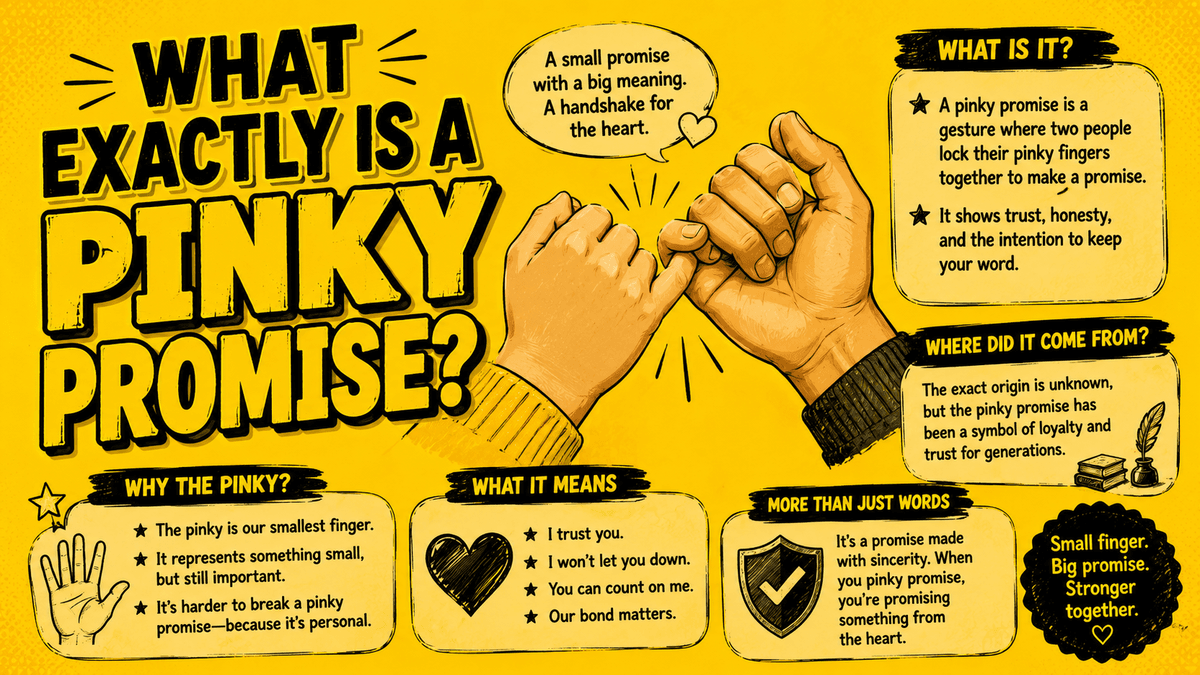
Everyone probably did it as a child.
We would hooked our little finger around someone else's and say: "Pinky promise?"
And somehow, those two tiny fingers made a promise feel more serious than simply saying, "I promise."
But have we ever wondered why the pinky finger?
Why not shake hands? Cross your fingers? Touch your thumbs?
And how did something that looks like a silly childhood game become a symbol of trust used around the world?
One thing to know is that it wasn't invented by children. One popular explanation traces the tradition to Japan, where the practice is known as yubikiri, meaning roughly "finger cut-off."
Not to worry, people don't actually cut off their fingers.
The expression comes from an old idea that two people could seal a serious promise by linking fingers, with the imagery suggesting that breaking the promise carried a severe consequence.
Over time, the tradition became associated with children and friendship rather than anything genuinely violent, and that's how the little finger became connected with keeping your word.
In Japanese culture, yubikiri has historically been associated with promises between people, particularly romantic promises. The idea was simple:
You give your word - and you are expected to keep it.
The tradition became so deeply embedded in popular culture that the phrase "yubikiri genman" is sometimes accompanied by a rhyme threatening a punishment of 10,000 needles for breaking the promise.
That's quite a dramatic consequence for something that looks like two children simply hooking fingers. But there's a reason promises have always been treated seriously.
Trust is fragile.
So why the pinky finger? Some theories suggest that because the pinky is the smallest and weakest finger, offering it represents vulnerability and trust.
You're essentially saying: "I'm trusting you with something important."
Another possibility is that the gesture became popular simply because children found it easy and memorable. Two people can hook their pinkies together without needing anything else.
No handshake or any written contract.
Just two fingers.
The pinky promise became particularly recognizable in American popular culture during the 20th century. Children began using it to seal secrets, friendships, agreements and personal promises.
"Don't tell anyone."
"I won't."
"Pinky promise?"
And with that, the conversation was official.
The gesture became especially powerful among children because it transformed an ordinary verbal promise into something physical. You could actually see the promise being made.
There's something psychological about it too. Think about how different these two statements feel:
"I promise." versus: "Pinky promise."
The second one feels more personal because you're adding a physical action to the words.
Humans have used physical gestures to reinforce agreements for thousands of years. Handshakes, raised hands, exchanged objects and other rituals all serve a similar purpose.
The pinky promise is basically a tiny ritual of trust, and because many people - especially learn it during childhood, the gesture can carry emotional meaning long after they grow up.
But here's the funny thing, breaking it feels different. If someone breaks a normal promise, you might be disappointed.
But if someone breaks a pinky promise, it can feel strangely personal.
Why? Because the gesture makes the promise feel almost sacred.
You didn't just say something. You physically participated in an agreement.
That's why children sometimes treat pinky promises as almost unbreakable.
And you've probably heard some version of:
"Break a pinky promise and you'll suffer terrible consequences."
There is no supernatural evidence that breaking one causes anything. The frightening Japanese rhyme associated with yubikiri is part of the cultural tradition, not proof of an actual curse.
Still, the symbolism is interesting.bThe threat exists because it reinforces the seriousness of keeping your word.
In other words, the "curse" is less about magic and more about teaching a lesson: Don't make promises you don't intend to keep.
Now, you don't have to be Japanese, American, or even a child to understand what a pinky promise means. Two people hook their little fingers together, and the message is almost instantly understood.
It's honestly amazing that such a tiny gesture can communicate something as enormous as trust. And perhaps that's why the tradition has survived.
A handshake can seal a business deal.
A signature can seal a contract.
But when two people quietly hook their pinkies together...sometimes, it means something even more personal.
So the next time someone asks you for a pinky promise, don't laugh too quickly because a promise means something only when you're willing to keep it.