Writers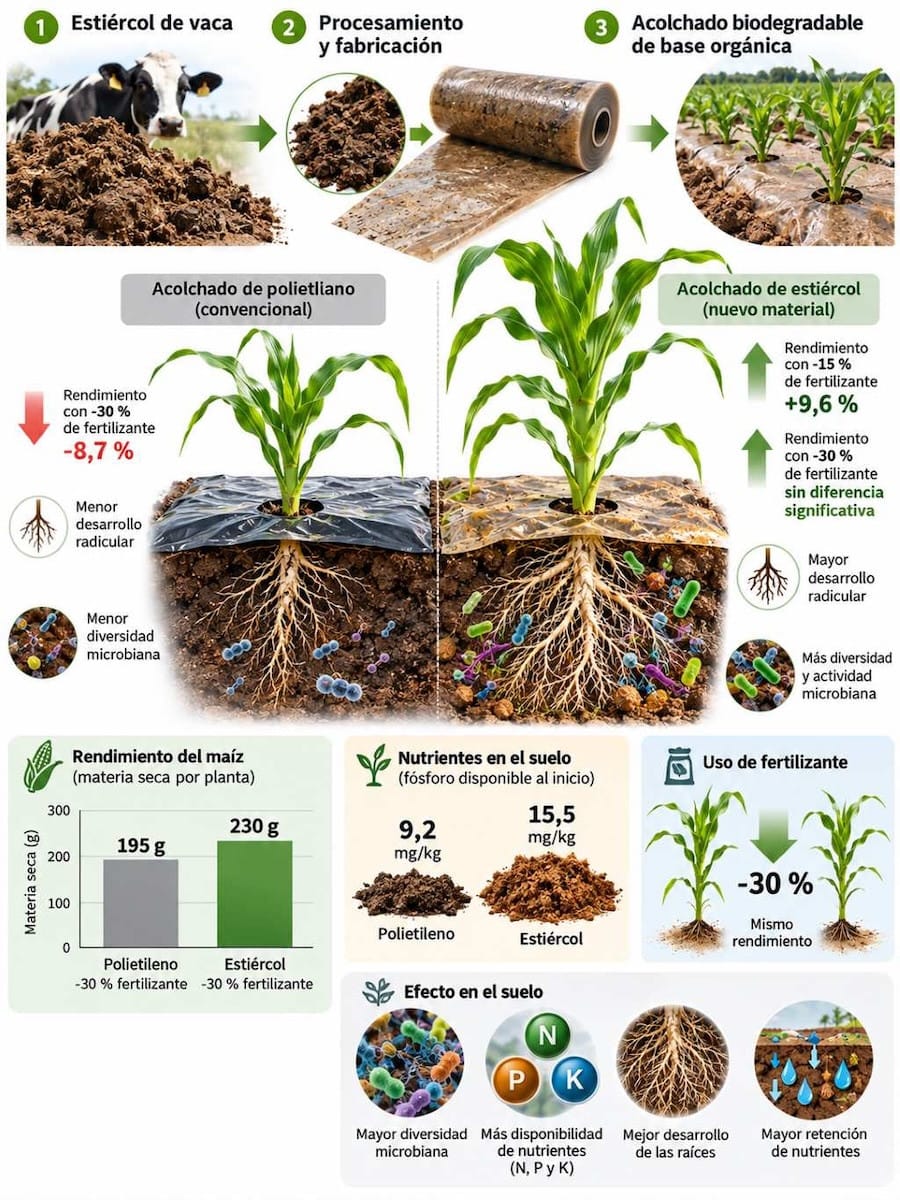
Contemporary agricultural practice simultaneously entails numerous environmental drawbacks: plastic waste from farming, wasted fertilizer, and waste from livestock. Researchers at China Agricultural University have proposed a compelling solution that addresses all of these issues simultaneously: a biodegradable film produced from cow manure.
What chiefly distinguishes this material from conventional agricultural film manufactured from polyethylene is its intended capacity to biodegrade gradually through interaction with the soil.
Advantages Associated with the Manure Film
Upon becoming moist, the film begins to biodegrade, releasing nitrogen, phosphorus, and potassium.
This process additionally contributes to soil fertilization, since certain microorganisms that consume the film are themselves capable of enriching the soil.
Consequently, agricultural film produced from manure could serve simultaneously as a fertilizer and as a substitute for mulch, ultimately integrating into the surrounding ecosystem.
Evaluating the Technology under Field Conditions
The researchers conducted field trials of the technology using forage maize.
In their report, they indicate that they managed to sustain crop yields at levels comparable to those achieved with polyethylene film, while cutting fertilizer application by 30%. In a separate trial, they observed that yields rose when fertilizer was reduced by 15 percent.
This implies that employing manure-based film would enable farmers to reduce expenditures on fertilizers while simultaneously mitigating the environmental consequences associated with polyethylene mulch films.
A Significant Environmental Drawback
Nevertheless, this technology is not entirely environmentally benign.
Producing the film consumes considerable quantities of energy and water; a life-cycle analysis determined that its impact surpassed that of conventional polyethylene film.
Consequently, the researchers face a considerable challenge in ensuring that manufacturing methods improve and require less energy and water.
A Valuable Technology, Provided It Can Be Optimized
Over the long term, this type of technology holds considerable value. Should the researchers succeed in optimizing the production process, it could assist in eliminating both agricultural plastic waste and manure waste, while additionally lessening the demand for fertilizer. Addressing all three problems simultaneously would, in fact, constitute a success, and the very possibility of manufacturing the technology renders it a worthwhile avenue of inquiry.
Concurrently, the researchers must undertake additional investigation before this technology is able to achieve genuine commercialization. They must devise a means of rendering the process less demanding in terms of both energy and water. They must also conduct further field trials in order to assess how this technology performs relative to alternative agricultural practices at a larger scale and with other crops.
Other agricultural technologies based on manure have been created, with Chile in particular developing comparable products, and these are nearer to reaching commercialization.
The Broader Context of This Research
This research constitutes a compelling illustration of agricultural waste being transformed into agricultural output. Perhaps the most significant element of the research is not the agricultural plastic film as such, but rather the precedent it establishes that waste generated by one process may be repurposed within another. While the research must be continued, the technology offers a compelling glimpse into the future of contemporary agriculture.
Sources:
urlEurekAlert — China Agricultural University research reporthttps://www.eurekalert.org/news-releases/1145384