 Writers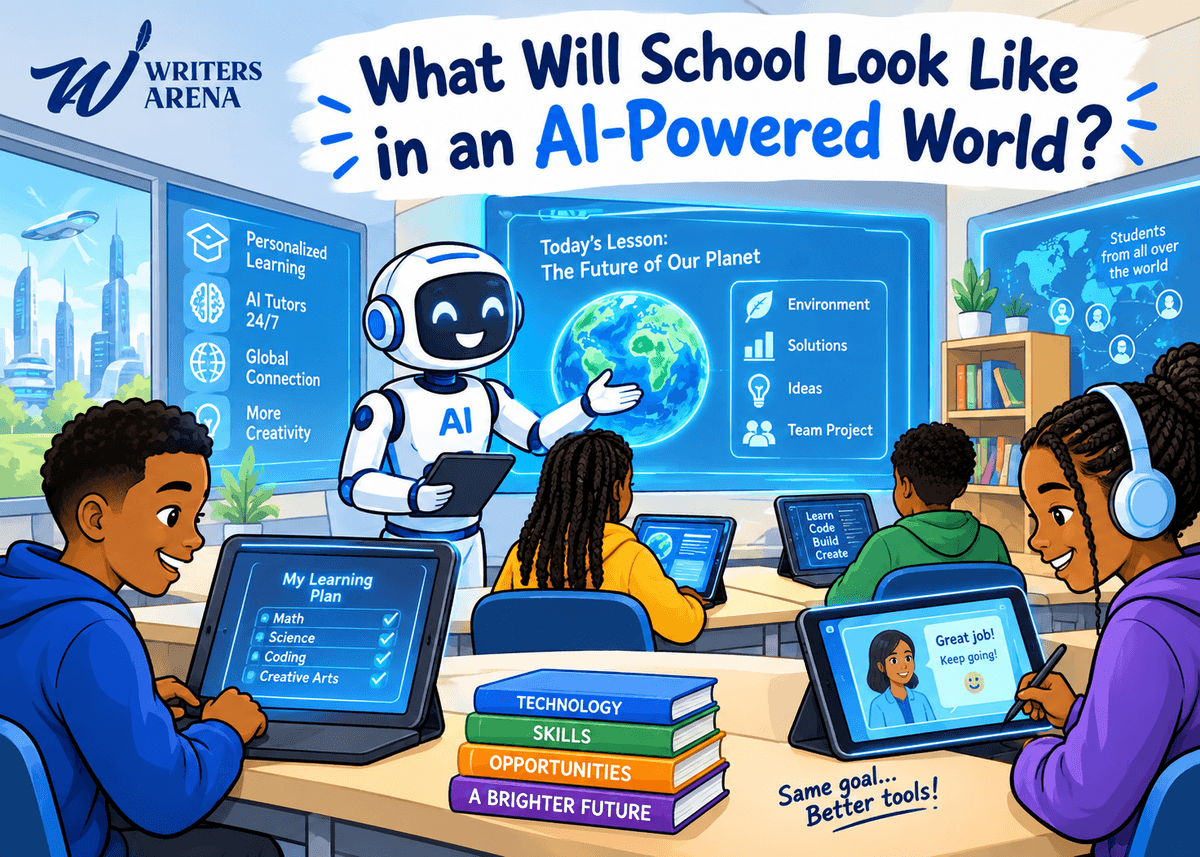
Imagine walking into a classroom where students are not only learning from teachers and textbooks, but also using intelligent computer systems that can answer questions, explain difficult topics, and help them practise what they have learned. This may sound like something from a science-fiction movie, but artificial intelligence, also called AI, is already changing education. In the future, schools may look very different from the schools we know today.
One major change will be the way students learn. Today, many students in a classroom are taught the same lesson at the same time. However, AI can help create learning that matches each student's needs. If a student finds mathematics difficult, an AI learning system could give the student simpler explanations and more practice. If another student understands the topic quickly, the system could provide harder questions. This could help students learn at their own pace without feeling left behind.
Teachers will also have new tools to help them. AI could help teachers prepare lessons, create practice questions, organise learning materials, and check some types of schoolwork. This would give teachers more time to focus on what machines cannot easily replace, such as encouraging students, understanding their feelings, solving classroom problems, and building good relationships with them.
The classroom itself may also become more digital. Students could use computers, tablets, smart boards, and other learning tools during lessons. Instead of carrying many heavy books, students might have most of their learning materials on one device. They could search for information quickly and use educational programmes to understand difficult subjects.
Virtual reality could also make lessons more interesting. For example, during a history lesson, students might take a virtual tour of an ancient city without leaving their classroom. In science, they could explore parts of the human body or travel through space using digital technology. This could make learning more practical and exciting.
AI may also change homework. Instead of simply giving students many questions to answer, teachers may use AI systems to give students activities based on what they need to improve. A student who struggles with grammar could receive extra language exercises, while a student who needs help with algebra could practise more mathematical problems.
However, an AI-powered school will not mean that teachers become useless. In fact, teachers may become even more important. AI can provide information, but it does not understand every student's life, emotions, dreams, or personal challenges in the same way a human teacher can. Students will still need teachers to guide them and teach them important values such as honesty, kindness, discipline, teamwork, and responsibility.
There will also be challenges. Students may become too dependent on AI and stop thinking for themselves. Some students may use AI to complete their assignments without understanding the work. This could make them perform poorly when they have to work alone. Schools will therefore need to teach students how to use AI responsibly.
Students must learn that AI is a tool, not a replacement for their own brains. They should use it to understand difficult ideas, practise skills, and discover new information, while still doing their own thinking and checking important facts.
Another important issue will be access to technology. Not every school or student may have good internet, computers, or other digital devices. If this problem is not addressed, the gap between students with technology and those without it could become wider. Governments and schools will need to work together to make sure that more students can benefit from modern learning tools.
Privacy will also become important. AI learning systems may collect information about students and their learning progress. Schools will need to protect this information and make sure it is used safely and responsibly.
Most importantly, education in an AI-powered world will focus not only on memorising information but also on using knowledge wisely. Creativity, communication, problem-solving, teamwork, and critical thinking will become very important skills. These are skills that can help students succeed even when technology continues to change.
The school of the future may have smarter classrooms, personalised learning, digital textbooks, virtual experiences, and powerful AI tools. Students may learn faster and have access to information that was once difficult to find. Yet the main purpose of education will remain the same: to help young people gain knowledge, develop good character, and prepare for life.
The future of school may not be a place where humans learn from machines. It may be a place where humans learn with machines. AI can make education more powerful, but it cannot replace the value of human teachers, human creativity, and human understanding. The best schools of the future will be those that combine the power of technology with the wisdom of people.