Writers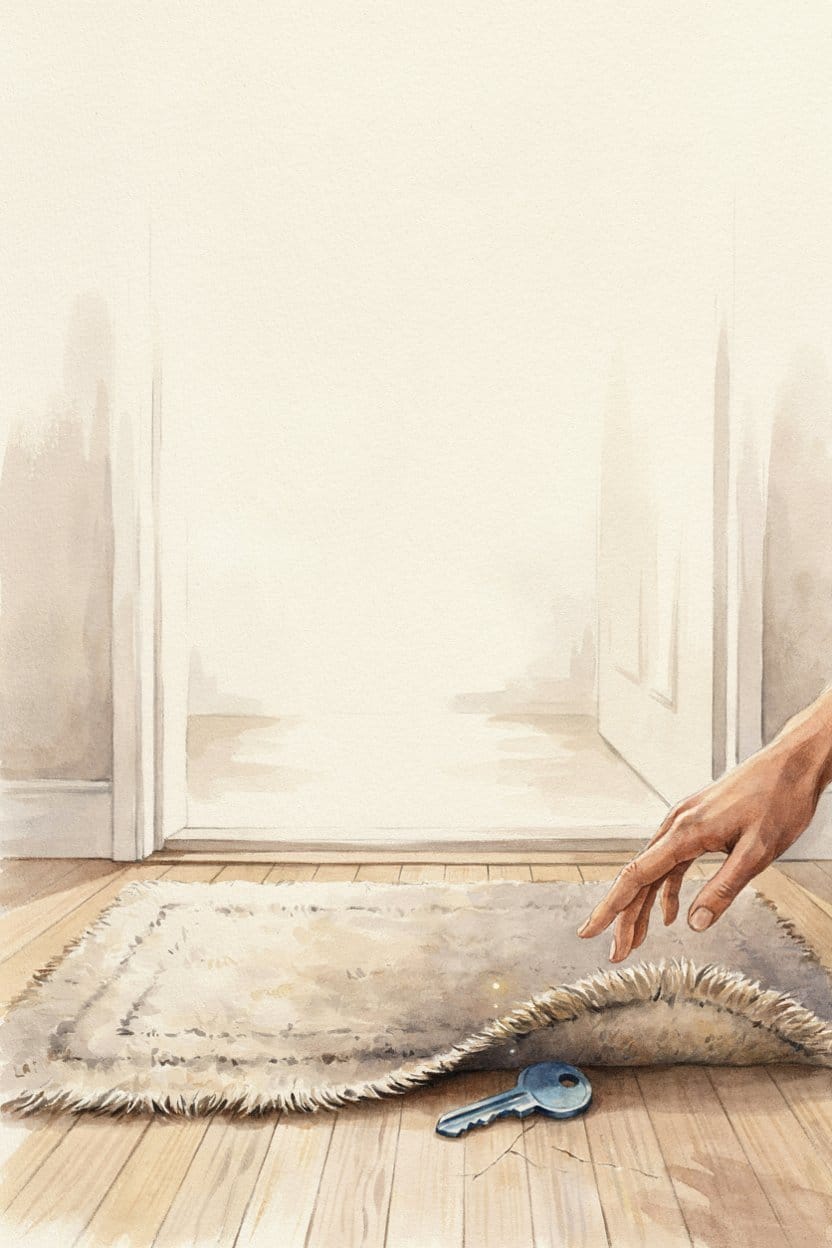
THE KEY UNDER THE MAT
Under the Mat, Mama concealed a key beneath the mat.
Not the mat for the doorway, the one inside, near the rack for shoes. Blue plastic, cracked at the edge, with a number 7 written in permanent marker.
When I first found it when I was nine, she said, "We don't talk about the key." "It's for emergency situations." "What kind of situation is this?" "The kind where you have to leave but are unable to use the front door." As if I had understood, I nodded. I did not.
The key sat there for years. We moved twice. After the boxes, Mama always put the mat down and slipped the key under it first. like setting up a flag.
The emergencies began to make sense once I turned seventeen. Dad’s voice got loud on Friday nights. After that, Saturday mornings. After that, a few Wednesdays. the crackling of glass. The sound of Mama in the bathroom with the fan on, the sound of me wearing headphones and acting like I was sleeping.
One night after that, Mama whispered to me, "Use the back stairs if you need to." "The key opens the downstairs storage room. A blanket is available. And snacks. And my phone charger.”
That key bothered me. I detested that we required it. I hated that “emergency” had an address now.
November marked the last night. On the windows, rain. Dad came home early. Words that started small and grew teeth. Mama looked at me across the kitchen table and did the thing she always did: a tiny nod toward the door.
I was against going. I desired to remain, grow, and fix it.
However, it failed that night. So, quietly, I put on my shoes. Took my backpack, shook the mat. The key was very cold. The scent of old paint and laundry soap filled the storage room. On the blanket, I sat. I had my phone charged. I texted Aunt Lola: code 7. That was the plan.
She came in twenty minutes with an umbrella and no questions. Just: “You okay?”
“Yeah.”
"Are you sure?" “No. But I’m here.”
We didn’t go back that night. or the following We first stayed with Aunt Lola for two weeks. Dad called. Mama did not respond. A different way of quieting the house occurred. When we finally went to get our belongings months later, half of the house was empty. Dad had left. The neighbors said he took two suitcases and the TV.
As if she were looking for ghosts, Mama walked through each room. She opened closets. She ran her hand over the counter. In the kitchen, she stopped and looked at the floor. She said, "The mat." It was still there, by the shoe rack. I moved it. The key was still underneath. Number 7. Cracked, but still present. I expected her to throw it away. Instead she picked it up, turned it over in her hand, and put it in her pocket.
"Why do you want to keep it?" I asked in the car.
She stated, "Because it did its job." “It got us out.”
After that, we didn't talk much about Dad. We discussed additional topics. Groceries. School. Until we moved the plant we bought from Mama to the window, it kept dying. We had our own apartment a year later. Smaller. Brighter. Mama put a new mat by the door the first night. There is no key within. "Do you feel secure?" I demanded. “I feel like we’re building it,” she said.
I began college. I got a part-time job. Mama would sometimes be asleep on the couch with a book on her chest when I got home late. I would shut off the lights and wrap her in a blanket. One day I found the key again. It was in the junk drawer, next to batteries and rubber bands. I gripped it. Number seven I thought about throwing it out. About what it meant to carry an emergency in a drawer.
I told Mama that night. "I discovered the key," She looked up from her tea. "What are you planning to do with it?" "I'm not sure." “Well, what did it teach you?”
I gave it some thought. “That we can leave, that rescue doesn't have to wait for us, that we can devise a strategy." She stated, "Then it's not just a key." "It serves as a reminder." Therefore, we did not discard it. We attached it to a string and drilled a small hole in it.
Mama hung it on the inside of the closet door. To avoid using to keep in mind, Some nights I still wake up at 2am and listen. to the silence. To the fridge humming. To nothing breaking.
And I think about that girl with the cold key in her hand, and how far she had to walk to learn that safety isn’t a place you find. It’s a thing you build, one decision at a time.
The key remains in place. Cracked. Number 7.
We no longer require it. But we keep it.
Because sometimes the bravest thing you do is know where the exit is, and decide to remain only when it’s safe.