 Writers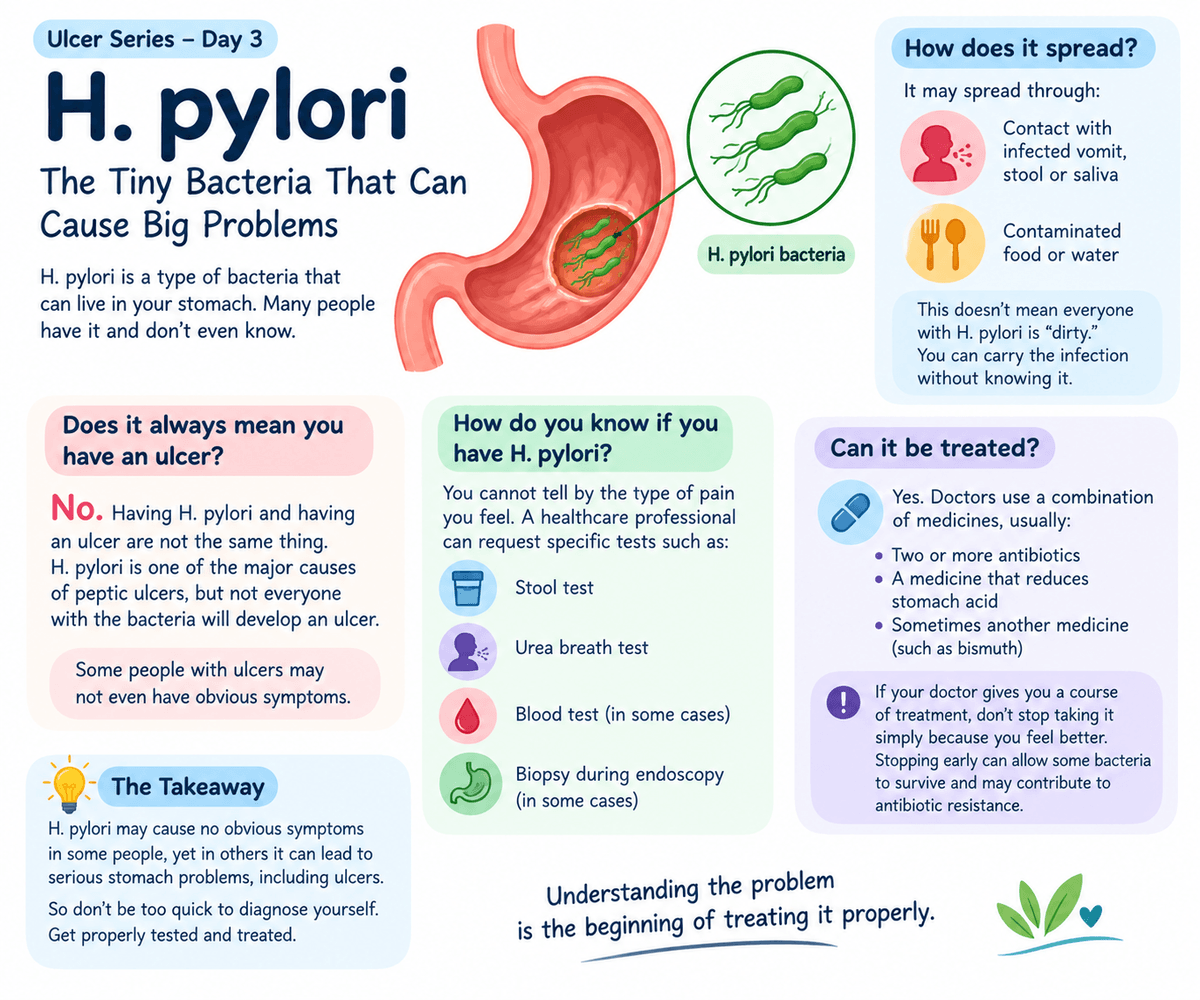
ULCER SERIES — DAY 3
H. Pylori: The Tiny Bacteria That Can Cause Big Problems
Yesterday, we talked about what can cause an ulcer.
We mentioned two major causes: H. pylori infection and certain painkillers.
But when I first heard the name H. pylori, I remember thinking, “What kind of thing is that?”
It sounds complicated, but the basic idea is actually quite simple.
Meet H. pylori
Helicobacter pylori, commonly called H. pylori, is a type of bacteria that can live in the stomach.
Yes, bacteria.
And this one is different from the bacteria we usually imagine causing an obvious infection. A person can have H. pylori and not even know it because many infected people don't have noticeable symptoms. However, in some people, the infection can damage the protective lining of the stomach and contribute to the development of an ulcer.
This is one reason why ulcer isn't something we should diagnose ourselves simply because our stomach hurts.
How does someone get H. pylori?
This is where things are still being studied.
Researchers have not completely established every detail of how people acquire H. pylori. However, the bacteria may spread through contact with infected vomit, stool or saliva, and contaminated food or water may also play a role.
This doesn't mean that every person with H. pylori is “dirty.”
That is an important point.
An infection is not automatically a reflection of someone's personal hygiene. People can carry infections without knowing they have them.
So instead of embarrassing someone who has been diagnosed with H. pylori, the better response is to encourage proper medical care.
But does having H. pylori mean you have an ulcer?
No.
Having H. pylori and having an ulcer are not exactly the same thing.
H. pylori is one of the major causes of peptic ulcers, but not everyone who has the bacteria will develop an ulcer.
And remember what we discussed on Day 1: some people with ulcers may not even have obvious symptoms.
This is why guessing can be dangerous.
You may think, “It's definitely ulcer.”
Meanwhile, the real problem could be something else.
So how do you know if you have H. pylori?
You don't determine it by the type of pain you feel.
A healthcare professional can request specific tests.
Depending on the situation, H. pylori can be investigated using tests such as a stool test or a urea breath test. Blood tests may also be used in some circumstances, while a doctor may detect the infection through a biopsy during an upper gastrointestinal endoscopy.
This is why repeatedly buying medication whenever your stomach hurts isn't always the best approach.
Find out what you're actually treating.
Can H. pylori be treated?
Yes.
When H. pylori is responsible for an ulcer or needs to be eradicated, doctors use a combination of medicines. Treatment commonly includes two or more antibiotics together with a medicine that reduces stomach acid, and sometimes another medicine such as bismuth is included.
And this part is very important:
If a doctor gives you a course of treatment, don't stop taking it simply because you feel better, unless your healthcare professional tells you to.
Stopping treatment too early can allow some bacteria to survive and may contribute to antibiotic resistance.
The lesson for today
We have spent years saying:
“I didn't eat early.”
“I ate pepper.”
“I was hungry.”
“I was stressed.”
And sometimes we attach all of these things to the word ulcer.
But our stomach is more complicated than that.
There can be a tiny organism living inside it that we don't even know is there.
H. pylori may cause no obvious symptoms in some people, yet in others it can contribute to serious stomach problems, including ulcers.
So don't be ashamed to ask questions about your health.
Don't be too quick to diagnose yourself.
And don't keep treating recurring stomach pain blindly.
Understanding the problem is the beginning of treating it properly.
