 Writers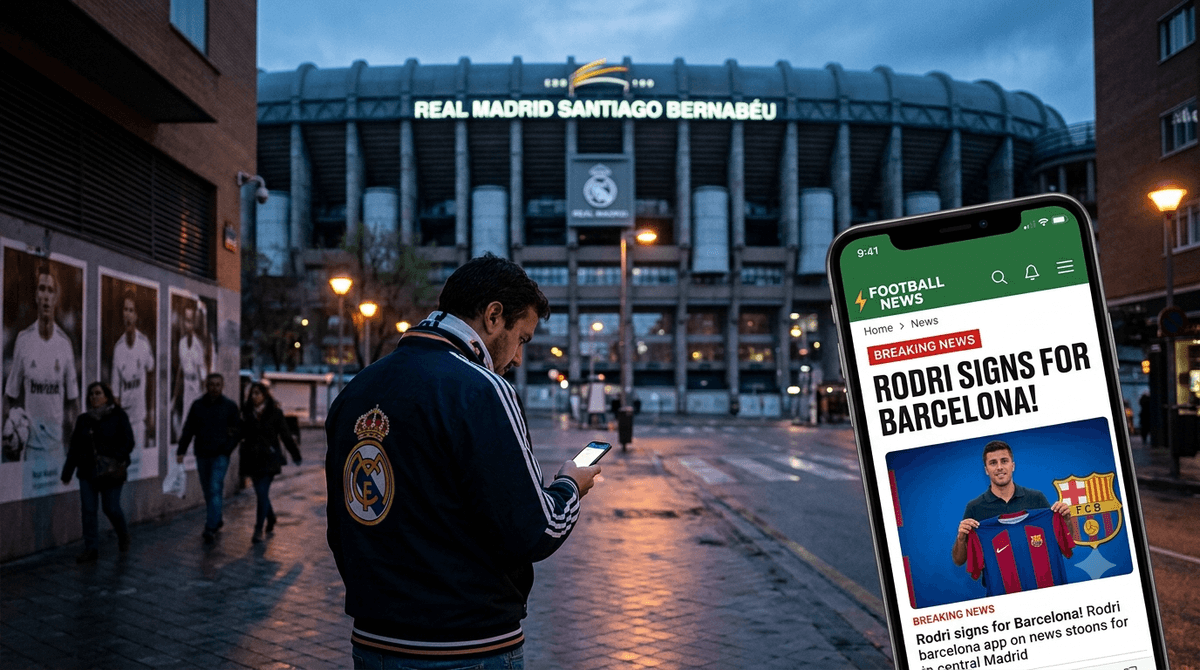
Why Rodri's Transfer To Barcelona Really Hit Real Madrid Where It Hurt
You need to understand something about Real Madrid before I tell you what happened with Rodri, because if you don't see how they see themselves, you won't feel how deep this one actually cut and hurts.
Real Madrid do not see themselves as just another football club.
They see themselves as the club. The standard. The name that makes other names go quiet in a room. Football royalty.
Fourteen Champions League titles will do that to a club's self-image. So will decades of watching the world's best players choose the Bernabéu over almost anywhere else, sometimes even when the money elsewhere was better.
So when Real Madrid wants a player, the assumption, quietly built into the DNA of the club, is that the player wants them back. Not "might." Wants!
That assumption is exactly what Rodri just broke, and that, more than any tactical gap in midfield, is why this transfer stings the way it does.
The Ego Wound Nobody At The Club Will Admit To
Let's start here, because it's the part people dance around.
Rodri isn't just any midfielder. He's a Ballon d'Or winner. A World Cup winner with Spain. Widely regarded as the best pure defensive midfielder in the world currently and, perhaps most importantly for this story, he's Madrid-born.
Not signed-from-elsewhere Madrid, actually from Madrid.
Reports and fan discussion around the deal made a point of digging up old photos of a young Rodri posing in Real Madrid colours, visiting the club's trophy room as a kid the way thousands of Madrid-born children do every year. Social media accounts sympathetic to the club leaned hard into that detail once talks with Barcelona heated up, essentially arguing he belonged to them by birthright before he ever belonged to anyone by contract.
That's the emotional backdrop. A hometown talent, at the peak of his individual prestige, chose the fiercest rival instead of the club whose crest he wore as a boy.
For an institution that has built part of its identity on being the destination every top player secretly dreams of, this isn't just a lost signing.
It's a "we assumed wrong" moment. And Real Madrid do not enjoy assuming wrong, especially not publicly, and especially not to Barcelona.
Think about how rare it actually is for a Spanish international, born and raised in the capital, to end up choosing Barcelona over Madrid when both clubs are genuinely in the running. It happens, but not often, and almost never with this much noise around it. Usually these stories get buried quietly, handled with a diplomatic quote about "family reasons" or "sporting project," and everyone moves on within a week.
This one didn't get buried quietly. It became a talking point precisely because of who Rodri is and where he's from. Fan accounts on both sides picked it apart for days. Madrid supporters searched for reasons to explain it away. Barcelona supporters, understandably, treated it as a statement signing, proof that the balance of power in Spanish football has shifted further than anyone expected.
Underneath all of that noise sits one uncomfortable fact Real Madrid can't spin away: the player himself, when given a genuine choice between the two biggest clubs in his own country, picked the other one.
They Actually Tried. That's What Makes It Worse.
Here's the part that separates this from a normal transfer miss.
Real Madrid didn't sit this one out and lose by default. By multiple accounts, they engaged in real negotiations, reportedly over roughly two weeks, and were said to have made an offer serious enough that people close to the deal described it as difficult to turn down.
There's also a version of the story, circulating among fan and commentary accounts close to the club, that José Mourinho didn't ask for Rodri by name specifically, but made clear he wanted a proper defensive midfield reinforcement, and that when other names he'd floated were turned down internally, the club pivoted toward Rodri as the answer, with Mourinho reportedly satisfied by that direction. Whether that specific internal sequence is exactly accurate or not, the broader shape of it lines up with what's been publicly reported; Madrid wanted a controlling midfield presence, and Rodri fit that need almost perfectly.
Which is what makes this such a strange kind of loss. This wasn't Madrid asleep at the wheel. This was Madrid wide awake, fully engaged, offering what by most accounts was a genuinely competitive package, and still not being enough.
There's a particular kind of sting in losing a race you actually ran hard.
Compare that to how these situations usually play out. Most transfer misses have an easy villain: an agent who strung the club along, a rival who moved faster, a medical that fell through at the last minute, a fee that got too rich too quickly. Those situations sting, but they come with a built-in excuse. "We were never really in it" is comforting because it removes the sense of personal rejection.
This one doesn't offer that comfort. Reports around the deal suggest Rodri's camp was even said to have expressed genuine appreciation for how seriously Real Madrid pursued him, for the respect shown throughout the process, and for what was described as an extremely strong offer. If even loosely accurate, that detail actually makes things worse for Madrid, not better. It removes the easy narrative that the club somehow fumbled the approach or lowballed him. By most accounts, they did the pursuit right. They just didn't win.
And when you do everything right and still lose, there's nowhere left to point the finger except at the simple, uncomfortable truth: he had a choice, and he made it, and it wasn't them.
The Actual Football Problem This Creates
Strip away the ego and the history for a second, because underneath all of that sits a real, practical football problem, and it's not a small one.
Real Madrid have had a Modrić-and-Kroos-shaped hole in their midfield since both legends departed in back-to-back years. Since then, the club has cycled through options trying to find someone who can do what those two did almost effortlessly for a decade: control tempo, dictate rhythm, break up opposition attacks before they start, and turn defense into attack in a single pass.
Rodri is arguably the single best example in world football of exactly that profile right now. Not a flashy playmaker. Not a box-to-box runner. A conductor. The kind of player who makes the eleven players around him look calmer, more organized, and more dangerous, simply by being the release valve in midfield.
Losing that specific profile to Barcelona doesn't just mean Madrid missed a good player. It means their most identifiable structural weakness, the one opposition analysts specifically target, remains unsolved heading into a season where they'll need to be at their sharpest.
Football, more than most sports, is won and lost in that unglamorous midfield battle. Teams with control in that zone dictate games. Teams without it chase them.
Real Madrid, for now, are still chasing an answer.
There's also a ripple effect worth mentioning here, because signings rarely exist in isolation. With Rodri off the board, the pressure inevitably shifts onto the midfielders already at the club to grow into a role they may not be fully ready for yet. Reports linked to the club have talked up other midfielders being handed a bigger starting role this season, effectively being asked to become the control-and-composure presence Madrid no longer have a clear external answer for.
That's not necessarily a bad thing on its own. Plenty of players have grown into exactly that kind of responsibility when trusted with it. But it does mean Real Madrid are now relying on internal development to solve a problem they had, for a brief window, a near-perfect external solution for. When the best answer to your biggest weakness signs for your biggest rival instead, "we'll develop our own" becomes a plan built more out of necessity than preference.
Barcelona Went And Rubbed It In
If this transfer had happened quietly, in isolation, Real Madrid might have absorbed it and moved on with minimal external noise.
However, football timelines rarely offer that kind of mercy.
Barcelona followed the Rodri deal with a 5-2 demolition of FC Basel in preseason, a performance that, while "only" a friendly, showcased exactly the kind of fluid, dominant, high-tempo attacking football that has already delivered them back-to-back La Liga titles, with a third straight crown very much the target this season. New signings looked sharp. The young players looked dangerous. The whole operation looked, from the outside, like a club firing on every cylinder, midfield conductor now included.
For a Real Madrid fanbase and hierarchy already digesting the loss of a Madrid-born superstar to their fiercest rival, watching Barcelona look that dominant, even in preseason, is close to the worst possible follow-up.
It's one thing to lose a transfer battle. It's another to watch the club that beat you to the signing immediately look like proof that they were right to want him.
The Quiet Damage Control
What tends to happen after a loss like this, at big clubs with image-conscious media operations, is predictable, and Madrid-aligned commentary has followed the pattern closely.
First comes the disbelief. Excited posts, some clearly built around fan enthusiasm rather than confirmed reporting, briefly framed Rodri's arrival as close to done, complete with mocked-up graphics of him in Real Madrid kit and "here we go" style declarations from supporters getting ahead of themselves.
Then, once the deal actually moved to Barcelona, came the pivot: quieter suggestions that Real Madrid never truly needed him that badly in the first place, or that the club's interest had cooled before the move was even finalized.
That kind of quiet reframing is a normal psychological release valve for a big fanbase. Nobody enjoys sitting in "we lost him and it hurts." It's much more comfortable to arrive at "we didn't really want him anyway."
Football reality doesn't bend to how a fanbase chooses to feel about it. The midfield gap was real before the Rodri chase started, and it's still real now that the chase has ended in someone else's colours.
There's almost a comedic side to watching this play out in real time on social media, if it weren't so telling. The same accounts that were posting mocked-up graphics of Rodri in Real Madrid white, complete with "here we go" banners and premature celebration posts, pivoted within days to explaining why the club was better off without him. No club statement forced that pivot. No official ever confirmed the deal was truly close in the way the excitement suggested. It was fan enthusiasm outrunning reality on the way in, then retreating just as fast on the way out.
That whiplash, more than almost anything else, tells you how emotionally invested people around the club were in landing this specific player. You don't get that kind of rapid rise-and-fall reaction over a squad player. You get it over someone the fanbase had already mentally installed as the answer to a problem that had bothered them for years.
Why This Specific Rejection Cuts Differently Than Others
Real Madrid have missed out on transfer targets before. Every big club has. That alone wouldn't be a story worth this many words.
What makes this one different is the specific combination of factors stacked on top of each other:
He's Madrid-born, which turns a business decision into something that reads, emotionally, almost like a personal rejection.
He chose their fiercest historic rival specifically, not a neutral third club where the sting would be softer.
He did it after Real Madrid genuinely tried, seriously and at length, rather than Madrid losing out through inaction or hesitation.
He fills the exact tactical gap Madrid have been visibly missing for multiple seasons.
And he did it heading into a season where Barcelona are defending back-to-back titles and chasing a third, meaning every strength Barcelona display, including the one Rodri now represents, directly threatens Madrid's chances of reclaiming the crown.
Any one of those factors alone would sting a little. All five landing at once is what turns a transfer story into a genuine institutional gut-punch.
What Happens Now
The uncomfortable truth for Real Madrid is that there's no quick fix available here. The midfield conductor role isn't something you solve with a panic buy in the final days of a window, and everyone at the club almost certainly knows that.
What's left is a season where Mourinho has to find a way to manufacture midfield control without the one player who was widely seen as the cleanest, most obvious answer to that exact problem. That likely means leaning further on academy talent still developing into the role, or asking existing squad players to stretch into a profile that isn't quite their natural game.
Meanwhile, Barcelona head into the season with their control problem solved, their attack already looking dangerous in preseason, and a genuine World Cup-winning, Ballon d'Or-holding midfielder walking straight into the heart of their team.
For a club as historically dominant as Real Madrid, the hardest part of moments like this was never really about one player. It's about the reminder that the assumption they've built their identity on, the idea that everyone eventually chooses them, just isn't guaranteed anymore.
Being a rivalry as old and as bitter as this one, that reminder, delivered by Barcelona of all clubs, is exactly the kind of thing that doesn't fade quietly.
It lingers. Through preseason. Through the first Clásico. Through every midfield battle Real Madrid have to fight this year without the man who was supposed to help them win it.
The Bigger Picture Nobody At The Bernabéu Wants To Say Out Loud
Step back from the individual transfer for a
moment and look at the wider pattern, because this is where things get uncomfortable for Real Madrid in a way that goes beyond one midfielder.
For most of the last decade and a half, the balance of power between these two clubs has swung back and forth, but Real Madrid always retained one specific advantage: when it truly mattered, when a genuinely elite player had to choose between the two, Madrid usually won that battle. It was part of the mythology. Part of why the club could tell itself, credibly, that it was the biggest institution in the sport.
Barcelona's recent stretch complicates that story. Back-to-back league titles. A squad that looks, on current form, both younger and hungrier than Madrid's. And now, a symbolic transfer win that isn't just about quality on the pitch, but about a Madrid-born, world-class player publicly choosing the other side of the city's football rivalry.
None of this means Real Madrid are in crisis. They remain one of the wealthiest, most decorated, most talent-rich clubs on the planet, and no single transfer changes that overnight. But football history has shown, again and again, that dynasties rarely collapse all at once. They erode first, one uncomfortable moment at a time. A missed signing here. A rival's “statement win” there. A fanbase quietly recalibrating what "we always get our man" actually means.
Whether this Rodri saga becomes a genuine turning point or just an uncomfortable footnote in an otherwise dominant Real Madrid era depends entirely on what the club does next. A strong season, a title challenge that goes the distance, and a midfield solution found from within, and this becomes a forgotten transfer saga by next May.
If Barcelona's midfield, now built around exactly the kind of control Rodri provides, helps deliver a third straight title while Real Madrid fall short again, this moment will get replayed constantly. Not as the cause of Madrid's struggles, necessarily, but as the clearest early symbol of them: the night the club that assumes it always gets its man found out, in the most public way possible, that it doesn't.