Writers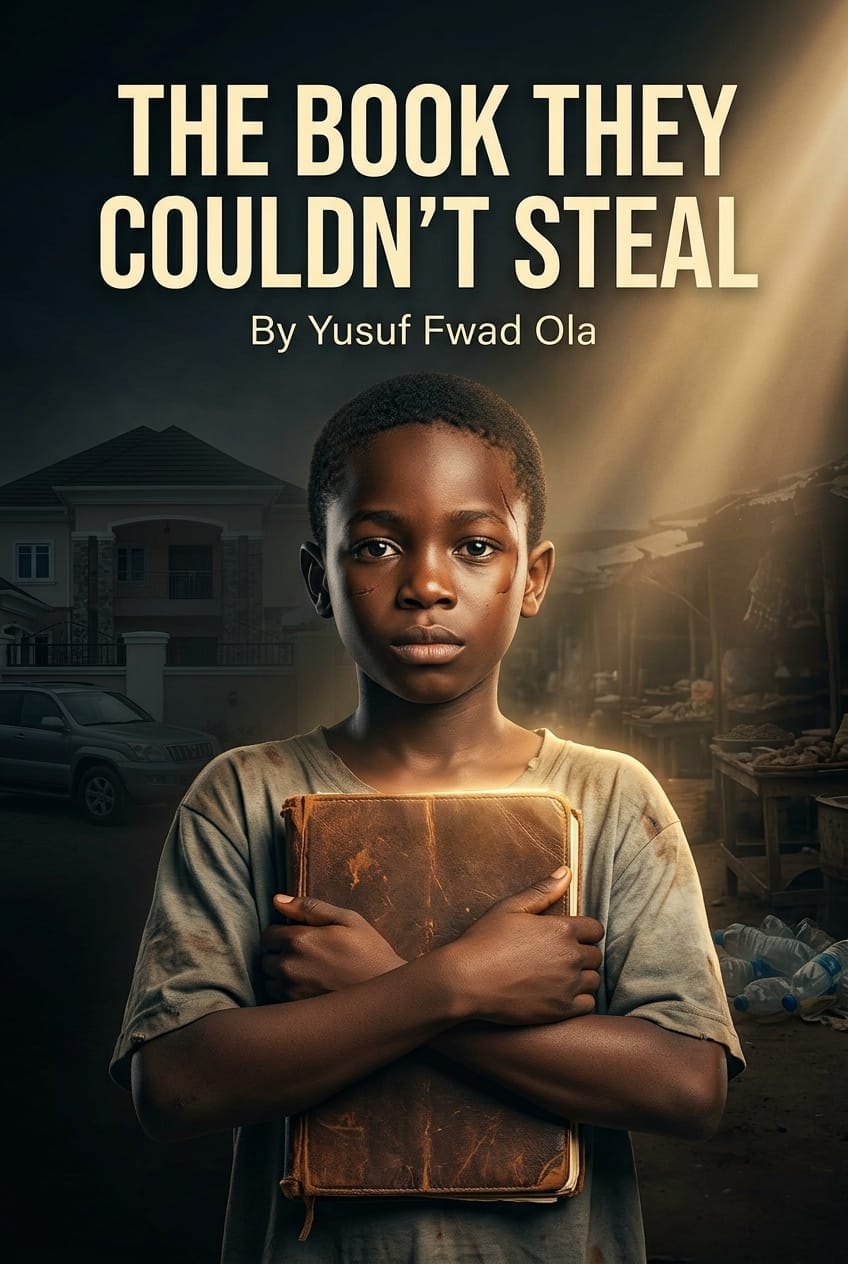
Alhaji Musa looked smaller than Suleiman remembered.
Perhaps it was simply the passage of years, or perhaps it was the particular way guilt and public shame can shrink a man who once carried himself with so much unearned confidence.😂 He stood in the doorway of the small room, glancing briefly at the bare cement floor, the narrow mattress, the single window — the same modest surroundings he had once condemned this family to without a second thought — and something like genuine discomfort crossed his face.
"Can I speak with you?" he asked, his eyes moving between Suleiman and his mother. "Alone, if possible. With Suleiman."
Suleiman's mother stiffened immediately, stepping slightly in front of her son out of pure instinct, years of protecting him from this exact family making her wary of leaving him alone with the man who had orchestrated so much of their suffering. But Suleiman, now seventeen, no longer the frightened nine-year-old who had watched buses driven away by strangers, placed a gentle hand on his mother's arm.
"It's fine, Mum," he said quietly. "I'll speak with him."
They sat outside the compound, on two plastic chairs a neighbor kept near the shared tap, the noise of the market drifting faintly in the distance — the same market where, years earlier, Suleiman had once searched through rubbish for bottles, and where a boy named Wasiu had left him with a scar that would eventually change the direction of his entire life.
Alhaji Musa didn't speak immediately. He sat with his hands folded, staring at the ground, and when he finally began, his voice carried none of the smooth confidence Suleiman remembered from that first meeting nine days after his father's funeral.
"I read the article," he said. "Several times, actually. I told myself, at first, that the journalist had exaggerated things, made it more dramatic than the reality had been. But I know that isn't true. I know exactly what I did, Suleiman. I have known for years. I simply chose not to think about it too closely, because thinking about it honestly would have required me to face what kind of man I had become."
Suleiman said nothing, letting the silence stretch, unwilling to make this easier for a man who had made nothing easy for his mother during the hardest years of her life.
"Your father," Alhaji Musa continued, his voice tightening, "was a better man than me. He built everything himself. I always told myself I deserved a share of it because I was his brother, because I had 'helped' in small ways over the years that I convinced myself mattered more than they actually did. When he died, some part of me decided that grief gave me permission to take what I felt I was always owed. I told myself it was temporary. I told myself I was protecting the business for you until you were old enough. But that was never true. It was greed, dressed up in family language to make it easier to live with."
He looked up, finally meeting Suleiman's eyes directly.
"I heard there may be a legal case coming. I won't fight it, if your lawyer decides to pursue it. Whatever the court decides, I will accept it. I came here today not to convince you to stop the case, but because I needed to say this to your face, man to man, before whatever happens next happens. I am sorry, Suleiman. Not the kind of sorry that comes with excuses. Just sorry."
Suleiman sat with the apology for a long moment, turning it over in his mind, weighing it against nine years of consequence — a stolen inheritance, a single room with one window, a childhood spent scavenging through rubbish, a scar above his ear that still occasionally ached in cold weather.
He thought about his father's notebook, about the sentence he had read so many times it had become part of how he understood himself. A man is not what he owns. A man is what he builds after he has lost everything.
He realized, sitting there, that the sentence applied to more than just himself. It applied to the choice sitting in front of him right now — the choice of what kind of man he wanted to become in this exact moment, with this exact opportunity to either hold onto anger that had, in some ways, already cost him enough years of his life, or to build something different with what remained.
"I'm not going to pretend what you did doesn't still affect us," Suleiman finally said. "My mother's hands are permanently rough from years of washing other people's clothes because of what you and the others took from her. I have a scar on my head from searching through rubbish for bottles because there wasn't enough money for food some weeks. Those things happened. I won't erase them just because you're sorry now."
Alhaji Musa nodded slowly, accepting this without argument.
"But," Suleiman continued, "holding onto hatred for you isn't going to give my mother her years back, or undo the scar, or rebuild what was taken. I've decided and I decided this a long time before you showed up here today that I'm not going to let what happened to us determine what kind of man I become. I'm going to build something. With or without whatever the court decides. With or without your apology, honestly. Your apology doesn't change my path. It only tells me something about yours."
He stood up, extending his hand — not entirely in forgiveness, not entirely in reconciliation, but in a kind of closure that felt more important, in that moment, than either of those things.
"Whatever happens with the legal case," Suleiman said, "happens. I'm not driving it out of revenge. My lawyer and my mother will decide what's fair. But I needed you to know that I'm not the same boy you left in that empty compound nine years ago. Losing everything didn't destroy me. If anything, it built me into someone I don't think I would have become otherwise."
Alhaji Musa shook his hand slowly, something like genuine respect perhaps for the first time in his life directed toward his brother's son rather than toward his brother's wealth visible in his expression.
* * *
The legal case, when it eventually concluded nearly two years later, resulted in a modest but meaningful settlement — not enough to rebuild the empire Bello Motors had once been, but enough to ease the remaining years of his mother's life considerably, and enough to fund the beginning of a small business Suleiman would eventually build for himself after completing university.
He studied hard, using every resource the scholarship provided, and graduated with results that would have made his father proud even without the dramatic backstory that had first opened that particular door for him. He started small — a modest logistics company, built entirely on his own effort rather than inherited wealth — and grew it carefully, year after year, until it eventually became larger than Bello Motors had ever been, with routes and vehicles and a name that people once again said with respect, this time entirely because of what Suleiman himself had built.
Years later, successful in his own right, Suleiman began accepting invitations to speak to secondary school students about resilience — young people navigating their own versions of loss, poverty, or family betrayal. He always began his talks the same way.
He would tilt his head slightly, point to the faint curved scar still visible above his left ear, and say:
"This is not where my story ended. This is where it finally started to make sense."
Then he would reach into his bag and produce an old notebook — the same one that had survived a family's greed, a bottle to the skull, and years of poverty, because nobody had ever thought it was worth stealing.
"Everything valuable that was ever truly mine," he would tell each new audience, "was never something anyone could take from me in the first place. Not because I was lucky. Because the most important inheritance my father ever gave me wasn't money. It was a single sentence, written in his own handwriting, that I now try to live by every single day."
He would open the notebook to the final entry, the page now worn soft from years of handling, and read the words aloud one more time.
A man is not what he owns. A man is what he builds after he has lost everything.
And every single time, somewhere in the crowd, there was always one student who understood exactly what those words had cost to earn — sitting quietly in the back, perhaps hiding a sleeve, or a silence they hadn't yet learned to break. Suleiman always found that student after the talk and always sat beside them first.
…………………….The End………………………
Note:
When I set out to write The Book They Couldn't Steal, I wanted to explore a question many of us quietly ask at some point in our lives: what remains when everything else is taken away?
Suleiman's story is fictional, but the truths inside it are not. Every day, somewhere, a child inherits loss before they inherit anything else — a home stripped by greedy relatives, a childhood cut short by hardship, a dream delayed by circumstances no nine-year-old should have to understand. And yet, again and again, we see that the human spirit finds a way to rebuild, often from the most unlikely materials: a notebook nobody thought to steal, a kind word from a stranger, a single sentence read at the right moment in the dark.
I wanted Suleiman's scar to mean something different by the end of the story than it did at the beginning — not a mark of shame, but a record of survival. I wanted his father's notebook to remind us that the most valuable things we leave behind are rarely the things that can be signed over in a will. And I wanted Alhaji Musa's arc to ask a harder question: what does it cost a man to take what isn't his, and is it ever too late to say sorry and mean it?
If this story leaves you with one thought, I hope it's this: whatever has been taken from you — money, time, family, safety or any other thing, you still hold the pen on what you build next. A man, or woman, is not what they own. They are what they build after they have lost everything.
Thank you for reading Suleiman's story. I hope some part of it stays with you the way his father's words stayed with him.
– Yusuf Fwad Ola