 Writers
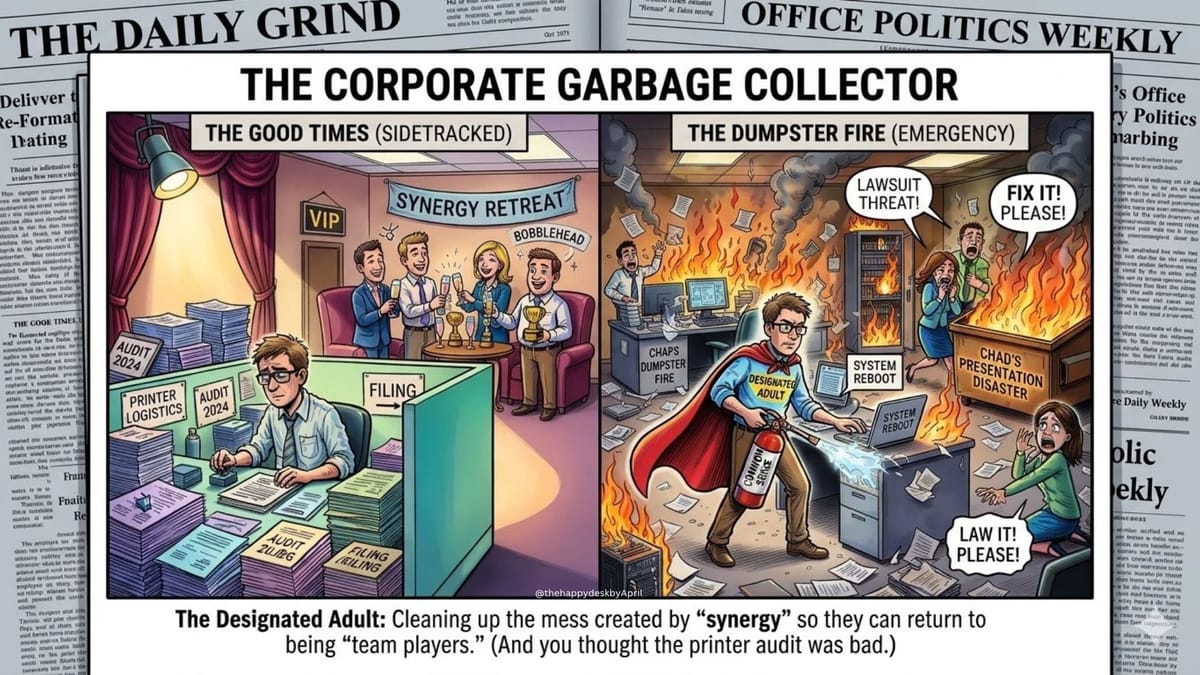
The Corporate Garbage Collector: A Tale of Integrity, Sidetracks, and Imminent Disasters
Welcome to the corporate matrix, where the currency isn't competence, but rather the ability to nod dynamically like a dashboard bobblehead.
I work in a standard office. It features standard grey cubicles, an aggressive coffee maker, and an executive leadership team that operates purely on vibes. In this ecosystem, promotions and glamorous "special assignments" are handed out like candy at a parade. Yet, my name is perpetually missing from the VIP roster. Why? Because I suffer from a severe, career-limiting medical condition known as Chronic Directness.
I don't play favorites. I don't laugh at the Big Boss’s abysmal jokes about golf. And when a project plan looks like it was drawn in crayon by an overcaffeinated toddler, I say so.
The Art of the Sidetrack
Take my colleague, Chad. Chad’s primary skill is "synergy visualization," which is a fancy way of saying he creates PowerPoint slides with lots of arrows. Last month, Chad was handed a high-profile, all-expenses-paid "strategic outreach" trip. Meanwhile, I was sidetracked to the corporate equivalent of Siberia: auditing the 2024 printer paper consumption logistics.
Then there is Sarah. Sarah is a master of the pre-emptive compliment. She noticed our manager got a haircut—which frankly made him look like a startled owl—and praised it so intensely she was immediately given the lead on the new, highly visible, zero-stress brand refresh project.
When you don’t play the sycophancy game, you become invisible during the good times. You are sidetracked from the gala dinners, the cutting-edge think-tanks, and the tasks that actually look good on a resume. You are left alone, sitting in your corner, listening to the ambient hum of the fluorescent lights.
Enter the Dumpster Fire
However, a fascinating phenomenon occurs the exact second things go completely off the rails.
When Chad’s "synergetic" client presentation accidentally deletes the client's actual database, or when Sarah’s brand refresh uses a logo that looks suspiciously like an offensive hand gesture, the corporate amnesia instantly clears. Suddenly, my invisibility cloak is ripped away. The sky darkens, alarms blare, and a shadow falls over my cubicle.
It’s the manager, holding a folder that is practically smoking.
"Hey," they say, their voice trembling with a mixture of panic and newfound respect. "We have a bit of a situation. The client is threatening a lawsuit, the system is down, and Chad is currently locked in the wellness room crying. Can you handle this?"
This is my true job title: The Designated Adult.
I don’t get the promotions, but I get the emergencies. I get the radioactive waste. When the corporate train derailment happens, they don't call the bobbleheads who agreed the tracks were fine; they call the person who told them the bridge was out three weeks ago.
The Paradox of the Fixer
It is a hilarious, exhausting cycle. I spend forty-eight hours straight mainlining espresso, rewriting broken code, apologizing to furious stakeholders, and sweeping up the ashes of other people's incompetence. I speak my mind to the clients too—ironically, they actually respect honesty—and the day is saved.
Do I get a promotion for pulling the company out of a literal nosecone dive? Absolutely not. That would disrupt the delicate ecosystem of favoritism. The moment the fire is out, I am promptly demoted back to being "the difficult one who isn't a team player."
But as I watch Chad return from the wellness room to receive an award for "Resilience in the Face of Adversity," I just smile. I might not have the fancy title or the corner office, but I have something far more powerful: the keys to the kingdom. Because everyone in this building knows that without the resident truth-teller, the whole place would burn to the ground by Tuesday.