 Writers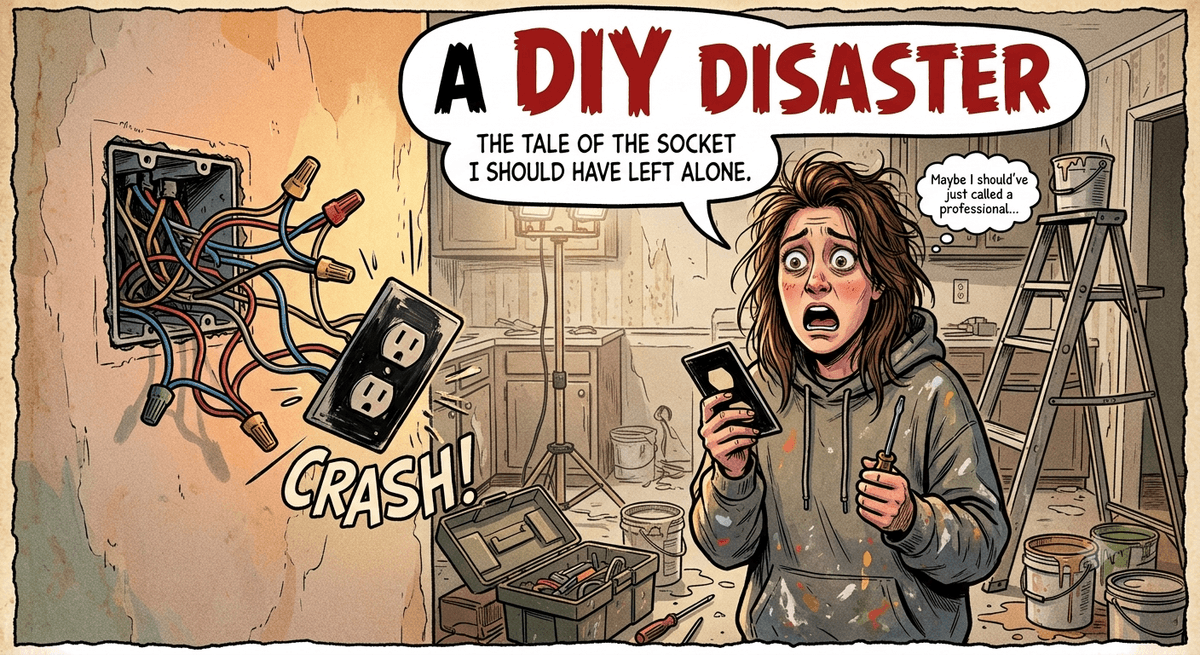
I had no business touching that socket. None at all. But at the time, I genuinely thought I was about to solve a small problem and save myself some money.
That was my first mistake.
I had been looking at the socket for a while, thinking about what was wrong with it. It was not working the way it should, and I kept telling myself, It's just a socket.
How complicated could it possibly be?
I had watched enough people handle little things around the house to convince myself that I could probably figure it out. I had watched YouTube videos too. So I got up and examined it.
I looked at the wires.
I looked at the replacement socket and at the wired again.
At that point, I probably should have stopped. But no, instead, my brain said, You've come this far.
That sentence has probably gotten me into more trouble than I care to admit.
I started trying to work out which wire went where, at the same time pretending I knew exactly what I was doing when I actually didn't.
There is a particular kind of confidence that comes from not knowing enough to be afraid.
I had it that day.
For a few minutes, everything seemed manageable.
Then something happened that made me pause.
I can't even remember exactly what thought went through my head, but I remember thinking: Hmm.
Not “I've got this” or “This is easy.”
Just: Hmm.
Apparently, I felt an electric shock.
And suddenly I became very interested in my own mortality. So I stepped back. I looked at the socket and at my tools.
Then looked around the room as though an electrician might magically appear because I had finally developed sense.
Nobody came.
And the worst part?
I didn't have money to call one immediately.
So there I was, standing in my room with a half-touched socket, wondering how a five-minute problem had somehow become my personal engineering project.
I eventually decided that perhaps the smartest thing I could do was stop. Which, ironically, was probably the smartest decision I had made since I started.
I left it alone and for once, I listened to the little voice in my head saying, Please don't make this worse. And that experience has stayed with me because adulthood is surprisingly full of moments like that.
You see a problem and you think you should be able to fix it.
You don't want to spend money fixing it, so you convince yourself that you can handle it.
Sometimes you actually can.
Other times, you are standing beside an electrical socket at 7 p.m., staring at wires and reconsidering every decision that brought you there.
I've since learned that knowing when to stop is also a skill.
Not every problem needs your immediate intervention or is worth experimenting with.
And sometimes saving money is not worth the possibility of creating an even bigger problem especially when electricity is involved.
So yes, I eventually got sense.
The socket stayed untouched.
And I learned something important that day: There are some things you don't fix because you're capable. You fix them because you know what you're doing.
And if you don't?
Leave the socket alone. 😭