 Writers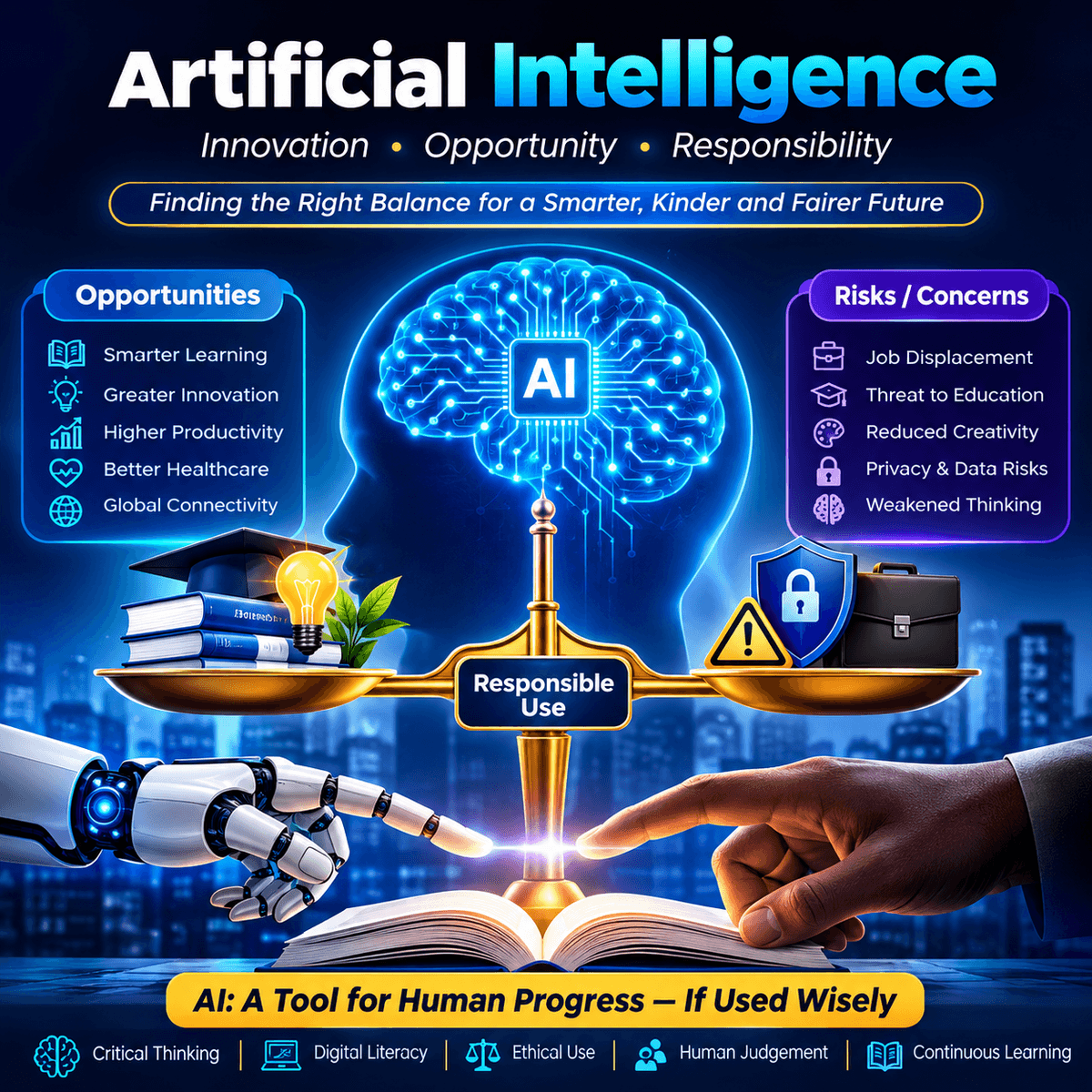
Perhaps nowhere is the controversy surrounding AI more intense than in education.
Students can now ask AI systems to explain concepts, solve mathematical problems, generate essays, summarise books and assist with research. Consequently, many educators are asking an important question:
Where does legitimate assistance end and academic dishonesty begin?
The answer is not always as simple as saying that every use of AI is cheating.
Consider a student who is struggling to understand a complex topic. The student asks AI to explain the subject in simpler language, studies the explanation, consults textbooks and other sources, and then writes an original response based on what they have learned.
That is fundamentally different from asking AI to complete an entire assignment, submitting the response without understanding it and presenting it as entirely personal work.
The difference is purpose, transparency and ownership.
Education is not simply about producing answers. It is about developing the ability to think.
A student may receive an excellent essay from an AI system and still learn very little from the experience. Conversely, a student who uses AI as a tutor, asks questions, challenges the answers, verifies information and then produces an independent response may actually deepen their understanding.
This is why educational institutions need to move beyond the simplistic debate of “AI versus no AI.”
The more important question is:
What kind of AI use promotes learning, and what kind undermines it?
The Problem of Academic Dependence
Imagine a student who uses AI to write every assignment from the first year of university until graduation.
On paper, the student may appear productive. But what happens when they enter a workplace where they are expected to think independently?
What happens when the AI gives an incorrect answer and there is no understanding behind the student's work to identify the error?
What happens when a professional decision requires experience, judgment and ethical reasoning rather than a generated response?
This is why education must remain centred on developing the person, not merely completing the task.
AI can be an excellent tutor, brainstorming partner, editor and research assistant. But students should still read, reason, question, write, calculate, experiment and solve problems themselves.
The Problem of False Information
Another controversy surrounding AI is its ability to produce information that sounds convincing but is incorrect.
This is one of the most important things users need to understand.
AI can sometimes generate an answer with confidence even when the information is inaccurate, incomplete or misunderstood. The polished nature of the response can make the error difficult to notice.
This creates a new responsibility for the user: verification.
AI should not automatically become the final authority simply because its response sounds intelligent.
When dealing with academic research, medicine, law, finance, theology, engineering or other sensitive subjects, important information should be checked against reliable sources and qualified professionals where appropriate.
The responsibility for the final decision remains with the human being.
AI and Writing
Another question frequently asked by writers is whether AI-generated writing is “real writing.”
There is no simple answer.
AI can help organise ideas, correct grammar, improve structure and suggest alternative ways of expressing something. These can be useful functions.
But writing is also about voice.
A person's experiences, convictions, memories, struggles, humour and perspective give their writing something unique. Two people may receive the same writing prompt and produce completely different pieces because their lives have shaped them differently.
Therefore, the responsible writer should not surrender their voice to AI.
AI can help polish a message, but the message should still belong to the writer.
AI can suggest an outline, but the writer should determine the argument.
AI can identify grammatical weaknesses, but the writer should remain responsible for the meaning.
The New Meaning of Originality
In an AI-driven world, originality will increasingly mean more than simply producing something without technological assistance.
It will mean contributing human thought, judgment, experience and responsibility.
The goal should not be to prove that we never used AI.
The goal should be to ensure that when AI is used, we remain intellectually present in the process.
A useful principle is this:
Never allow AI to do the thinking that you are supposed to learn to do.
Use it to accelerate learning, not to escape learning.
Use it to improve understanding, not to manufacture competence.
Use it to support your work, not to falsely represent someone else's—or a machine's—work as your own.
When used responsibly, AI does not have to destroy education. It can challenge educational systems to focus more deeply on understanding, critical thinking, creativity and practical application.