Writers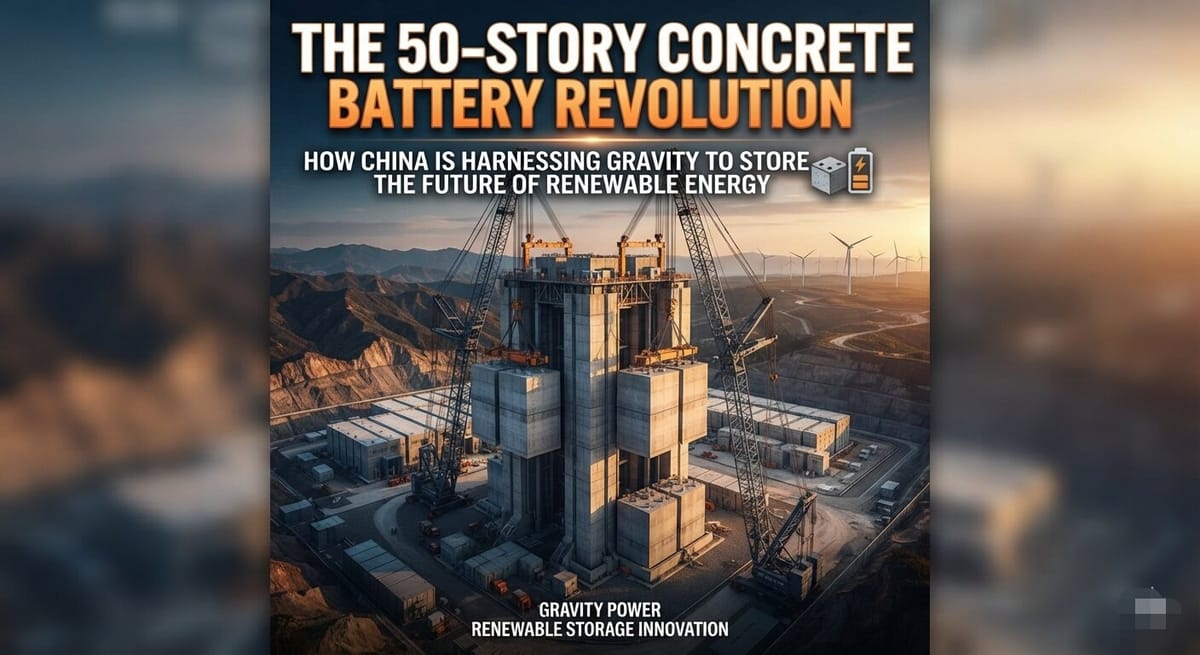
China has created a new way to store energy: a giant battery composed of concrete blocks.
This battery has been built in Rudong, Jiangsu province, and takes the form of a “tower” nearly 148 meters high, comparable to a 50-story building.
This battery aims to store energy in the form of concrete blocks that will then be lowered to produce electricity.
How does a gravity battery work?
The principle is relatively simple.
When wind turbines or solar panels produce more electricity than the network can absorb, the excess electricity will be used to raise the blocks.
Thus, the kinetic energy of the blocks will be transformed into electrical energy and stored.
Once the battery is fully charged, the blocks will be lowered to the bottom of the tower.
At this point, the kinetic energy of the blocks will be used again to produce electricity.
According to the article, this battery has a power of 25 MW and a storage capacity of 100 MWh, which means that it would be able to provide its maximum power for 4 hours.
Why concrete blocks?
It must be noted that gravity batteries have an advantage over conventional lithium batteries: they do not have the same drawbacks.
Indeed, this technology does not require any lithium, but uses concrete blocks, which can be reused or recycled.
These blocks contain various materials, concrete debris, for example.
In addition, they are much more resistant than lithium batteries.
The idea of this project is thus to develop a technology that allows a long-term storage of electricity, made of recyclable materials.
Support for renewable energies
As explained in the article, the development of this type of battery is part of an effort to facilitate the transition to 100% renewable energy.
One of the problems with renewable energy is that it is not produced at the same time as energy demand.
However, a battery can solve this problem by storing the electricity produced during periods of low demand and releasing it during periods of high demand.
This is why this type of battery could make renewable energy a reality.
During the periods when the sun is shining or the wind is blowing, gravity batteries could store this energy in the form of concrete blocks.
Then, during the evening, when the wind decreases or when the clouds cover the sun, this stored energy could be used to compress air to produce electricity.
Nevertheless, this technology has some disadvantages.
These batteries are not always competitive with lithium batteries, since they require much infrastructure: large areas of land, concrete blocks and large machines.
According to the analysis mentioned in the article, a gravity battery with a capacity of 100 MWh would be much more expensive and would occupy much more space than a lithium-ion battery.
According to the article, China is not the only country to have developed such a technology.
Indeed, there is also the Chinese project of an abandoned mine that stores energy.
Other projects are based on similar principles, such as using inclines to move concrete blocks.
These different projects show that this technology can be adapted to different environments.
It is not necessary to build a tower of 50 floors: it is possible to imagine a version based on a slope.
The tower built in Rudong will be connected to the last grid , and it seems that this test will provide valuable information on the potential of this technology.
The big question is whether this alternative to lithium batteries can become a serious competitor.
More information:
"Futura-Sciences — Inside the record-breaking 50-story battery revolution" (https://www.futura-sciences.com/en/it-towers-over-the-great-pyramid-inside-the-record-breaking-50-story-battery-revolution_38305/?utm_source=chatgpt.com)