Writers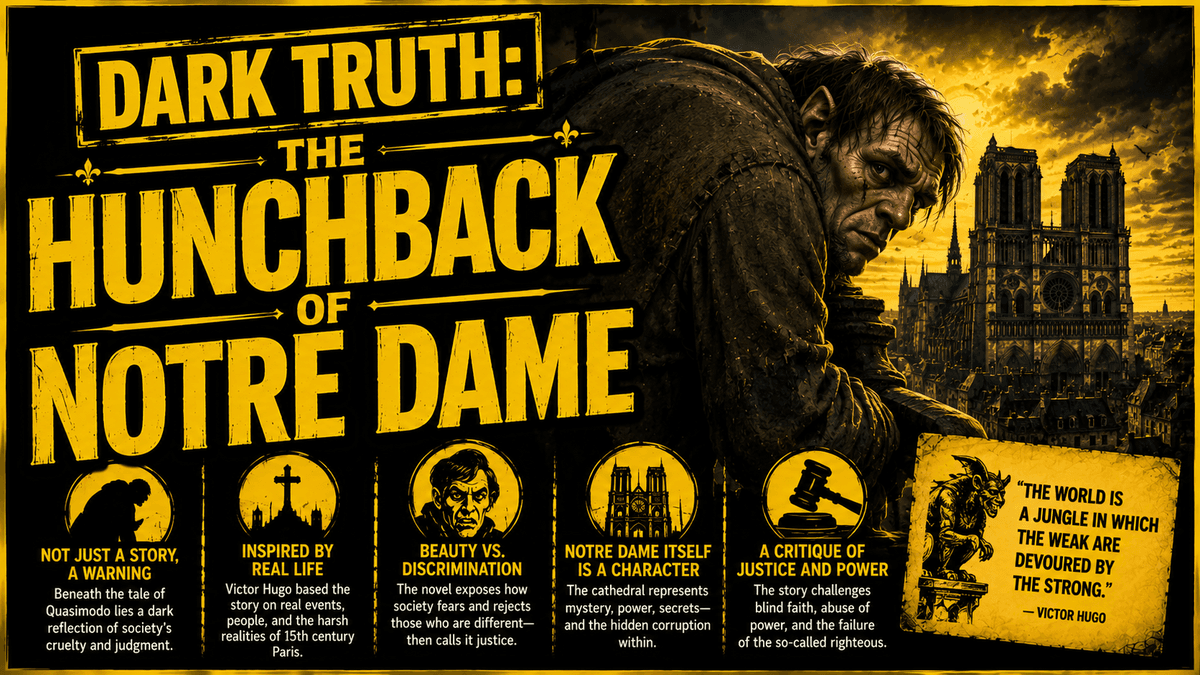
If you only know The Hunchback of Notre Dame from Disney, you probably remember a kind-hearted bell ringer, a beautiful dancer, a villainous judge, and a story that somehow ends with hope.
But the original story by Victor Hugo is far more tragic to what Disney showed us.There is no neat happy ending waiting around the corner.
Quasimodo’s story? It gets much darker than most people realize.
This story begins in 15th-century Paris, around the enormous Notre-Dame Cathedral.
Living inside the cathedral is Quasimodo, a severely deformed, partially deaf bell ringer who has spent most of his life isolated from society.
People stared at him. Mocked him and feared him. Because of this, he spends so much time ringing the cathedral bells, his hearing eventually becomes almost completely ruined.
But Quasimodo isn't the monster everyone assumed he was. In fact, he was one of the most emotionally vulnerable characters in the entire story.
The person who controls much of his life is Claude Frollo, an archdeacon who took Quasimodo in when he was an abandoned child.
Frollo is supposed to be a religious man. But his obsession with another character (Esmeralda) will eventually destroy almost everyone around him.
Esmeralda was a woman everyone wanted. She was a young Romani dancer who captured attention wherever she went but unfortunately for her, several men become obsessed with her.
One of which was Claude Frollo.
His attraction to Esmeralda becomes increasingly disturbing because he believed his religious devotion and his desire for her couldn't coexist. So, instead of accepting responsibility for his own feelings, he began blaming Esmeralda.
Meanwhile, Quasimodo develops a deep affection for her - but his love was completely different.
He doesn't want to possess her. He simply wants to protect her. And that difference becomes painfully important.
At one point, Quasimodo was publicly punished after being involved in an attempted kidnapping of Esmeralda. He was tied to a pillory and left exposed while a crowd mocked him.
Imagine being already isolated from society, then having your worst fears confirmed in front of hundreds of people.
Quasimodo becomes desperately thirsty and begged for water. Nobody helped or spared him a glance.
Then Esmeralda approaches slowly. She gives him water. That tiny act of kindness changes everything.
For perhaps the first time, Quasimodo experiences genuine compassion from someone who isn't afraid of his appearance.
And from that moment, his loyalty to Esmeralda becomes absolute.
Esmeralda was in love with Captain Phoebus.
But here's where the story becomes especially painful.
Phoebus is handsome, charming and confident but he wasn't the noble hero Disney showed us. He was actually rather shallow and careless with Esmeralda's feelings.
Frollo becomes consumed by jealousy. Eventually, he attacks Phoebus while Esmeralda is present.
Phoebus survived but Esmeralda was blamed for the crime. She was arrested, tortured, and eventually condemned to death.
Instead of finding a way to help her since he was obsessed with her, Frollo does something even worse. He offers her a choice:
Give yourself to him, or die.
But she refused.
When Esmeralda was about to be executed, Quasimodo suddenly appears. He rescues her and carries her into Notre-Dame Cathedral. He famously declares that she is under the protection of the church.
For a while, she is safe there. Inside the cathedral, the terrifying bell ringer becomes her protector.
He brought her food. He watched over her. He kept his distance because he knew she was frightened of him. And strangely enough, the man everyone called a monster becomes the one person genuinely trying to save her.
But the sanctuary cannot last forever. Eventually, a mob attacked Notre-Dame. Quasimodo believed they were trying to hurt Esmeralda, so he desperately fights to defend the cathedral.
But outside, Frollo has another plan. He had Esmeralda captured while Quasimodo was busy so he couldn't save her.
She was executed.
When Quasimodo realizes what had happened, something inside him broke. He tracked down Frollo and sees him watching Esmeralda's execution from the cathedral.
Quasimodo finally understood who had caused so much suffering. In his anger, he pushes Frollo from the heights of Notre-Dame - who fell to his death.
But Quasimodo's story doesn't end there. Many years later, people discover two skeletons in a tomb.
One skeleton belongs to a woman. The other appears to be a deformed man embracing her.
When the remains are separated, the man's bones mysteriously crumble.
What it meant was that Quasimodo had found Esmeralda's body and stayed with her even after death.
He had spent his life being rejected because of the way he looked. Yet when he finally found someone who showed him kindness, he never abandoned her.
Not even in death.
After reading this, tell me who was the real monster in the story?
This question one of the uncomfortable questions Victor Hugo left behind for it readers to answer.
Was Quasimodo the monster because of his appearance? Or was the real horror found in the people who judged, exploited, tortured and condemned others?
Hugo's story wasn't simply about a hunchback living inside a cathedral. It was about obsession, prejudice, loneliness, power and compassion.
Disney gave the story a more hopeful shape.
Victor Hugo gave it something much harsher. A reminder that sometimes the person everyone fears is the one with the most humanity.
And sometimes, the real monster doesn't even look like a monster at all.