 Writers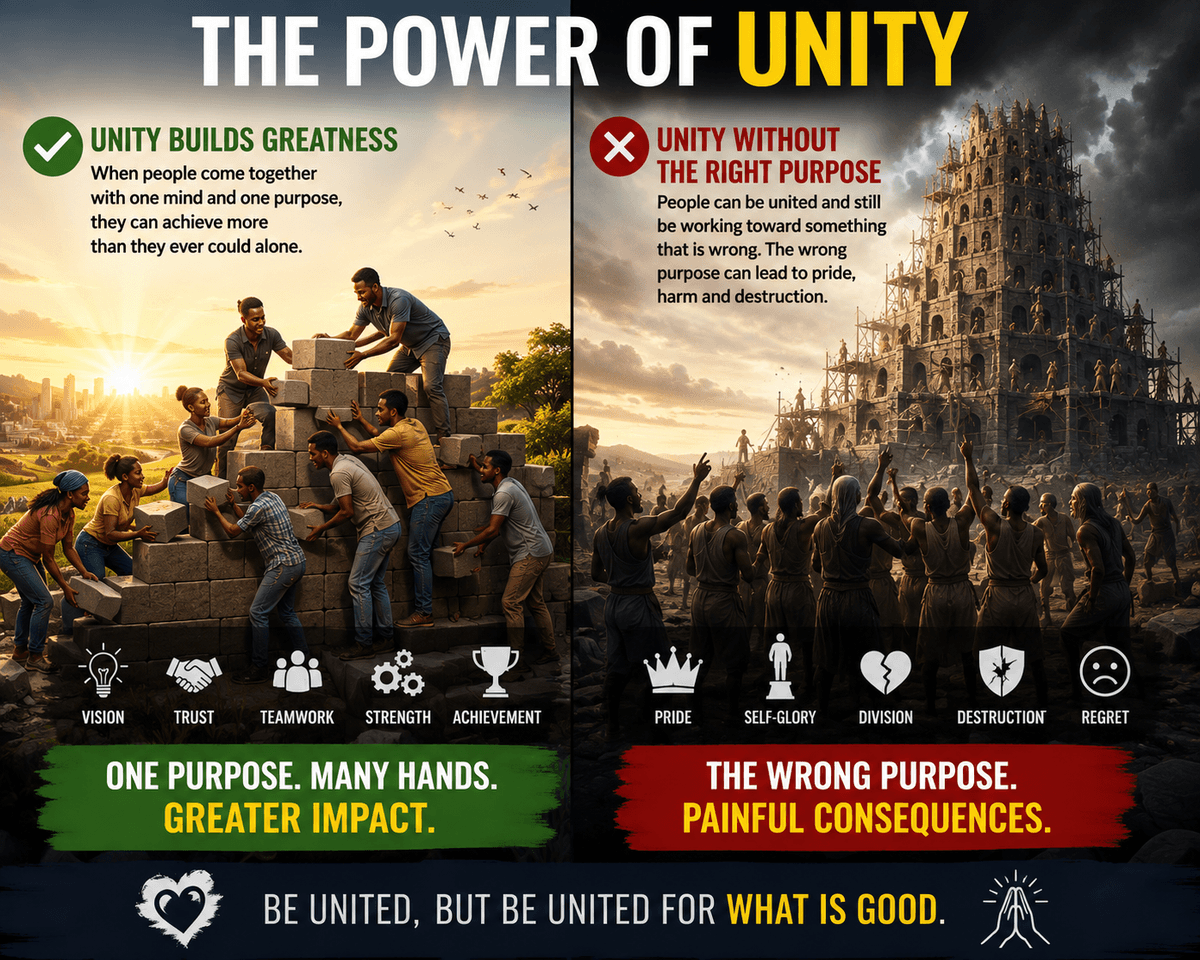
THE POWER OF UNITY PART TWO
What Are You United For?
The first lesson from the story of Babel is fascinating: unity is powerful.
But there is another lesson that may be even more important.
Not everything we unite around deserves to succeed.
Genesis 11 tells us about people who came together with one language and one purpose. They wanted to build a city and a tower whose top would reach heaven. They wanted to make a name for themselves and avoid being scattered across the earth.
They were united.
They were organised.
They were ambitious.
And they were making progress.
Then God intervened.
Genesis 11:7 records God's response:
“Go to, let us go down, and there confound their language, that they may not understand one another's speech.”
Why would God interrupt something that was apparently working so well?
Because the purpose behind their unity was wrong.
Their unity was being used to pursue pride and self-exaltation.
They weren't simply building. They were trying to make a name for themselves.
That distinction matters.
We can look at unity and automatically assume that because people are working together, what they are doing must be good.
But unity itself is not the final test.
A group of people can be united and still be wrong.
Friends can unite around gossip.
People can unite to destroy someone's reputation.
A group can unite around hatred.
A workplace can unite around dishonesty.
A community can unite around discrimination.
Even individuals can join together to pursue selfish ambitions.
They may be organised.
They may be successful.
They may even appear powerful.
But success does not automatically mean that the purpose is right.
That is why we need to ask ourselves a deeper question:
What are we building together?
This question applies to almost every area of life.
What are you and your friends united around?
What are you and your partner building together?
What is your family collectively pursuing?
What is your church united around?
What is your organisation trying to achieve?
What is the purpose behind your ambition?
Sometimes we become so excited about achieving something that we forget to ask whether the thing we are pursuing is actually worth achieving.
We celebrate growth without asking what the growth is producing.
We celebrate influence without asking what that influence is being used for.
We celebrate success without asking what it cost us to achieve it.
Babel reminds us that a successful project can still be built for the wrong reason.
This is why purpose matters.
Imagine having a group of brilliant people, unlimited determination and excellent communication, but everyone is moving in the wrong direction.
Their unity will make them more effective but it will also make them more effective at pursuing the wrong thing.
That is a frightening thought.
Unity is like a powerful tool.
A tool can build a house or destroy something.
The question is not simply whether the tool is powerful.
The question is who is using it, why are they using it, and what are they trying to accomplish?
This is why our relationships matter.
The people we unite ourselves with can influence the direction of our lives.
Proverbs 13:20 reminds us that walking with wise people has an effect on us.
Not every partnership deserves our commitment.
Not every friendship deserves unlimited access.
Not every opportunity is worth pursuing simply because it is available.
And not every group deserves our loyalty.
Sometimes we need the courage to ask:
“Is this agreement taking me closer to God or further away from Him?”
“Are we building something meaningful or simply trying to prove ourselves?”
“Is our unity producing good or causing harm?”
“What kind of person will I become if I continue walking with these people?”
These questions require maturity.
It is possible to be surrounded by people and still be going in the wrong direction.
It is possible to be part of a successful team and still be building something that will eventually collapse.
And it is possible to walk away from a group not because you hate the people involved, but because you recognise that the direction is no longer consistent with your values.
The story of Babel therefore gives us a balanced understanding of unity.
Yes, unity is powerful.
But power needs direction.
Yes, together we can accomplish more.
But we must first ask what we are trying to accomplish.
Yes, there is strength in becoming one.
But we must be careful about what we become one for.
The greatest question is therefore not:
"How many people are on my side?"
It is:
“Is what we are building worth God's approval?”
Because there are things we can successfully build that we were never supposed to build.
There are doors we can force open that were never meant for us.
There are goals we can achieve that will leave us empty when we finally arrive.
And there are victories that may look impressive to people but mean nothing in eternity.
So before you unite your strength with someone else's, examine the purpose.
Before you join a movement, examine its direction.
Before you chase a goal, examine your motive.
Before you celebrate success, ask what that success is producing.
Unity can make us powerful. Purpose determines whether that power becomes a blessing or a danger.
The people of Babel teach us both lessons.
Be united.
But be united around what is right.