 Writers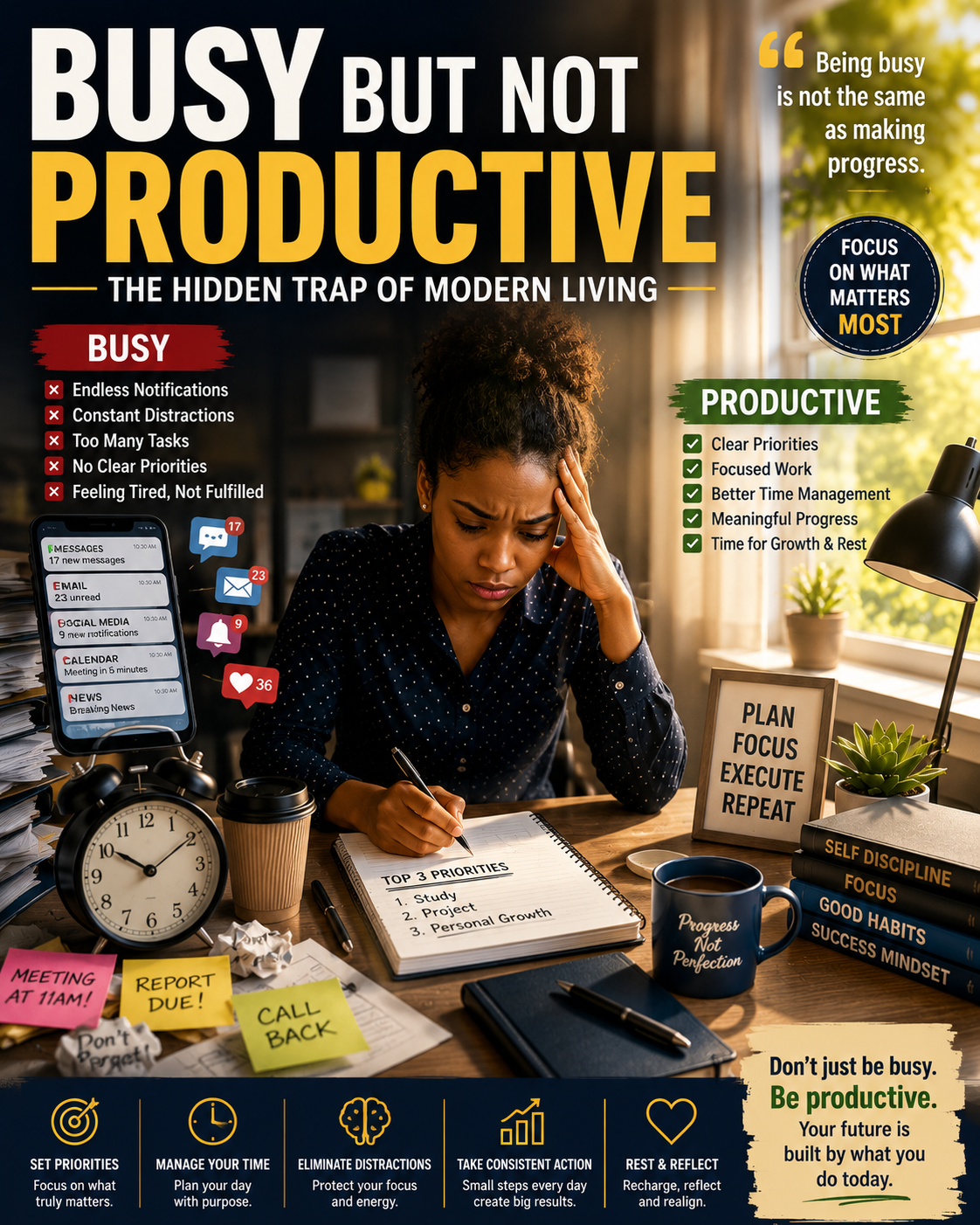
Busy but Not Productive: The Hidden Trap of Modern Living
"Being busy is not the same as making progress."
If someone asked how your week has been, chances are your answer would be, "I've been so busy." It has become one of the most common responses in everyday conversations. We wear busyness like a badge of honour, believing that a packed schedule automatically means we are making meaningful progress.
But is that really true?
Think about the last time you reached the end of a long day. You answered messages, attended classes or meetings, scrolled through social media, replied to emails, and completed several small tasks. Yet, when you finally lay down to rest, you still felt that something important had been left undone.
Many of us confuse movement with progress.
Modern life constantly demands our attention. Notifications compete for our focus, social media keeps us entertained, and endless responsibilities fill our calendars. We become experts at staying occupied while quietly neglecting the activities that truly move our lives forward.
Productivity is not about doing more things. It is about doing the right things.
Imagine a person who spends eight hours organizing a study table without reading a single page. Compare that with someone who studies with complete focus for just two hours. The second person may achieve far more because they concentrated on what truly mattered.
This is why priorities are so important. Every day presents us with countless choices. Some tasks are urgent, while others are important. The challenge is that urgent tasks often shout the loudest, while important ones patiently wait. Unfortunately, those quiet but important tasks reading, learning a new skill, exercising, praying, spending time with family, or planning for the future are the ones that shape our lives the most.
Another obstacle to productivity is the desire to multitask. Although it may feel efficient, constantly switching between different activities often reduces concentration and increases mistakes. Giving one task your full attention is usually more effective than dividing your focus among several things at once.
Rest also plays an important role in productivity. Many people believe working without breaks is the key to success, but our minds and bodies perform better when they have time to recover. Rest is not laziness; it is preparation for sustained excellence.
One helpful habit is to begin each day by identifying the three most important tasks you must complete. Before checking social media or responding to less important distractions, focus your energy on those priorities. Completing meaningful work early creates momentum that carries through the rest of the day.
It is also important to celebrate small victories. Every chapter completed, every assignment submitted, every healthy meal prepared, and every positive habit repeated is evidence that progress is taking place. Great achievements are built through consistent daily actions rather than dramatic overnight success.
At the end of each day, instead of asking, "How busy was I?" ask yourself, "Did I make progress toward the life I want to build?" That single question can change the way you approach your time.
Your future will not be determined by how many hours you stayed busy. It will be shaped by how wisely you invested those hours.
Being productive is not about filling every minute with activity. It is about filling your life with purpose. When your actions align with your priorities, even an ordinary day becomes a meaningful step toward an extraordinary future.
So, the next time someone asks how your day went, perhaps the best answer isn't, "I was busy." Perhaps it is, "I made progress."