Writers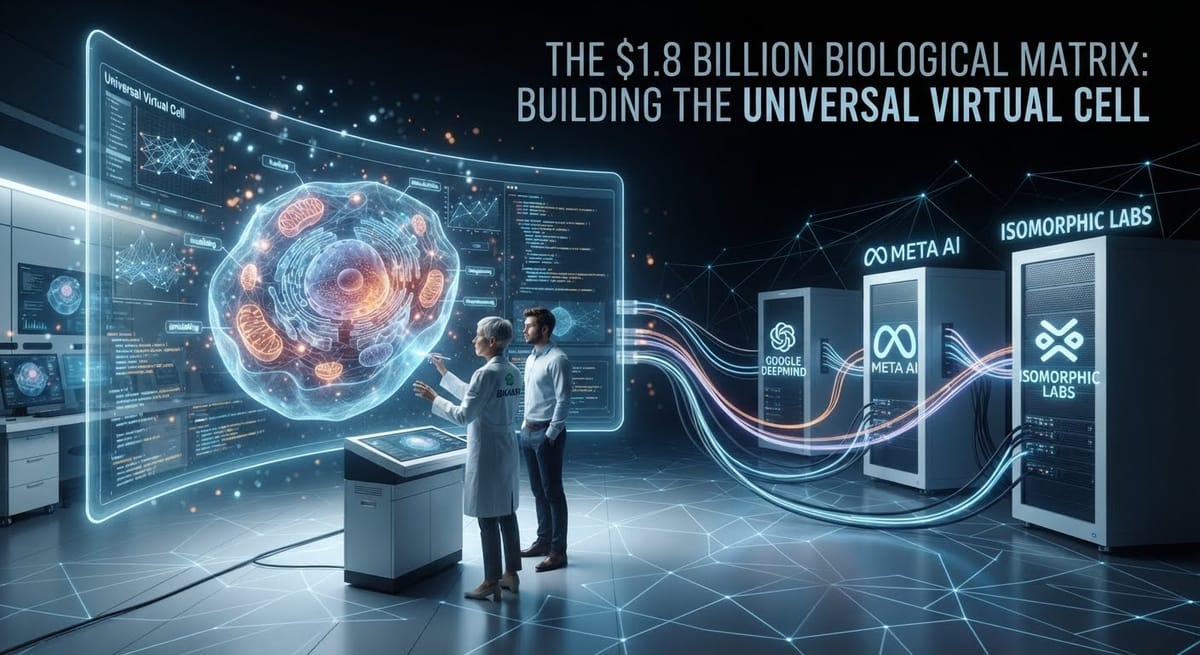
The frontier of artificial intelligence and medicine has reached a new height. In an unprecedented partnership, Google DeepMind, Meta, and Isomorphic Labs have joined together in a $1.8 billion global alliance, with the Zuckerberg-backed nonprofit fueling the effort with $300 million into the Chan Zuckerberg Biohub's Virtual Biology Initiative (https://biohub.org). This massive investment scales a previous $500 million commitment from the start. Backed by an equally expansive federal investment from the U.S. Department of Energy (DOE) and the National Institutes for Health (NIH), the partnership's ultimate ambition is nothing less than to create a "Universal Virtual Cell," a near-perfect predictive computer model of human biology.
By creating software that can simulate how cells behave and fail, researchers are entering an era in which biomedical experiments are conducted on a computer screen rather than in an actual laboratory.
What Is A "Virtual Cell"?
In the real world, discovering how a cell responds to a new molecule or genetic mutation is an intensely laborious process that requires scientists to actually conduct experiments in a physical lab.
A "virtual cell" would create an end-run around this process. This proposed artificial intelligence system would be trained on a broad range of empirical biological information. Then, when fully developed, scientists could ask this digital cell certain questions and get accurate answers.
Instead of testing a few thousand molecules in a lab setting, they could run millions of digital simulations and whittle down the best candidates to test in the real world. Dr. Alex Rives, the head of science at the Biohub, believes that an accurate predictive model of biology would fundamentally accelerate scientific discovery by enabling researchers to conduct experiments in-silico.
Biology's Data Bottleneck - And How This $1.8 Billion Project Will Solve It
While large language models (LLMs) have been able to consume trillions of words of text by scraping the internet, AI biology has a fundamentally different data challenge. The data needs of healthcare-focused AI systems are much harder to satisfy because they cannot rely on unreviewed text on the internet; they need quality-assured, standardized, and empirical physical evidence that must be created from scratch.
The $1.8 billion funding matrix for the Virtual Biology Initiative is specifically designed to address this data challenge by consolidating and standardizing biological data:
• Zuckerberg's Biohub ($500 Million / April Commitment): Overall project leadership and data coordination
• Google DeepMind, Meta, & Isomorphic Labs ($300 Million): Frontier AI architecture and technology development
• U.S. Department of Energy (DOE) ($>500 Million / 5-Year Budget): Lab measurement, modeling, and exascale computing (the Genesis Mission)
• National Institutes of Health (NIH) ($>500 Million / Prior Federal Data): Federally funded data repositories and knowledge libraries
This represents the most ambitious effort to date at creating AI-ready biological data. The Department of Energy will leverage its extensive National Laboratory system to create petabytes of data through exascale supercomputing, autonomous laboratories, and advanced optical physics such as cryo-electron microscopy. At the same time, the NIH will work directly with the Biohub to organize and standardize its existing data repositories to create a foundation of information suitable for training AI models.
One Very Important Incentive For The Tech Giants Behind This Initiative
While the ultimate goal of the Virtual Biology Initiative is to democratize and enable open-source research by providing a public database of biological information, the technology giants backing the effort have a significant proprietary research incentive.
As reported in the article, the corporate partners will receive an exclusive one-year embargo on the data they helped fund before it is made public.
In the high-stakes world of AI technology, a one-year head start to analyze a proprietary dataset could be enormously valuable. This is especially the case for Isomorphic Labs (https://yahoo.com), the Alphabet Inc.-backed drug-discovery start-up, where the President Dr. Max Jaderberg has described building predictive systems biology as a problem that requires getting beyond the data limitations of any single organization.
Isomorphic Labs serves as the drug-production arm of Google-parent Alphabet Inc. in the race to create new medicines through AI. With an exclusive research window on the Biohub's comprehensive multi-modal dataset, Isomorphic will be able to rapidly train its proprietary AI engines. In particular, the company could bring significantly better treatments to rare diseases, where it has several partnerships with pharmaceutical giants such as Eli Lilly and Novartis.
Going Beyond "Scaling Laws" To Achieve "Empirical AI"
As described in the article, Max Jaderberg - the President of Isomorphic Labs - sees the need to move beyond "scaling laws."
These are specific mathematical equations that govern how adding more data or model parameters affects the accuracy of large language models. Most recently, papers published in journals such as Nature Methods have found that at a certain point, adding more data or parameters to single-cell foundation models creates diminishing returns.
Instead, researchers are pursuing an entirely new type of AI called "empirical AI." This is large foundation model technology that has been adapted to learn from physical evidence and can potentially make accurate predictions about how cells behave in uncoverserved conditions. The first application of this technology will be to map out basic cellular behavior, but the end goal is to create individualized AI models that can study and predict how an individual patient's disease operates and what specific treatment could cure it.
A Preview Of The Next Phase Of The AI Biology Race
This partnership gives a glimpse at how technology companies are racing to apply trillions of dollars of capital to the next great frontier of biology. The commercial incentives are extremely compelling:
• Anthropic has built an in-house biology wet lab to create its own proprietary training data
• The OpenAI Foundation has a $125+ million grant program focused on raising funds to build new biological datasets
• Nvidia is an infrastructure partner for these efforts, as there is an enormous demand for the graphics processing chips needed to run large biology AI models
By raising $300 million from the U.S. government and the Chan Zuckerberg Biohub, Google and Meta are taking a very strategic, cost-efficient shot at winning the AI biology race.