Writers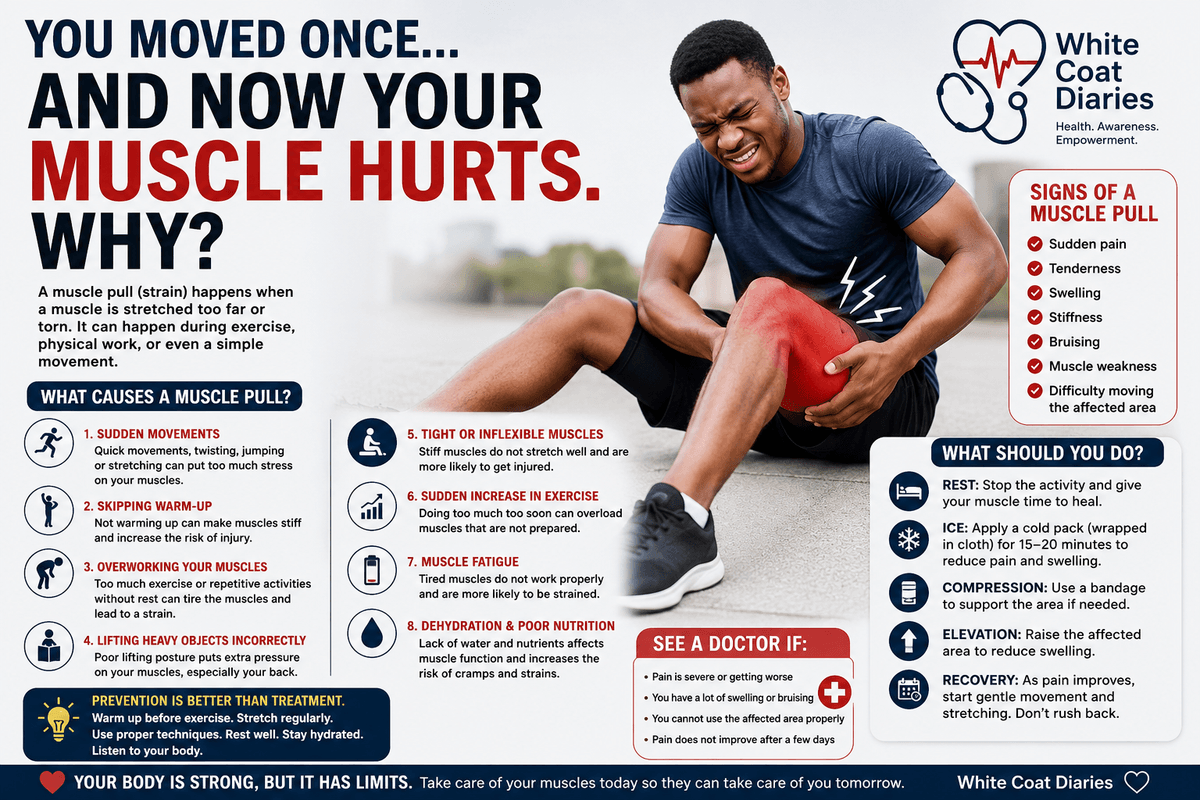
Have you ever made one simple movement and suddenly felt a sharp pain in your thigh, back, shoulder, or arm?
You may have only stretched, bent down, stood up, ran, jumped, or lifted something—and suddenly, ouch! Your muscle starts hurting.
You might even wonder, “How did this happen? I barely did anything!”
One possible explanation is a muscle pull, also called a muscle strain.
A muscle pull happens when a muscle is stretched beyond its normal limit or when some of its fibres are damaged. It can happen during exercise, sports, physical work, or even during an everyday movement.
SO, WHAT REALLY CAUSES A MUSCLE PULL?
1. SUDDEN MOVEMENTS
Your muscles may not always be ready for sudden movements. Quickly changing direction, jumping, sprinting, twisting your body, or suddenly stretching can place excessive stress on a muscle.
This is why you should be careful when starting physical activities, especially if your body is not used to them.
2. SKIPPING YOUR WARM-UP
Imagine turning on a car and immediately driving at top speed. Your body also needs time to prepare.
Going straight into intense exercise without warming up can increase the risk of muscle injury. A proper warm-up gradually prepares your muscles and joints for more demanding movements.
Even a few minutes of gentle movement before exercise can be useful.
3. OVERWORKING YOUR MUSCLES
Your muscles are strong, but they are not machines.
Exercising too hard, doing repetitive physical work, or training the same muscle repeatedly without enough recovery can cause fatigue. When tired muscles continue to work under heavy stress, they become more vulnerable to injury.
Rest is not laziness. Rest is part of recovery.
4. LIFTING HEAVY OBJECTS INCORRECTLY
Have you ever tried to lift something heavy and immediately felt pain in your back?
The problem may not always be the object itself. The way you lift it matters.
Bending, twisting, or using poor technique while lifting can place excessive stress on your muscles. This can lead to a strain, particularly in the lower back.
5. TIGHT OR LESS FLEXIBLE MUSCLES
Muscles that are very tight may not tolerate sudden stretching very well. Limited flexibility can make certain movements more difficult and may increase the risk of injury.
Gentle stretching and regular movement can help maintain flexibility.
6. SUDDENLY INCREASING YOUR EXERCISE
Maybe you have not exercised for several months, and one morning you decide to run for an hour.
Your motivation is excellent—but your muscles may not be ready!
Increasing exercise too quickly can overload muscles that have not had time to adapt. It is better to start gradually and increase the intensity over time.
7. MUSCLE FATIGUE
When your muscles become extremely tired, they may not perform as efficiently. Your movements can become less controlled, and this may increase the chance of straining a muscle.
Knowing when to stop can save you from an unnecessary injury.
HOW DO YOU KNOW YOU HAVE PULLED A MUSCLE?
A muscle pull may cause sudden pain, tenderness, swelling, bruising, weakness, stiffness, or difficulty moving the affected area.
The symptoms can range from mild to severe depending on how badly the muscle has been injured.
A mild strain may improve with proper rest and care, while a more serious muscle tear may require medical treatment.
WHAT SHOULD YOU DO AFTER A MUSCLE PULL?
First, stop the activity that caused the pain. Continuing to exercise through significant pain can make the injury worse.
Rest the affected muscle and avoid activities that increase the pain. During the first day or two, a cold pack wrapped in a cloth can help with pain and swelling. Do not place ice directly on your skin.
As the pain improves, gentle movement may help prevent stiffness. However, don't rush back into intense exercise just because you feel slightly better.
Give your body enough time to recover.
WHEN SHOULD YOU SEE A HEALTHCARE PROFESSIONAL?
Not every muscle pull requires medical attention, but some injuries should not be ignored.
Seek medical care if you have severe or worsening pain, significant swelling or bruising, severe weakness, difficulty using the affected body part, or symptoms that are not improving.
And remember: prevention is always better than being forced to sit out because of an injury.
Warm up before intense exercise. Increase your activity gradually. Use proper lifting techniques. Give your muscles enough rest and listen when your body tells you to slow down.
That sudden pain after one simple movement may seem mysterious, but your muscles have limits.
Your body is strong—but even strong muscles need preparation, proper care, and rest.
White Coat Diaries 🤍 — helping you understand your body, one health story at a time.