Writers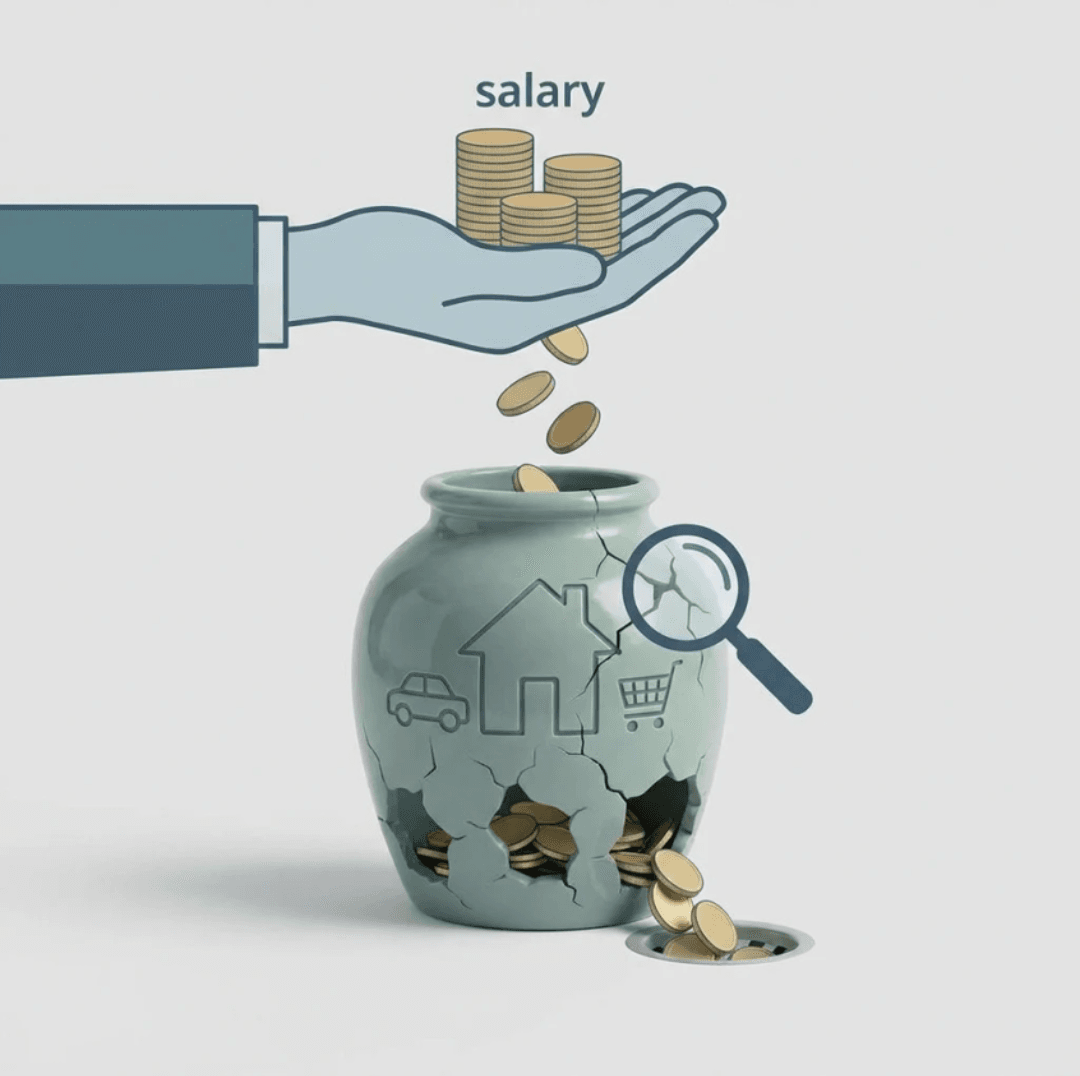
You got the raise. You still feel broke.
That gap between "earning more" and "feeling financially secure" trips up more people than any budgeting app cares to admit. It's tempting to blame the number on your paycheck. But for most people, the real issue isn't how much they make; it's what happens to the money after it arrives.
The Lifestyle Creep Trap
Every time income rises, spending tends to rise with it. Psychologists call this "lifestyle inflation," and it's not a character flaw; it's a default setting.
A $10,000 raise rarely turns into $10,000 in savings. Instead, it quietly becomes a nicer apartment, a few more takeout dinners, a slightly newer car. None of these choices feels reckless in the moment. Together, they can erase the entire benefit of earning more.
The uncomfortable truth: if your expenses grow at the same rate as your income, a raise changes nothing except the size of the numbers on your statements.
Example: Someone earning $50,000 and saving 10% puts away $5,000 a year. If their income jumps to $65,000 but their savings rate stays at 10%, they're still only banking $6,500 — a small gain relative to the raise, especially after taxes.
Where the Money Actually Goes
Most people can't say, with confidence, where their last $500 went. Not because they're careless, but because modern spending is designed to be frictionless. Subscriptions renew silently. Card taps don't feel like spending money the way handing over cash does. Delivery apps remove the last bit of effort between wanting something and buying it.
This isn't about guilt. It's about visibility. You can't fix a leak you can't see.
A Simple Exercise
Pull up your last two months of bank and card statements. Don't judge — just categorize. Housing, food, transportation, subscriptions, discretionary spending. Most people find at least one category that's quietly grown without a conscious decision behind it.
That's usually where the "missing" salary went.
Fixed Costs Are the Real Ceiling
Income problems get attention because they're visible and emotionally satisfying to blame. Fixed costs are less exciting to examine, but they often do more damage.
Rent or mortgage payments, car loans, insurance, and subscriptions lock in a baseline of spending before a single discretionary dollar is touched. If fixed costs consume 70% of take-home pay, no amount of coupon-clipping on groceries will create meaningful breathing room.
This is why two people earning the same salary can have wildly different financial outcomes. One signed a lease that eats 40% of their income; the other kept it closer to 25%. The paycheck was identical. The trajectory wasn't.
Practical takeaway: Before chasing a raise, look at your biggest fixed obligations first. A $200/month reduction in a recurring cost — a cheaper car payment, a renegotiated insurance rate, a smaller apartment — often outweighs a 5% raise after taxes.
The Debt Multiplier
High-interest debt changes the math entirely. Money that goes toward interest payments isn't building anything; it's covering the cost of past spending.
A credit card balance carried month to month, accruing double-digit interest, can quietly consume a raise before it ever reaches savings. This is one of the clearest cases where income isn't the bottleneck. The bottleneck is the interest rate working against you.
If this applies to you, the order of operations matters:
Identify the highest-interest debt first.
Direct any extra income there before increasing lifestyle spending.
Automate the payment so it doesn't compete with daily spending decisions.
None of this requires earning more. It requires redirecting what's already coming in.
No System Means No Progress
A salary without a system is just cash flow — it comes in, and it finds somewhere to go. Without a plan, spending naturally expands to match income, because there's no structure telling it otherwise.
A system doesn't need to be complicated. It can be as simple as:
A percentage of every paycheck moved automatically into savings before you see it
A monthly check-in on fixed costs, even a 10-minute one
One "spending category" you track closely, rather than trying to track everything
The goal isn't perfection. It's creating a small amount of friction between earning money and spending it, so decisions become conscious instead of automatic.
What Actually Moves the Needle
If salary isn't the core issue, three things usually are:
Awareness — knowing where money goes, not guessing.
Fixed costs — the recurring obligations that set your financial floor before discretionary choices even begin.
Automation — removing the temptation to spend money before it's saved.
Chasing a bigger paycheck can still be worthwhile. But it solves the wrong problem for most people, because the habits and structures around spending don't automatically improve with income. In fact, more income often just gives bad habits more room to expand.
A Better Question to Ask
Instead of "How do I earn more?" try asking: "Where is my current income actually going, and does that match what I say I value?"
That question tends to be more uncomfortable and more useful. It shifts the focus from something you can't always control (your salary) to something you can: your spending decisions, your fixed obligations, and the systems you build around both.
A raise feels like progress. But without visibility into spending, control over fixed costs, and a system to direct new income intentionally, more money often just means more spending not more security.
Before blaming your paycheck, take an honest look at what's happening to the money you already have. That's usually where the real problem and the real solution is hiding.