 Writers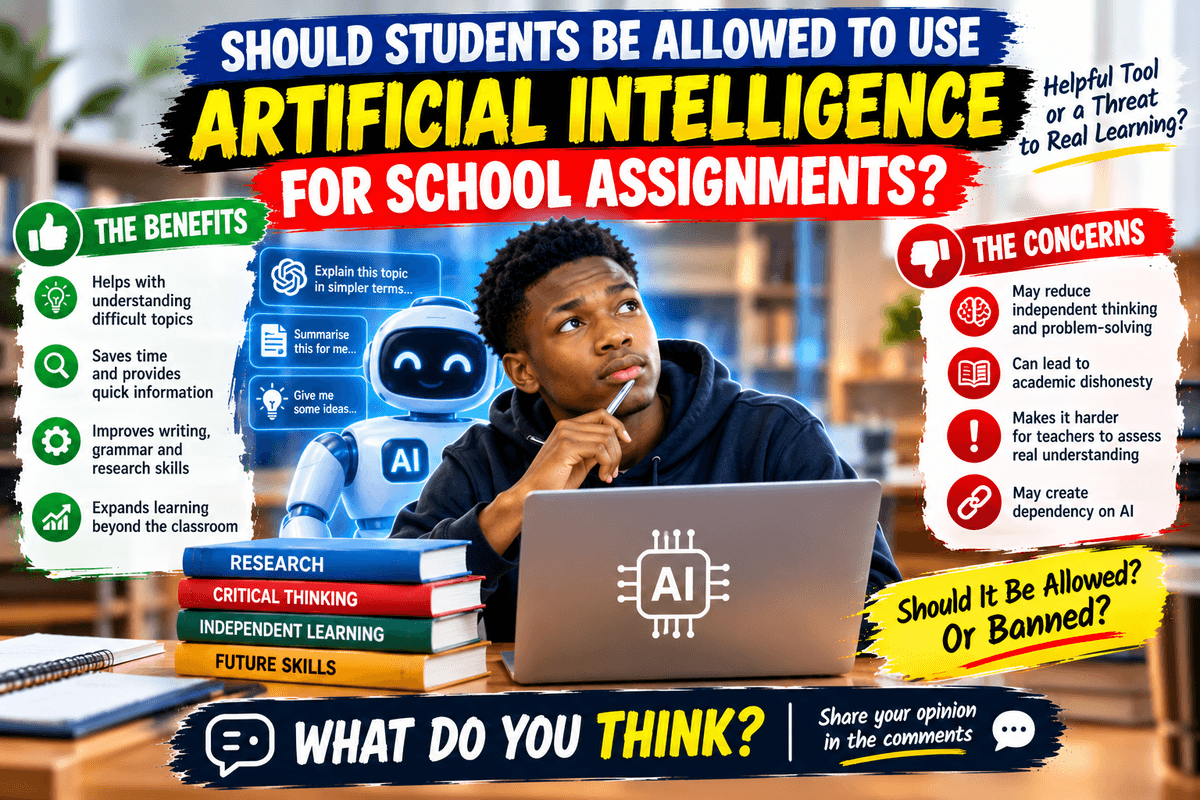
Artificial intelligence has quickly become part of everyday life. Students can now use AI tools to explain difficult topics, generate ideas, summarise information, correct grammar and assist with research.
But this development has created a serious debate in education:
Should students be allowed to use artificial intelligence for their assignments, or should schools completely restrict its use?
The Argument for AI in Education
AI can be a useful learning tool when students use it properly.
A student who does not understand a particular topic can ask an AI tool to explain it in simpler language. Another student can use it to generate questions for revision or receive assistance with grammar and writing.
AI can also help students explore subjects beyond what is available in their classroom.
Used in this way, AI does not necessarily replace learning. Instead, it can become another educational resource, similar to textbooks, libraries and other digital resources.
But There Is a Serious Problem
The biggest concern is what happens when students allow AI to do all their academic work for them.
A student may receive an assignment, enter the question into an AI tool and submit the response without reading, understanding or researching the topic.
The student may receive a good grade, but what have they actually learned?
Education is not simply about producing answers. It is also about developing the ability to think, analyse information, solve problems and communicate ideas independently.
If students constantly allow technology to think for them, they may gradually become dependent on it.
What About Academic Dishonesty?
Another concern is academic integrity.
Submitting AI-generated work as if it were entirely the student's own work can create questions about honesty and authorship.
Teachers may also find it increasingly difficult to determine whether an assignment reflects a student's actual understanding.
This creates a challenge for schools and universities. Instead of simply asking students to produce long written assignments, educators may need to place greater emphasis on discussions, presentations, practical projects, research processes and examinations that demonstrate genuine understanding.
Should AI Be Banned?
A complete ban may not necessarily be the best solution.
Technology continues to develop, and students will encounter AI in higher education, employment and everyday life. Rather than pretending AI does not exist, schools could teach students how to use it responsibly.
Students can be taught to verify information, identify errors, protect personal information, acknowledge appropriate AI assistance and use technology as a learning aid rather than a replacement for independent thinking.
The Teacher Still Matters
AI can provide information, but education involves much more than information.
Teachers understand their students, observe their progress and can provide encouragement, correction and human guidance.
A teacher can recognise when a student is struggling emotionally, socially or academically and provide appropriate support.
Technology can assist education, but it does not eliminate the importance of good teachers.
The Future of Education
The question may no longer be whether students will use AI. The more important question may be how they will use it.
A student who uses AI to understand a difficult concept and then completes the work independently is using the technology differently from a student who simply copies and submits an AI-generated answer.
The difference is not necessarily the tool itself. It is the purpose and manner of its use.
The Big Question
Should students be allowed to use AI for school assignments if they are required to understand, verify and properly use the information, or should schools completely ban AI from academic work?
If you were a teacher, would you allow your students to use AI for assignments—or would you consider it cheating?
Share your opinion in the comments.
