 Writers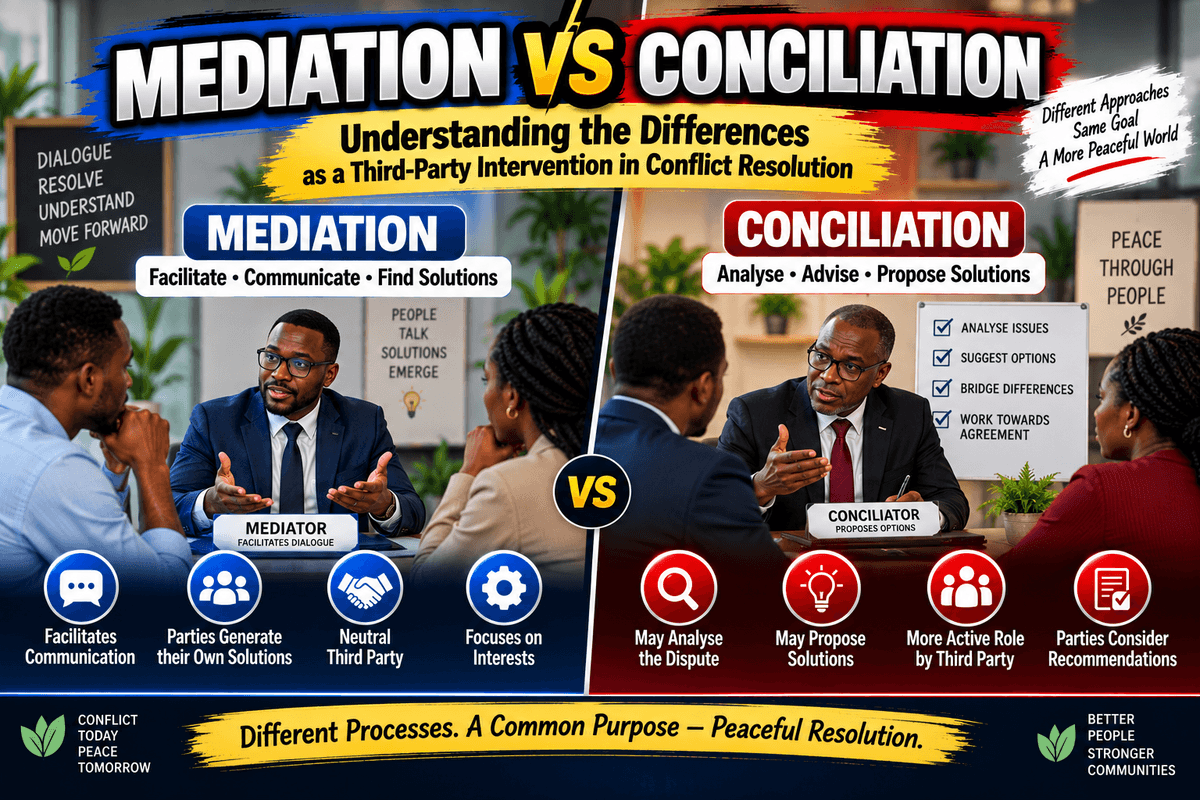
Conflict is a normal part of human interaction. Individuals, families, communities, organisations and even states can experience disagreements because of differences in interests, values, expectations, resources or perceptions.
When conflicting parties are unable to resolve their disagreement on their own, they may seek the assistance of a third party. Two important forms of third-party intervention are mediation and conciliation.
Although the two processes have similarities, they are not exactly the same. Understanding their differences can help people choose an appropriate approach when attempting to resolve a conflict peacefully.
What Is Mediation?
Mediation is a conflict-resolution process in which a neutral third party, known as a mediator, assists conflicting parties in communicating and exploring possible solutions.
The mediator does not normally make the final decision for the parties. Instead, the parties retain control over the outcome.
For example, imagine two business partners who disagree about how their company should be managed. Rather than taking the dispute immediately to court, they may agree to meet with a mediator.
The mediator can allow each partner to explain their concerns, identify areas of disagreement and agreement, and help them explore possible solutions.
The mediator's primary role is to facilitate communication and negotiation.
What Is Conciliation?
Conciliation is also a third-party conflict-resolution process. Like a mediator, a conciliator helps conflicting parties communicate and work toward resolving their disagreement.
However, conciliation can involve a more active role by the third party. Depending on the particular setting and rules governing the process, a conciliator may evaluate the issues, clarify positions and propose or recommend possible solutions to the parties.
For example, if two employees have a serious workplace disagreement, a conciliator may meet with them separately, understand the concerns of each person and then suggest possible ways of addressing the dispute.
The parties can consider the proposed solution, but the conciliator does not necessarily have the authority to impose it.
It is important to note that the exact distinction between mediation and conciliation can vary depending on the country, institution or legal framework involved. In some contexts, the terms are even used interchangeably.
Key Differences Between Mediation and Conciliation
1. Role of the Third Party
One of the most commonly identified differences concerns the role of the third party.
A mediator primarily facilitates communication and negotiation, helping the parties develop their own solutions.
A conciliator may take a more active role by analysing the dispute and, where appropriate, suggesting possible solutions.
2. Development of Solutions
In mediation, the parties are generally encouraged to generate and negotiate their own options.
In conciliation, the conciliator may contribute ideas or recommendations for resolving the dispute.
This does not mean that the conciliator automatically decides the outcome. The parties generally retain an important role in determining whether they accept a proposed solution.
3. Level of Intervention
Mediation is often described as a relatively facilitative process. The mediator creates an environment in which the parties can communicate more effectively.
Conciliation can be more interventionist, because the conciliator may become more involved in analysing the dispute and suggesting ways forward.
4. Focus of the Process
Both processes seek peaceful resolution, but mediation often places strong emphasis on communication, interests and voluntary agreement.
Conciliation may place greater emphasis on identifying the issues and helping the parties consider specific proposals for settlement.
Similarities Between Mediation and Conciliation
Despite these differences, mediation and conciliation have several similarities.
Both involve a third party who assists people or groups experiencing conflict.
Both can provide an alternative to more adversarial approaches to dispute resolution.
Both can encourage communication, reduce tension and help parties understand the concerns of the other side.
Both may also help preserve relationships because they give conflicting parties an opportunity to resolve their differences without necessarily turning the dispute into a prolonged confrontation.
Most importantly, neither process should be confused with simply forcing people to agree. Effective third-party intervention requires appropriate procedures, fairness and meaningful participation by the parties.
Why Are These Processes Important?
Mediation and conciliation can be particularly useful where the conflicting parties have an ongoing relationship.
Consider a family, workplace, community or business dispute. Even after the immediate disagreement is resolved, the parties may still have to interact with one another.
A constructive resolution can therefore be more valuable than simply determining who won and who lost.
These processes can also encourage people to focus on solutions rather than blame.
Instead of asking only, “Who is responsible?”, the parties can begin asking:
“What caused the disagreement?”
“What does each side need?”
“What can we do to resolve the problem?”
“How can we prevent the same conflict from happening again?”
Conclusion
Mediation and conciliation are both important forms of third-party intervention in conflict resolution. While they share many characteristics, a commonly recognised distinction is that mediation generally emphasises facilitating the parties' own negotiation, while conciliation may allow the third party to take a more active role in analysing the dispute and proposing possible solutions.
Neither approach is automatically suitable for every conflict. The nature of the dispute, the relationship between the parties, their willingness to participate and the applicable rules can all influence which process is appropriate.
Ultimately, the purpose of third-party intervention is not simply to end an argument. It is to create an opportunity for conflicting parties to communicate, understand their differences and work toward a peaceful and acceptable way forward.
Conflict may divide people, but constructive dialogue can create a pathway toward resolution.
