 Writers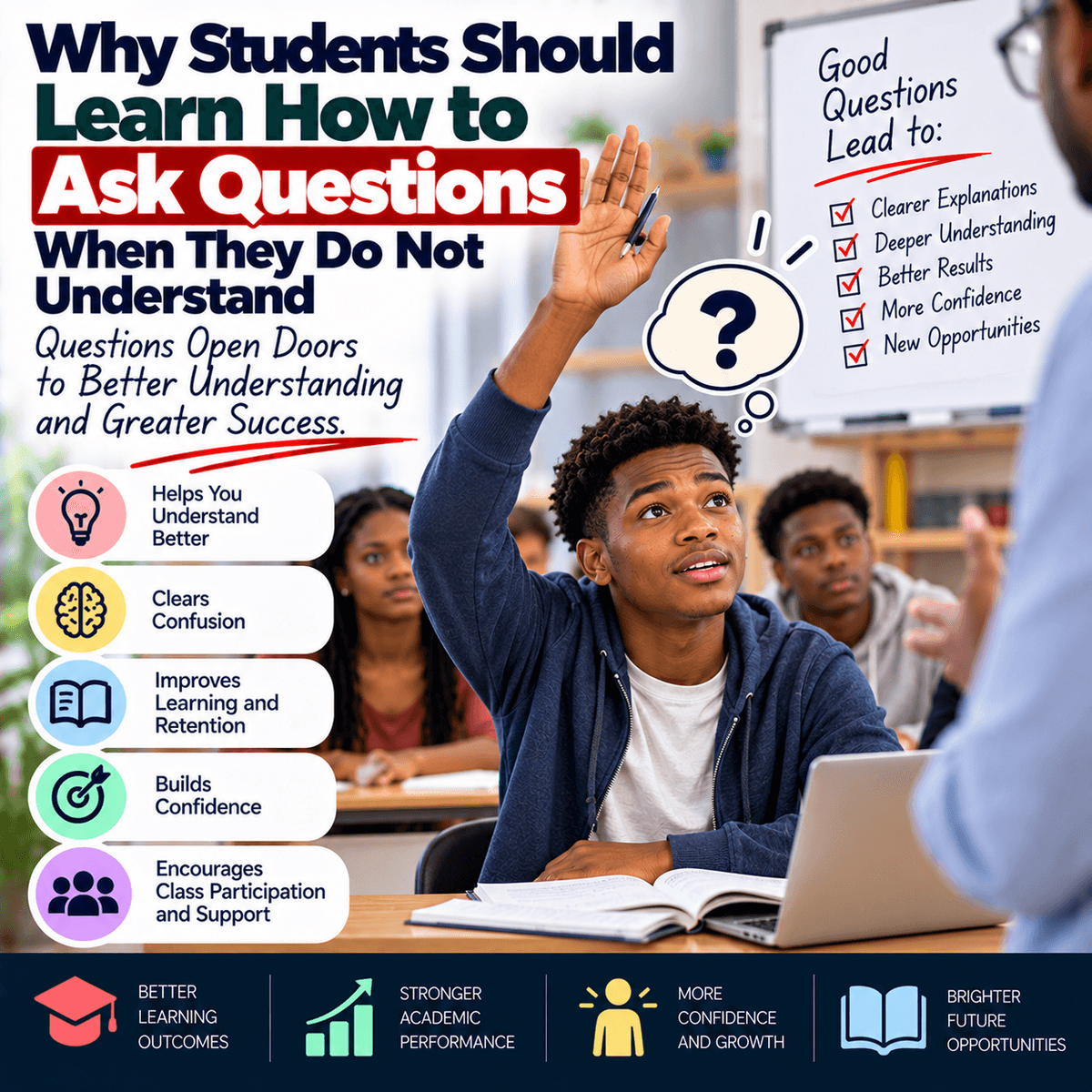
One of the most important habits a student can develop is the ability to ask questions when something is not clear. Many students attend classes, listen to lectures and take notes but remain silent when they do not understand a particular point. Some are afraid that their classmates will think they are not intelligent. Others worry that the teacher may consider the question too simple, while some believe they should understand everything immediately after it has been explained once. As a result, they leave the classroom with unanswered questions and continue to the next topic without fully understanding the previous one. This can create difficulties because learning often builds from one idea to another. If a student does not understand a basic concept, more advanced parts of the subject may become increasingly difficult. Asking a question is therefore not a sign of poor ability. It is a practical way to identify what is missing from your understanding and obtain the information you need. Good students are not necessarily people who understand everything immediately. They are often people who recognise what they do not understand and take steps to improve their knowledge. Teachers and lecturers may also be unaware that students are confused unless someone asks for clarification. A lesson that seems clear from the teacher's point of view may contain unfamiliar terms or difficult explanations for students encountering the subject for the first time. By asking questions, students become active participants in their education rather than simply receiving information. They begin to take responsibility for understanding what they are being taught instead of hoping that confusion will disappear on its own.
Learning how to ask useful questions can make this habit even more effective. Instead of simply saying, “I don't understand,” try to identify the exact point causing the difficulty. For example, you could say that you understand the definition but do not understand how it applies to the example given in class. In mathematics, you might understand the formula but be unsure why a particular step was taken during the calculation. In a history class, you may understand what happened but want clarification about why the event was important. Specific questions make it easier for a teacher to identify the problem and provide a useful explanation. Before asking, it can help to briefly review what has already been explained. Sometimes you may discover that the answer is already in your notes, textbook or course material. However, students should not spend excessive time struggling with a problem simply because they are afraid to ask for help. If you have made a reasonable effort and still do not understand, ask. The timing and method can depend on the learning environment. Some questions can be asked during the lesson, while longer or more personal questions may be better discussed after class, during office hours or through an approved communication channel. Online students can use discussion boards, class groups or other channels provided by their institution. Whatever method you use, be respectful and clear. Explain what you have already tried and where you became confused. This shows that you are not simply asking someone else to do the work for you; you are seeking help to understand how to do it yourself.
Asking questions can also improve critical thinking because education should involve more than memorising information. Students need to learn how to examine ideas, compare evidence and understand why a conclusion is reasonable. Questions such as “What evidence supports this claim?”, “Why does this method work?”, “What would happen if this condition changed?” and “How is this idea different from the one we studied earlier?” encourage deeper learning. This is particularly important today because students can find large amounts of information online within seconds. Search engines, social media, video platforms and artificial intelligence tools can provide answers quickly, but a fast answer is not necessarily a correct or complete one. Students who have developed the habit of asking good questions are better prepared to evaluate what they find. Instead of accepting an online statement because it sounds convincing, they can ask who produced the information, what evidence supports it and whether other reliable sources agree. The same principle applies when using artificial intelligence for learning. An AI tool may help explain a difficult concept or provide another example, but students should not assume that every response is accurate. Important information should be checked against course materials and reliable sources. Students should also avoid using technology simply to obtain answers to assignments they do not understand. Getting the final answer without understanding the process may help complete one task, but it does little to prepare the student for an examination or a future situation where the same knowledge must be applied independently. Questions should therefore be used to improve understanding, not merely to avoid the effort involved in learning.
A classroom where students feel comfortable asking questions can benefit everyone. One student may ask about something that several classmates also found confusing but were unwilling to mention. The teacher's explanation can therefore help more than one person. Questions can also give teachers useful feedback about their lessons. If many students struggle with the same concept, the teacher may decide to explain it differently, provide another example or spend more time on the topic. Students can also learn from one another's questions because another person may approach a subject from a perspective they had not considered. However, asking questions should be balanced with listening. If a question has just been answered, repeatedly asking the same thing because you were distracted does not support effective learning. Students should pay attention, take useful notes and make an effort to follow the lesson. They should also respect other people's opportunities to participate rather than using every class discussion to dominate the conversation. Teachers, for their part, can encourage questions by responding respectfully and avoiding unnecessary embarrassment when a student is confused. A student who is mocked for asking a basic question may become reluctant to speak again. Education works better when questions are treated as a normal part of learning. Even outside formal classes, study groups can provide opportunities to ask and answer questions. Explaining an idea to another student can reveal whether you truly understand it, while hearing another explanation may make a difficult concept easier to understand. The goal should be shared learning rather than making anyone feel inferior because they need clarification.
The ability to ask questions remains valuable long after a student leaves school. In the workplace, employees need to ask questions when instructions are unclear, especially when making the wrong assumption could lead to wasted time, financial loss or other problems. Someone starting a new job may need to ask how a particular process works instead of pretending to understand and making avoidable mistakes. Business owners ask questions to understand customers and suppliers. Professionals ask questions to gather information before making decisions. People also need to ask questions when dealing with financial services, contracts, healthcare, technology and other important areas of life. Students can prepare for these situations by becoming comfortable with seeking clarification now. Start by accepting that you will not understand everything immediately. When confusion occurs, identify exactly what you know and what you do not know. Review your notes or learning materials, attempt the problem where appropriate and then ask a clear question if you still need help. Write questions down during lectures if there is no opportunity to ask immediately, and make sure you return to them later rather than forgetting them. Most importantly, focus on understanding the answer. Do not ask a question simply to receive information that you immediately copy without thinking about it. Listen carefully, connect the explanation to what you already know and try to apply it yourself. Education becomes more useful when students are willing to admit that something is unclear and actively seek understanding. A simple question asked at the right time can prevent a small gap in knowledge from becoming a much larger problem later.
