 Writers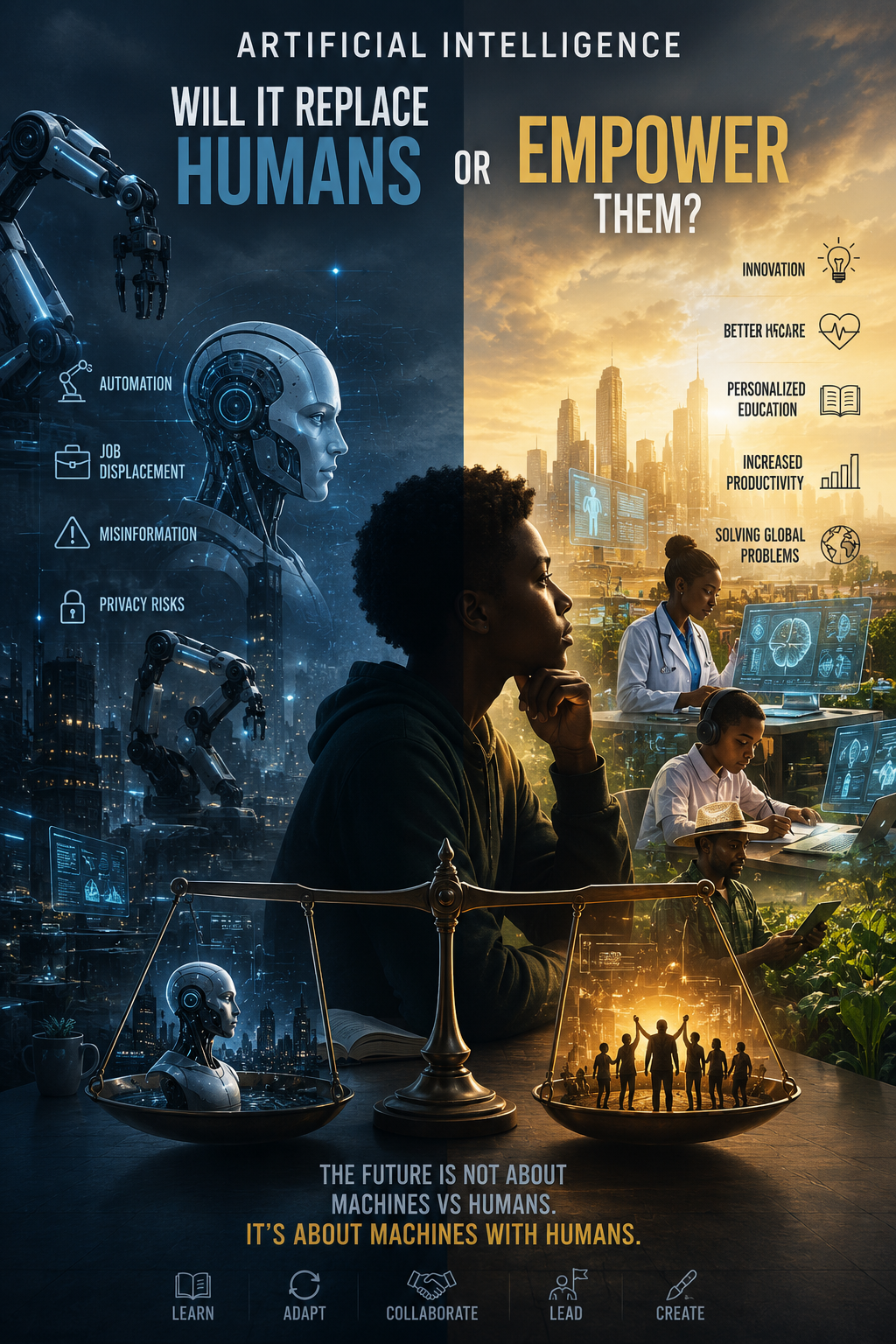
ARTIFICIAL INTELLIGENCE: Will It Replace Humans or Empower Them?
"The greatest fear about Artificial Intelligence is not that machines will become smarter than humans, but that humans may stop thinking for themselves."
Imagine waking up one morning to discover that your teacher has been replaced by a robot, your doctor is an AI assistant, your favorite songs are composed by a computer, and even your news articles are written by machines. It sounds like a scene from a science fiction movie, yet many of these things are already happening today. This raises an important question: Will Artificial Intelligence replace humans, or will it empower us?
Artificial Intelligence (AI) refers to computer systems designed to perform tasks that normally require human intelligence. These tasks include learning, problem-solving, understanding language, recognizing images, and making decisions. AI has become part of our everyday lives, often without us realizing it. Every time Netflix recommends a movie, Google Maps finds the fastest route, or a virtual assistant answers a question, AI is quietly at work.
The rapid growth of AI has sparked excitement and concern in equal measure. Some people believe that AI will eventually replace humans in many professions. In fact, certain jobs have already changed because of automation. Banks now use automated teller machines, supermarkets have self-checkout systems, and many factories rely on robots to assemble products faster than humans can. This has created fears that millions of workers may lose their jobs in the future.
However, history teaches us that every major technological advancement changes the way people work rather than eliminating the need for people altogether. When computers became common, many feared they would replace office workers. Instead, they created entirely new careers in software development, cybersecurity, digital marketing, and information technology. Likewise, AI is creating new opportunities that did not exist just a few years ago, including AI trainers, prompt engineers, machine learning specialists, and ethics consultants.
Beyond employment, AI has brought remarkable improvements to healthcare. Doctors now use AI to detect diseases earlier, analyze medical images more accurately, and support complex diagnoses. In education, students can receive personalized learning support, while teachers use AI tools to prepare lessons more efficiently. Farmers use AI to monitor crops and predict weather patterns, helping them produce more food with fewer resources. These examples show that AI can become a powerful partner rather than a competitor.
Nevertheless, AI also presents serious challenges. One of the biggest concerns is misinformation. AI can generate realistic fake videos, images, and articles that make it difficult to distinguish truth from falsehood. Privacy is another issue, as AI systems often rely on large amounts of personal data. There is also the danger of becoming overly dependent on technology. If people stop thinking critically or developing their own skills because AI can perform tasks for them, society may lose valuable human creativity and judgment.
Despite these concerns, there are qualities that AI cannot truly replace. A machine can process information at incredible speed, but it cannot genuinely love, forgive, comfort someone in pain, or understand the depth of human emotions. Compassion, moral responsibility, creativity inspired by personal experience, and ethical decision-making remain uniquely human strengths. These qualities remind us that intelligence alone does not define humanity.
The future will not belong to those who compete against AI but to those who learn how to work alongside it. Students should develop skills such as critical thinking, communication, creativity, leadership, and emotional intelligence. These abilities will remain valuable regardless of how advanced technology becomes. Instead of fearing AI, we should focus on using it responsibly to solve problems, improve productivity, and create a better world.
Artificial Intelligence is neither our enemy nor our savior. It is a tool, and like every tool, its impact depends on the hands that use it. If guided by wisdom, ethics, and human values, AI can empower individuals, transform industries, and improve lives. But if used carelessly, it can create new risks and deepen existing challenges.
As we step into the future, perhaps the real question is no longer "Will AI replace humans?" Instead, we should ask ourselves, "Are we preparing ourselves to become the kind of humans that AI can never replace?