Writers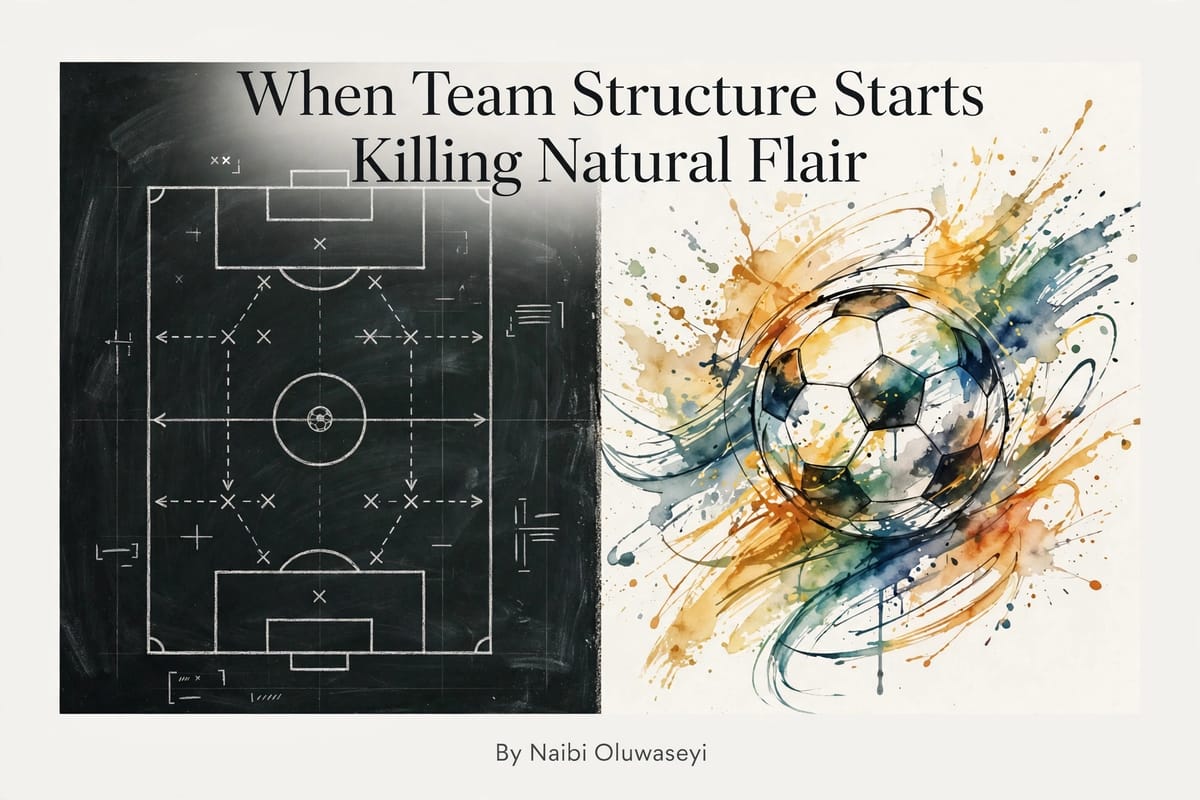
There was a time when football was not just about formations, statistics, pressing systems and positional discipline. Football was also about expression.
It was about the player who received the ball and made you lean forward because you genuinely didn't know what he was going to do next.
Players like Ronaldinho and Austin “Jay-Jay” Okocha represented that football.
They weren't simply footballers. They were entertainers. They played with imagination, confidence and freedom. They could take a simple situation and turn it into something beautiful.
Today, I sometimes wonder whether that type of footballer is slowly disappearing.
Not because football has stopped producing talented players, but because modern football increasingly demands that individuality serve the system.
When the Player Was the System
When I think about players like Ronaldinho and Okocha, I don't first remember their statistics.
I remember the moments.
Ronaldinho receiving the ball, facing a defender and seemingly having unlimited options. Okocha standing over the ball, making a defender guess which direction he would go before producing another piece of magic.
There was unpredictability.
There was freedom.
There was personality.
You could know exactly what Okocha wanted to do and still struggle to stop him.
That is one of the things that made natural flair so special.
The Game Has Changed
Modern football is incredibly tactical.
Players are expected to understand positioning, pressing triggers, defensive transitions, passing structures and space management. Coaches can spend hours analysing an opponent's smallest weaknesses.
And this development has made football more sophisticated.
But there is another side to it.
Sometimes, the player who wants to take a risk is told to play the simple pass.
The winger who wants to take on his full-back is told to recycle possession.
The midfielder who wants to attempt a difficult pass is told to keep the ball.
The young player who repeatedly loses possession while trying to dribble may eventually learn:
Don't take the risk.
And when that happens too often, something precious can disappear.
I Miss the Football That Made Me Shout
As someone who grew up loving football, I miss those moments when a player could make you jump out of your seat simply because you knew something extraordinary was about to happen.
I remember watching players like Okocha and Ronaldinho and thinking, How did he even see that?
That feeling is difficult to explain to someone who only looks at football through statistics.
Sometimes football isn't about the percentage of successful passes.
Sometimes it is about the one pass nobody else would have attempted.
Sometimes it isn't about maintaining possession.
Sometimes it is about taking the defender on.
Sometimes the most valuable thing a player can give his team is the courage to be unpredictable.
My Manchester United Memories
This is also why my memories of Manchester United are so important to me.
The United I fell in love with wasn't simply about winning matches. It was about personality, belief and emotion.
There was always the feeling that something could happen.
A difficult game could suddenly change because somebody produced a moment of quality. A team could be behind and still make you believe a comeback was possible.
Those memories are why football became more than just a sport for me.
It was the late nights.
The celebrations.
The heartbreak.
The arguments with friends.
The excitement before big matches.
The belief that the game wasn't over until the final whistle.
And at the centre of all of that was individuality.
Players had their own personalities and their own ways of playing.
The Street Footballer Is Disappearing
I also believe the disappearance of natural flair is connected to how young players are developing.
Street football taught you to improvise.
You played against older boys. You played on rough surfaces. You had limited space. You got embarrassed when someone nutmegged you, then came back the next day determined not to let it happen again.
You learned by experimenting.
You learned how to beat your opponent.
You learned how to protect the ball.
Most importantly, you learned how to think for yourself.
Modern academies provide excellent coaching, facilities and tactical education, but there is a danger when young players become too programmed.
We can teach a child where to stand.
But we must also allow him to discover what he can do from that position.
We Don't Need Less Tactics
This isn't an argument against modern football.
Tactics matter.
Structure matters.
Teamwork matters.
A player cannot simply do whatever he wants for ninety minutes.
The problem comes when structure becomes so important that individuality becomes a problem.
The ideal footballer should understand the system but still have the freedom to break away from it when the moment demands it.
Teach the player when to pass.
But also teach him when to take responsibility.
Teach him how to defend.
But don't remove his attacking instincts.
Teach him discipline.
But don't destroy his imagination.
We Need Another Generation of Magicians
Football needs players who can still make us ask:
“How did he do that?”
We need the dribblers.
The risk-takers.
The players who see passes that others don't.
The players who can turn a boring 0–0 match into a moment of magic.
Ronaldinho and Okocha remind us of what football can be when talent is allowed to breathe.
They remind us that football isn't only about efficiency.
It is also about joy.
It is about creativity.
It is about expression.
It is about making people fall in love with the game.
Let Them Play
Modern football will continue to evolve, and it should.
But we should be careful about what we lose along the way.
Because if every player becomes perfectly disciplined, perfectly positioned and perfectly predictable, we may eventually have a game that is tactically impressive but emotionally empty.
Football needs structure.
But football also needs freedom.
It needs coaches.
But it also needs artists.
It needs systems.
But it needs players brave enough to occasionally break those systems.
Because when I remember why I fell in love with football, I don't remember the tactical diagrams.
I remember the magic.
I remember players like Ronaldinho and Austin “Jay-Jay” Okocha, doing things that seemed impossible.
I remember watching football and wondering what would happen next.
And perhaps that is the greatest thing we can give the next generation of footballers:
Teach them the system—but don't teach the magic out of them.
Let them play.
Let them express themselves.
Let them take risks.
Because football without flair may still be football.
But football without imagination will never feel quite the same.