Writers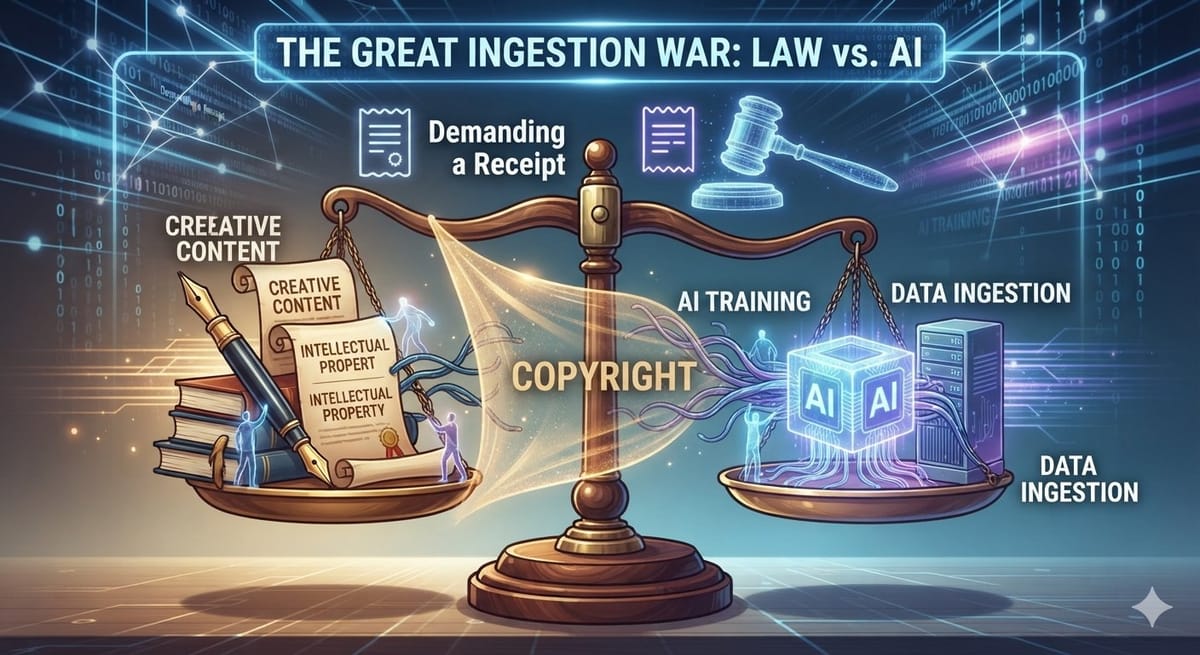
The AI Loophole Just Closed: Why the Courts are Finally Demanding a Receipt for Our Words
For those of us who make our living by writing, there is a existential crisis brewing in the courts that will directly impact our ability to earn a living. We are currently witnessing the closing of what could be called "The Great Ingestion War" - a total paradigm shift that will redefine the relationship between writers and artificial intelligence for decades.
Consider the analogy: Imagine spending years building up a beautiful library, only to have a tech company come in, have a robot read through all of your books for free, and use that information to build a competing library right next door to yours. When you go to court to sue them, they defend themselves by saying "We didn't copy your pages, we merely trained our robot on your content"
For years, this has been the industry standard, with tech conglomerates essentially stealing our articles, stories, and research for free under the umbrella of "fair use"
But the feds just shut that loophole wide open.
In a landmark decision, a federal appellate court ruled that it is not "fair use" to appropriate a competitor's proprietary information to create a product that directly competes with the source of that information. This means that AI companies may no longer freely use snippets of human writing to boost their search rankings or power their own content farms.
But here's the twist - this seismic shift in copyright law has actually created a civil war in Washington, with the Department of Justice fighting to defend the AI companies in one court while fighting for their own life in another.
Just days prior to the filing, the DOJ jumped into the New York Times vs. OpenAI lawsuit to defend the right of AI companies to use intellectual property without permission. The government's position was that forcing AI companies to pay for content would stifle American innovation and hurt the competitiveness of the US tech sector on the global stage.
Meanwhile, human writers and creators are screaming into the void that Big Tech should not be able to exploit human intellectual property to build their own content empires. And just to throw gasoline on the fire, across the pond in the UK, the Supreme Court recently ruled that AI software configurations can be patented for the first time ever.
How This Affects Independent Creators, Bloggers and Publishers
While this turn of events certainly makes for good courtroom drama, you may be wondering how it affects your own writing habits and income streams. In fact, this development is an absolute gift to independent creators, bloggers and online publishers. Here are the ways this particular thunderstorm is about to drop some much-needed rain on our industry:
The Emergence of the Data Licensing Economy: AI researchers have discovered that scraping random forum posts yields poor results, as the information is often of low quality and rife with errors. They now need clean, high-quality data to train their language models on - and due to these lawsuits, they are willing to pay top dollar for it. Thanks to our friends at the court, companies that host our articles, blogs, stories and essays can now directly monetize this demand by striking a deal with AI researchers
We Finally Have Legal Leverage Against Large Language Models: Say a blogger writes an informative post about a specific subject, and an AI uses that information to build a blog post about the same exact topic. Previously, this would have had no legal recourse since the AI did not directly copy the content. This new ruling now allows us to demand that AI companies compensate us for using our content to train their large language models
Niche Content and Expert Writing Will See a Sudden Surge in Value: Information that is readily available to the public will now become commoditized, since any AI can write it in a heartbeat. However, unique perspectives and opinions will become more valuable than ever before. This is an enormous opportunity for bloggers, essay writers, and researchers to monetize their unique content by publishing it on a platform that can prevent plagiarism and monetize it through a licensing program as described above.
The Downside: The Slow Death of the Open Web
Naturally, this development cannot happen without casualties on either side. Due to human content becoming a valuable asset class, many companies are moving to segment the open web and monetize their content through a proprietary network.
This comes at a great cost: The death spiral of the open web cuts off vital discovery sources for us as writers, making it that much harder to find new audiences and build new sources of income.
The Wild West frontier of AI technology finally came to a sudden and decisive end, and the law is now catching up with the reality on the ground. But what do you think? Should AI models be able to freely consume the internet to power humanity's new technological revolution, or should content creators be able to monetize their work and protect their intellectual property? Let's discuss in the comments!
Further Reading and Resources
For those that wish to read more about this fascinating development and follow the legal and corporate intrigue, I recommend the following resources:
The Thomson Reuters Appellate Ruling: Review the full ruling and analysis of the case on Reuters Legal News (reuters.com)
The DOJ's Interventions and the Publisher Backlash: Learn more about the political drama unfolding in Washington on POLITICO Tech (politico.com)
In-Depth Commentary on the Fair Use Implications: More information on how this case affects the publishing world at Words and Money legal commentary (wordsandmoney.com)
UK Supreme Court's Patent Ruling Review: Read more about the changes to copyright law in the United Kingdom at Lexology Intellectual Property Library (lexology.com)