Writers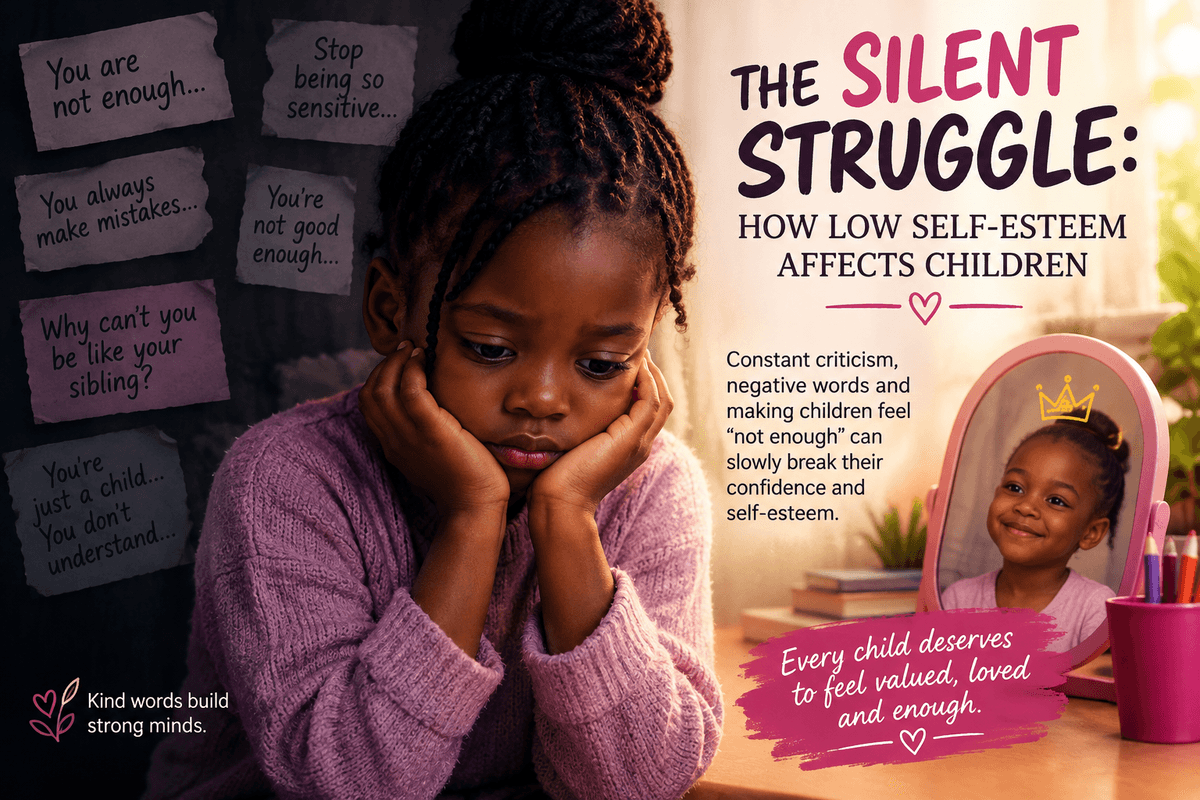
THE SILENT STRUGGLE: HOW LOW SELF-ESTEEM AFFECTS CHILDREN
We often forget that self-esteem is also a crucial part of a child’s life. It shapes the way our children see themselves and, in many ways, influences the people they grow up to become.
Self-esteem, as the name implies, is the way people see and value themselves, including how worthy, capable, and confident they feel as a person. In the life of a growing child, it is important that a child is brought up knowing fully well that he or she is enough. This is not because a child does not make mistakes; it is because parents should teach their children that making mistakes does not make them less valuable.
A child needs to grow up knowing that they can learn, improve, and still be loved even when they make mistakes. When this foundation is missing, children may begin to see themselves through the negative words and experiences around them.
For a child to grow up with low self-esteem, there are usually causes and circumstances surrounding that attitude.
1. Constant Criticism
This is a major cause of low self-esteem in children. It is one thing to be there as a parent, but it is another thing to be there and do it the right way.
Children are still young and have developing minds. As such, they remember the words that are said to them and carry them in their minds as they grow up. For a child who has constantly been told, “You are not enough,” “Why are you this slow?” or “You are embarrassing me,” that child may grow up carrying those words and become emotionally distant.
The child grows up thinking and doubting their capabilities, always being overly cautious and sensitive so as not to embarrass their parents. They may become quiet, insecure, and afraid to voice out their opinions about certain things.
Correction is important, but the way a child is corrected matters. A child can be corrected without being made to feel worthless.
2. Bullying
The word bullying is tough, for a child who is being bullied by fellow students. It is saddening. A parent may believe, “I have taken my child to school; I have done my part.” No, you haven’t. It is your responsibility to make sure that your child is okay, both physically and mentally, in that school.
Bullying is common in schools—schools that are meant to be molding a child’s future but can sometimes become a source of danger to the child. A child being bullied in school can grow up with low self-esteem, allowing people to talk down to him or her and making them feel like they can never be enough.
Bullying is a major cause of low self-esteem, but it can sometimes be overlooked. A child who is constantly being laughed at, insulted, excluded, or made to feel small may begin to believe those things about themselves.
3. Comparing Children With Siblings and Neighbors
This is a very important factor for me because this is something that I also passed through.
Comparing a child to another child is not good mentally for a growing child. Why then did God give you a child if you already have the one that you wanted? You give birth to a child and then compare that same child to another child. It is unfair.
A growing child swallows everything told to him or her and registers it in their brain. The painful part is that it sticks, as if it is meant to be there. God creates children with different abilities because we are created by God in His own image and likeness, so why compare the child?
By doing so, parents may not realize that they are slowly damaging the child’s self-esteem. Later, you wonder why your child is so nervous in public and cannot stand up for themselves. It is because you may have unknowingly damaged that self-esteem in ways you thought were helping them.
A child grows up thinking, “I can’t be better than my siblings. I have to always be in the shadows while the spotlight was created for them.” It is not only being unfair to the child; it is also going against the value God placed in that child.
4. Lack of Encouragement
As funny as it may sound, a child likes being encouraged and commended for a job well done. A sentence like, “My baby, you are enough. Let nobody tell you otherwise,” can be enough to raise a child’s self-esteem.
The lack of these words brings doubt and fear into the life of the child. The child begins to ask questions that may show that something is wrong somewhere.
Questions like, “Am I really enough?” and “Can I do it?” may seem little and short, but they can have a big effect on a child’s self-esteem.
Sometimes, encouragement does not have to be complicated. A simple “I am proud of you,” “You can try again,” or “I believe in you” can remind a child that their efforts matter.
THE CONSEQUENCES OF LOW SELF-ESTEEM
We have seen the causes of low self-esteem in children. Let’s now look at the consequences of these experiences and the results they can have on our kids.
1. They Become Afraid to Speak Up
Not because they do not have the words to say, but because they are afraid of being criticized. A child may have an opinion but choose to remain silent because they are scared that what they say will be considered wrong.
2. They Doubt Their Capabilities
You could imagine a child for whom the sky is just a starting point, doubting whether they have the ability to go far in life, be what he or she wants to be, and make the place a better place.
A child should not grow up believing that their dreams are too big for them. Yet constant criticism and comparison can make them question their own abilities.
3. They May Struggle to Make Friends
Most children with low self-esteem may struggle to make friends with other people. The reason is simple and clear: they are filled with doubts.
They may constantly wonder whether people will accept them, laugh at them, or reject them. This can make it difficult for them to express themselves freely around others.
4. They May Be Scared to Try New Things Because They Fear Failure
Children are often scared to explore new things because they are afraid of failing and getting disappointed, whereas failure is also a part of life.
A child needs to understand that failing at something does not mean they are a failure. Sometimes, trying, failing, learning, and trying again is how people discover what they are capable of.
THERE IS ALWAYS A WAY FORWARD
In all this, there is no problem without a solution in this life. Teachers, parents, and adults in general have a role to play in it—even the children themselves.
Parents should actively participate in the lives of their children, correct them with love and kindness, and always whisper words of encouragement to them. It helps to boost their confidence.
Children should also learn to accept correction, learn from their mistakes, and never think that they are not enough because they are. Even the Bible bears witness to this. Always say every day, “I am beautifully and wonderfully made.”
A child may not always remember every gift they received, but they may remember the words that were repeatedly spoken to them. This is why we should be careful about the words we use when raising children.
CONCLUSION
In conclusion, a child’s self-esteem is influenced by the environment he or she is raised in. Let’s all help raise children with confidence—children who can walk into a room full of strangers and still feel like they matter.
Let us raise leaders who will make our country and the world a better place.
The spotlight is on and is waiting fo
r them to take over. Let’s not dim their light.