 Writers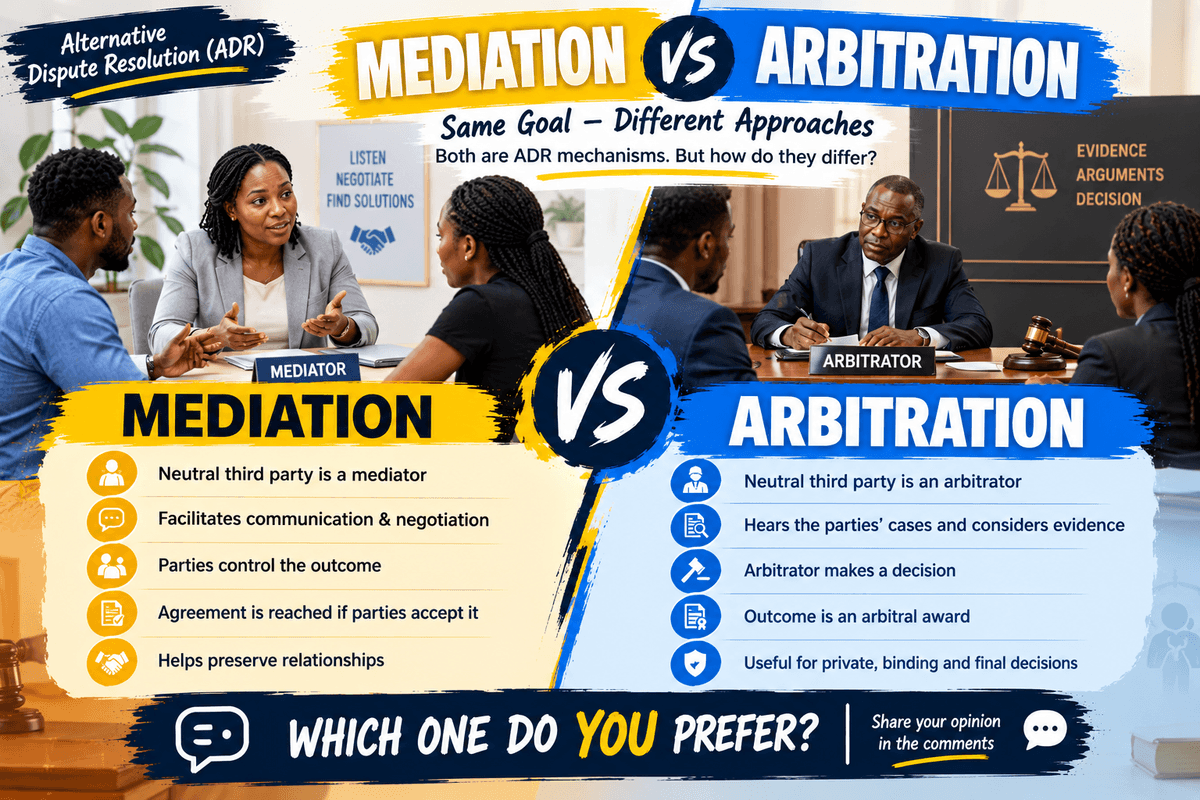
Conflicts are part of human relationships. Disagreements can occur between family members, employees and employers, business partners, landlords and tenants, communities and even organisations. While going to court is one way of resolving disputes, it is not the only option.
Alternative Dispute Resolution (ADR) provides different methods through which disputes can be resolved outside traditional litigation. Two important ADR mechanisms are mediation and arbitration.
Although both involve the intervention of a third party, they are not the same. Understanding the difference can help people choose the appropriate mechanism for resolving a particular dispute.
What Is Mediation?
Mediation is a voluntary dispute-resolution process in which a neutral third party, known as a mediator, helps people in conflict communicate and negotiate toward a mutually acceptable solution.
The mediator does not normally decide who is right or wrong. Instead, the mediator facilitates communication, identifies areas of disagreement, helps the parties understand each other's interests and encourages them to explore possible solutions.
For example, imagine two business partners who disagree about how to share profits. Instead of immediately taking the matter to court, they could agree to mediation. The mediator would listen to both sides and help them negotiate an agreement.
The final decision remains with the parties.
This means that mediation generally gives disputants greater control over the outcome.
What Is Arbitration?
Arbitration is also an ADR mechanism, but it operates differently.
In arbitration, the parties present their dispute to a neutral third party called an arbitrator, or sometimes a panel of arbitrators. The arbitrator considers the arguments and evidence presented by the parties and makes a decision known as an arbitral award.
Unlike mediation, the parties do not normally decide the outcome themselves.
For example, if two companies have a contractual dispute and their agreement contains an arbitration clause, they may refer the dispute to arbitration. Each side can present its case, and the arbitrator determines the outcome according to the applicable rules and agreement.
The Major Difference
The most important difference between mediation and arbitration is the role of the third party.
In mediation, the mediator helps the parties reach their own agreement.
In arbitration, the arbitrator decides the dispute.
This creates a fundamental difference in the level of control that disputants have over the outcome.
Mediation
The third party is called a mediator.
The mediator facilitates communication and negotiation.
The parties generally control the outcome.
An agreement is reached only if the parties accept it.
It can help preserve relationships because parties work toward a mutually acceptable solution.
Arbitration
The third party is called an arbitrator.
The arbitrator hears the parties' cases and considers the evidence.
The arbitrator makes a decision.
The outcome is an arbitral award, subject to the applicable legal framework.
It can be particularly useful for disputes where the parties want a private adjudicative process rather than court litigation.
Which One Is Better?
There is no single ADR mechanism that is automatically suitable for every dispute.
Mediation may be particularly useful where the parties want to preserve an ongoing relationship and are willing to negotiate. Family, workplace, community and business disagreements can sometimes benefit from this approach.
Arbitration may be more appropriate where parties want a neutral decision-maker to determine a contractual or commercial dispute, particularly where they have agreed to arbitrate.
The nature of the dispute, the relationship between the parties, the terms of any existing agreement and the applicable law can all influence the appropriate choice.
Can Mediation and Arbitration Work Together?
Interestingly, ADR does not always have to involve choosing only one mechanism.
Some dispute-resolution arrangements allow parties to attempt mediation first and proceed to arbitration if mediation does not produce an agreement. This approach can give disputants an opportunity to settle their disagreement themselves before moving to a more adjudicative process.
Conclusion
Mediation and arbitration are both important ADR mechanisms, but their purposes and processes are different.
Mediation helps people resolve their own dispute, while arbitration gives a neutral third party the responsibility of deciding the dispute.
Understanding this difference is important for anyone interested in conflict resolution, business, workplace disputes, community peacebuilding or access to justice.
The Big Question
If you were involved in a serious dispute, would you prefer mediation, where you and the other party negotiate the solution, or arbitration, where an independent arbitrator decides the outcome?
Which one would you trust more, and why?
Share your opinion in the comments.
