 Writers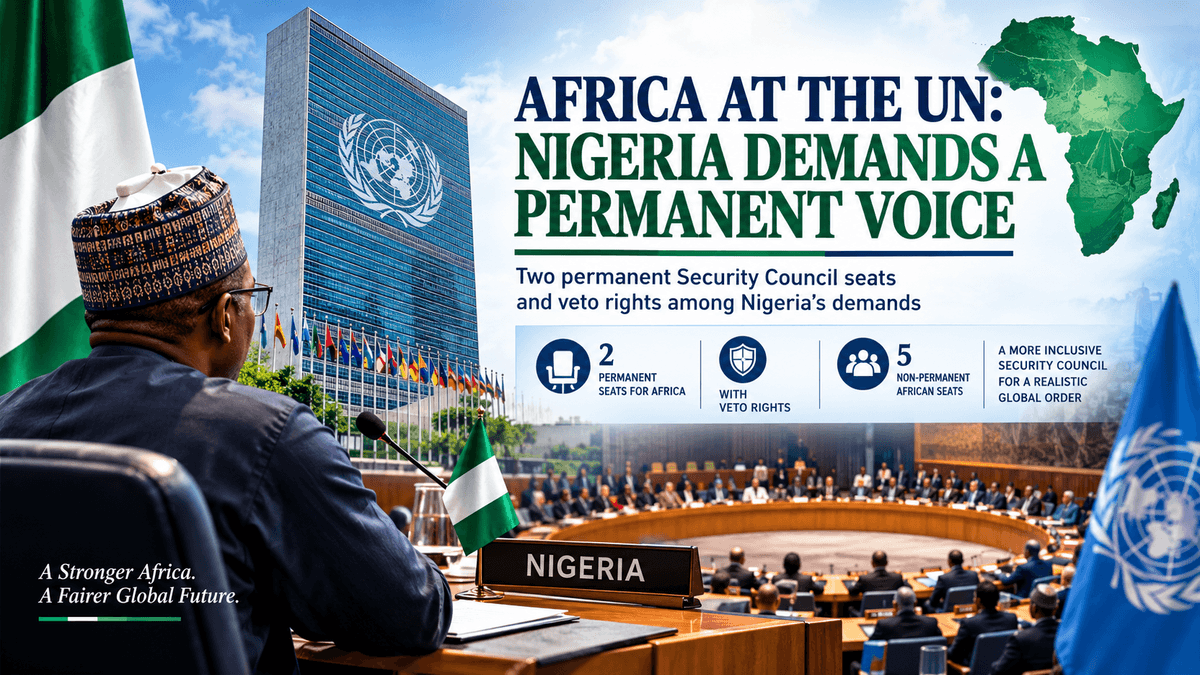
Africa at the UN: Nigeria Demands a Permanent Voice
By Kareem Usman
The debate over who gets to shape decisions at the United Nations has once again taken centre stage, and Nigeria has placed Africa’s long-standing demand for greater representation firmly on the global agenda.
At the 81st session of the United Nations General Assembly in New York, Nigeria renewed its call for a major reform of the UN Security Council, arguing that the current structure does not adequately reflect the realities of the modern world.
Nigeria’s position is clear: Africa should have permanent representation on the Security Council. The country is calling for at least two permanent seats for Africa with the same rights and privileges as existing permanent members, including veto power, alongside five non-permanent seats for the continent. (Channels Television)
The demand was presented on behalf of President Bola Ahmed Tinubu by Vice President Kashim Shettima during Nigeria’s contribution to the General Debate of the 81st UN General Assembly. The issue has become one of the recurring elements of Nigeria’s diplomacy at the United Nations.
Why Does Africa Want Permanent Seats?
The United Nations Security Council currently has 15 members: five permanent members — China, France, Russia, the United Kingdom and the United States — and ten non-permanent members elected for two-year terms. (United Nations)
None of the five permanent seats belongs to an African country.
This has remained a major point of discussion because Africa has 54 UN member states and is heavily represented in issues concerning international peace and security. UN records and discussions on Security Council reform have repeatedly highlighted Africa’s significant involvement in peacekeeping and the large proportion of Council matters connected to the continent. (Digital Library)
For African governments supporting reform, the argument is therefore not simply about obtaining prestigious positions. It is about having a permanent voice in decisions that can directly affect African countries.
Nigeria has consistently supported this position. In an official Nigerian statement earlier in 2026, the country reiterated its support for permanent African representation with all the associated privileges, including veto power. (United Nations Office of Legal Affairs)
Nigeria’s Role in the Debate
Nigeria has for years presented itself as one of Africa’s major voices in international affairs. Its latest position continues that diplomatic tradition.
In 2025, Nigeria argued at the UN General Assembly that the Security Council should reflect the world as it exists today rather than the international balance that existed when the UN was created. Nigeria also called for a permanent African presence on the Council. (State House)
The argument has continued into 2026.
Nigeria’s position also follows the broader African reform framework, which calls for no fewer than two permanent seats and five non-permanent seats for Africa. (UN eStatements)
The question of who would occupy any future African permanent seats would itself require agreement among African countries. Nigeria’s current demand is therefore part of a broader continental negotiation rather than a declaration that Nigeria alone should receive a permanent seat.
Why the Veto Matters
One of the most important parts of Nigeria’s position is the demand that any permanent African members should have veto rights.
The five existing permanent members possess veto power, meaning that a negative vote from any one of them can prevent the adoption of a substantive Security Council resolution.
Nigeria and other supporters of African representation argue that creating permanent seats without equivalent rights could leave Africa with representation that does not carry the same decision-making authority as the existing permanent members.
This is why Nigeria has repeatedly included veto rights in its reform proposal. (United Nations Office of Legal Affairs)
The Wider Question: Can the UN Reflect Today’s World?
The debate goes beyond Africa.
The Security Council was established in the aftermath of the Second World War, and its permanent membership has remained concentrated among the five countries that currently hold those positions.
The international system, however, has changed considerably since 1945. Population centres, economic power, regional alliances, security challenges and geopolitical relationships have all evolved.
UN Secretary-General António Guterres has also publicly supported reform and argued that the absence of permanent African representation is difficult to justify in today’s international system. Earlier in 2026, he described the situation as a mismatch between the world of today and institutions shaped by the realities of the mid-20th century. (United Nations)
The question now is whether political support for reform can eventually translate into an actual change in the UN Charter and the composition of the Security Council.
What Could Change If Africa Gets Permanent Seats?
Permanent African representation could give the continent a more direct role in international decisions concerning conflicts, sanctions, peacekeeping and other security matters.
It could also increase Africa’s ability to participate in negotiations over international security rather than primarily responding to decisions made by other powers.
However, permanent representation would also come with responsibilities. African countries would have to determine how their representatives are selected, what positions they should defend and how continental interests should be balanced with the national interests of individual countries.
There could also be disagreements among African states over which countries should occupy the permanent positions.
These questions mean that obtaining agreement on reform would only be one stage of a much longer process.
A Debate That Is Bigger Than Nigeria
Nigeria’s latest intervention should therefore be understood within a wider African campaign for reform of global governance.
The issue is not simply whether Nigeria should receive a permanent seat. The broader question is whether Africa, as a continent, should have a permanent presence in one of the world’s most powerful decision-making bodies.
For Nigeria, the answer remains yes.
The country is calling for a Security Council that includes permanent African representation and gives those representatives the same fundamental rights attached to existing permanent membership.
Whether the proposal eventually becomes reality will depend on negotiations among UN member states and, ultimately, agreement on changes to the UN Charter.
For now, Nigeria has once again placed the question before the international community: Can an organisation created in 1945 fully represent the geopolitical realities of 2026 without permanent African representation?
The debate is far from over, but Africa’s demand for a seat at the highest table of global security is becoming increasingly difficult to ignore.