Writers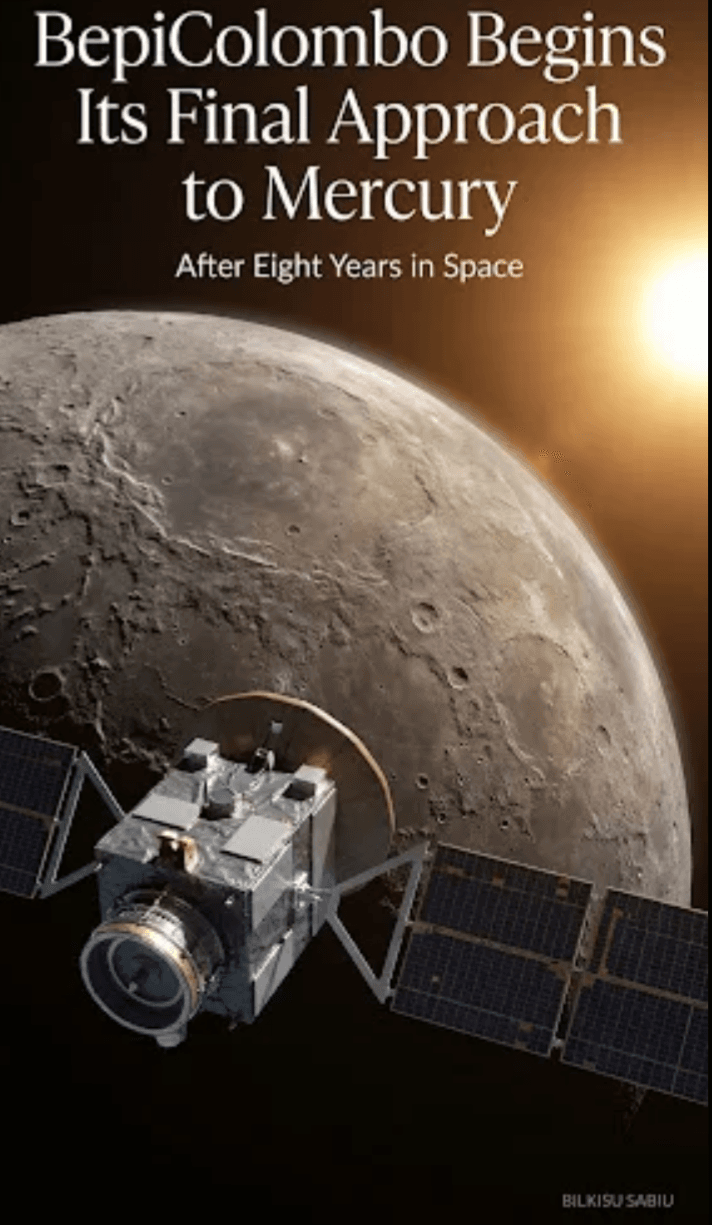
After spending eight years orbiting the inner solar system, the BepiColombo mission has reached a new milestone on its way to Mercury.
On 3 September 2026, the European Space Agency (ESA) and Japan Aerospace Exploration Agency (JAXA) mission successfully separated its Mercury Transfer Module (MTM) from the spacecraft stack.
Having travelled nearly 9.9 billion kilometres and performed nine planetary flybys, the mission has reached the start of its final, tricky series of manoeuvres en route to the Solar System’s smallest and hottest planet.
The Significance of the MTM Separation
The Mercury Transfer Module has played a key role in getting BepiColombo this far.
About the size of a small car, it provided two large solar wings that powered the spacecraft stack, and used solar-electric propulsion to provide continuous, gentle thrust.
This was an innovative and powerful technology for a mission heading towards Mercury since it does not produce short, intense bursts of energy like chemical propulsion.
Now, with the spacecraft set to enter its most challenging phase, the MTM has done its job, and the remaining spacecraft stack can begin its work.
A Long Road to Mercury
Getting to Mercury is easier said than done.
BepiColombo’s journey towards the Solar System’s smallest and hottest planet has not been a straightforward one.
Long-distance space travel involves a complicated dance of inertia and gravity, and BepiColombo’s mission managers had to carefully plan the spacecraft’s trajectory.
Planetary flybys and months of solar-electric propulsion have delivered the mission to the threshold of its destination.
The spacecraft’s engineers have also had to be prepared to improvise.
An unforeseen complication regarding the amount of power generated by the MTM’s solar arrays required mission managers at Europe’s Space Operations Centre in Darmstadt, Germany to modify the spacecraft’s trajectory to get back on course.
Such mission adjustments are a testament to humanity’s enterprising spirit and the value of space exploration.
The Most Challenging Part of the Mission is Still to Come
The separation of the MTM does not mark the end of the road for BepiColombo, but rather the beginning of the end.
According to ESA, the spacecraft was still more than three million kilometres from Mercury after the separation, and the arrival process itself will involve a number of tightly choreographed steps that will take about six months to complete.
The first of these is the insertion procedure, which is currently scheduled to begin on 21 November 2026.
After the MTM is separated, Japan Aerospace Exploration Agency’s (JAXA) Mio spacecraft is to separate from the stack in early December.
ESA’s Mercury Planetary Orbiter (MPO) will then perform a final, precise orbital insertion in March 2027 to begin its science activities, and scientific investigations are to start in April 2027.
Two Spacecraft to Study One Planet
One of the things that makes BepiColombo such an exciting mission is that is comprises two uniquely specialised spacecraft: Mio and Mercury Planetary Orbiter .
Mio, which is a contribution by JAXA, will study the magnetic environment and magnetosphere of Mercury, while MPO, which is a contribution by ESA, will examine the planet itself, including its geology, surface and interior structure, and its interaction with the magnetosphere.
With these two spacecraft, scientists on Earth will be able to conduct a thorough mission of scientific discovery and investigation of the planet that is closest to our Sun.
The Value of Discovering Mercury
Mercury is something of a paradoxical planet: it is the smallest and densest of the Solar System’s four terrestrial planets, and yet it also happens to be the fastest spinning.
In many ways, the planet is the odd one out when it comes to the Solar System’s rocky planets.
BepiColombo’s mission to examine and understand Mercury has the potential to enhance and deepen our understanding of the formation and evolution of not just the planet itself, but of the Solar System as a whole.
The spacecraft’s arrival at the planet will enable scientists to conduct more detailed investigations of the planet’s surface, interior structure, magnetosphere, and its interaction with the solar wind.
Scientists hope that a more thorough understanding of Mercury will help us to better understand our own planetary system.
BepiColombo’s scientific observations during the cruise phase and planetary flybys have already contributed valuable information towards this end.
Mission managers and scientists are looking forward to the upcoming science phase, which will allow them to further our understanding of the planet.
The Beginning of the End of a Long Road
The separation of the Mercury Transfer Module might seem like a small step compared to the launches of the spacecraft itself, but it nevertheless marks a huge milestone on BepiColombo’s journey to Mercury.
For eight years, the MTM was a necessary part of the spacecraft. With its successful separation, the spacecraft is now entering the final stretch of its trip.
The next few months will see the spacecraft and its mission managers do another test of their navigational, propulsive, and operational capabilities
If all goes to plan, BepiColombo will soon enter a new chapter of its mission: not the journey to Mercury, but the study of Mercury.
With a journey of eight long years in space, the end of the road seems like a fitting conclusion to BepiColombo’s long and difficult trip.
Source:
European Space Agency (ESA), “BepiColombo begins Mercury arrival with MTM separation success,” 7 September 2026.
Read the full ESA article at the link below:
https://www.esa.int/Enabling_Support/Operations/BepiColombo_begins_Mercury_arrival_with_MTM_separation_success