Writers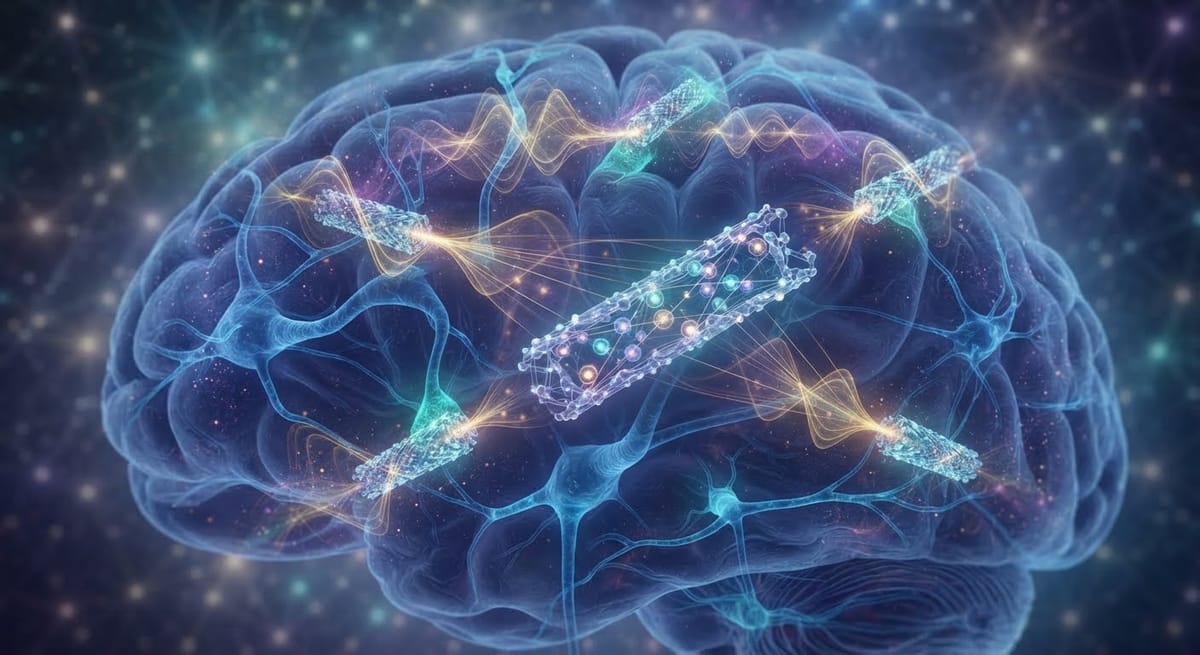
The Quantum Secret Hidden Inside Your Brain’s Synapses
Have you ever wondered how your brain can instantly recall the scent of a childhood rainstorm, the melody of a song you haven't heard in twenty years, or the exact layout of your first school?
You know your mind better than anyone else, but the mechanism behind your deepest memories has baffled science for centuries. For decades, textbooks told us that memories are stored like digital files on a hard drive—electrical signals passing through neural networks, strengthening physical bridges called synapses.
But there is a major problem with that classic theory.
The proteins and molecules that make up your synapses are incredibly unstable. They are constantly tearing down, recycling, and replacing themselves every few days or weeks.
If the physical hardware of your brain changes entirely in less than a month, why don't your memories vanish along with it? How does a memory survive for eighty years when its physical housing disappears in thirty days?
The strange thing is... your memory isn't just chemical.
It’s quantum. Your brain is playing a subatomic game of telephone!
🧠 Beyond the Electrical Impulse
To understand how you retain your identity, we have to look past the large structures of the brain. If we zoom into a single neuron, past the cell wall and deep into its structural skeleton, we find microscopic, hollow cylinders called microtubules.
For years, scientists assumed these cylinders were nothing more than structural scaffolding—the structural beams holding the cell together.
However, international research into the frontiers of quantum biology has revealed a completely different story.
These tiny scaffolding tubes are packed with highly ordered water molecules and light-sensitive pigments. Instead of just sitting there, they act as quantum biological computers. When an experience happens to you, your brain doesn't just record it as a static chemical footprint. It translates it into a subatomic wave function.
But this is just part of the story…
🌌 Subatomic Vibrations Are Part of the Process Too
Some of the information processing in your mind travels through a process called quantum entanglement. This is a physical phenomenon where two subatomic particles become deeply connected. What happens to one instantly influences the other, no matter how far apart they are.
In effect, when your brain processes a thought, it uses two distinct layers of communication: the slow, chemical signals moving across synapses, and the instantaneous, subatomic shifts happening inside the microtubules.
Traditional neurological tools only pick up the slow, electrical signals. They completely miss the subatomic layer.
It turns out this dual-processing system has an unbelievable effect on your daily perception. Researchers studying advanced biophysics have discovered that quantum coherence plays a vital role in preventing memory decay.
By locking information into a quantum state inside the microtubules, your brain shields your memories from the chaotic, warm environment of the body. The molecular recycling of the cell can happen around the quantum state without ever disturbing the information itself.
🔬 Why Do Memories Feel So Vivid After Decades?
A major factor in how you experience a memory is the way your brain handles time and sensory integration.
One reason an old memory can suddenly feel incredibly fresh—flooding you with the exact emotions you felt decades ago—is that quantum information doesn't experience time the way macroscopic objects do. In a quantum state, information can exist in a superposition, meaning multiple facets of a memory are held in a suspended, perfect state of preservation.
This means your brain doesn't just store a data file of what happened; it stores the actual, fundamental wave footprint of the experience.
When you recall a moment, your brain isn't pulling an old, dusty folder out of a cabinet. It is actively re-measuring a living quantum state. That is why the memory feels less like a description and more like a time-capsule experience. Your subatomic architecture has preserved the exact frequency of the original event.
⚛️ The Discovery That Shook Physics
Another reason this biological breakthrough is rewriting science textbooks is because it solves a massive argument between biologists and quantum physicists.
For nearly a century, physicists believed that quantum states could only exist in highly controlled environments—like ultra-freezing laboratory chambers cooled to absolute zero. They argued that the human body is far too warm, wet, and noisy to sustain delicate quantum connections.
Yet, nature has had millions of years to perfect its design.
Recent studies published in leading physics journals show that the structural layout of cellular microtubules actually utilizes the ambient heat of the body to shield its quantum states. The "noise" of your cells acts as a natural harmonic buffer.
Instead of destroying the subatomic connections, the biological warmth of your brain acts like a protective blanket, keeping the quantum memory system stabilized. Nature didn't avoid the laws of quantum mechanics; it built an engine out of them.
🩺 The Real-World Impact on Human Health
Although understanding how memory works is fascinating on a philosophical level, the biggest impact of this discovery is happening in modern medical labs.
When a brain suffers from neurodegenerative conditions like Alzheimer's disease, doctors have historically focused on clearing out the physical plaques and tangled proteins that build up outside the neurons. Unfortunately, treating just the physical plumbing hasn't stopped the devastating loss of memory.
This new quantum perspective explains why.
The physical tangles are just the visible symptom of a deeper collapse. The true damage happens when the structural microtubules inside the cell lose their quantum coherence. When those subatomic vibrations break down, the brain can no longer access its deep storage banks, even if the surrounding neural pathways are temporarily kept alive.
By shifting medical research toward stabilizing the quantum environments inside microtubules, scientists are unlocking entirely new treatment paths. Instead of relying solely on heavy chemical drugs, future therapies may use targeted electromagnetic frequencies to gently hum the brain's internal scaffolding back into its correct quantum rhythm.
🔮 Wait, So What Is a Thought?
Interestingly enough, there is really no single, simple definition of a human thought.
The thought you experience consciously is a beautiful duet between two worlds. It is born in the invisible, subatomic realm of quantum probability, and it manifests physically as a spark of electricity leaping across your neural network.
Both layers are completely real, but they are entirely different states of matter.
This is also why your internal mind can feel so vast, creative, and limitless, even though it is physically contained inside a small, bony skull. Your physical brain is bound by biology, but your subatomic architecture operates under the wide-open rules of quantum mechanics. You are quite literally walking around with a microscopic universe tucked inside your head.
❓ Frequently Asked Questions
If memories are quantum, where are they physically located?
They don't live in a single physical spot. Because of quantum entanglement, memories are distributed globally across the internal matrix of your brain's microtubule networks, rather than being pinned to one specific cell.
Can our brains interact with the quantum world around us?
While your brain uses quantum mechanics internally to process and store data, your senses filter out external quantum chaos so you can interact with the solid, predictable macroscopic world without getting overwhelmed.
Does this mean the brain works like a quantum computer?
Yes, but it is vastly more sophisticated. While human-made quantum computers require massive cooling systems, your brain achieves natural quantum coherence at normal body temperature using biological structures.
Why do we still forget things if our memories are perfectly preserved?
Forgetting is usually an access issue, not a storage issue. The quantum data remains intact inside the microtubules, but the physical neural pathways required to retrieve and translate that data can degrade over time.
🔑 Final Thoughts
Your consciousness is created when biology and quantum physics shake hands.
As you go about your day, your brain records your life in two ways: through the shifting chemical links of your physical synapses, and through the subatomic vibrations locked deep inside your cellular skeleton.
Synapses change, molecules recycle, and old cells die, but the quantum blueprint remains undisturbed.
The world we interact with seems solid, predictable, and entirely mechanical. But sometimes, the most staggering secrets are hiding inside the very tools we use to perceive reality. Your mind isn't just an organ made of tissue and blood—it is a sophisticated quantum engine, quietly humming away in the dark.
🌿 An Ethical Perspective
One of the greatest gifts of science is that it shatters our rigid assumptions about human limitation.
Sometimes, the breakthroughs that seem the most complex are the ones that bring us closest to understanding our shared humanity. When we look at the mind through the lens of quantum biology, the old idea of the brain as a cold, mechanical machine completely falls away.
It reminds us that every memory, every dream, and every creative spark is an intricate, beautifully orchestrated event.
Sources
• Max Planck Institute for Quantum Optics — Research foundational constants and quantum state coherence over extended timelines.
• National Institutes of Health (NIH) — Documentation regarding cellular microtubule architecture and neurodegenerative structural data.