 Writers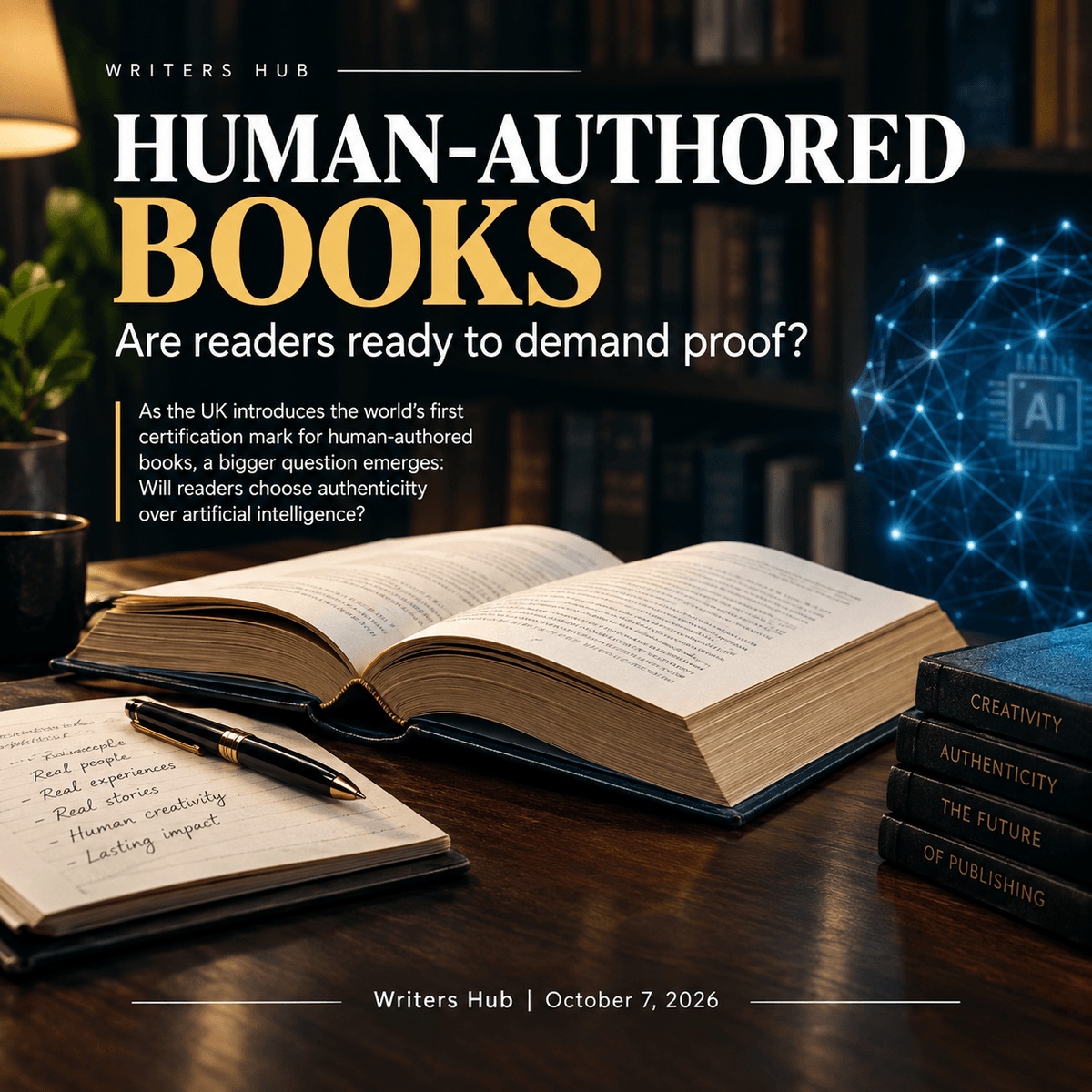
THE HUMAN-AUTHORED BOOK IS MAKING A COMEBACK IN THE AGE OF AI
For generations, readers opened a book with one simple assumption: a human being wrote it.
That assumption is now being challenged by the rapid growth of artificial intelligence.
Today, October 7, 2026, a major development in the publishing world is putting human creativity back at the centre of the conversation. The UK Intellectual Property Office has registered a certification mark for human-authored books, creating a new way for publishers to signal that a book was written by a person rather than generated by artificial intelligence.
The initiative comes from Books by People, a British organisation created around the idea that readers should be able to distinguish human storytelling from AI-generated writing.
WHY DOES THIS MATTER?
Artificial intelligence has changed the publishing industry almost overnight.
Today, anyone can generate pages of text within seconds. A person with little writing experience can produce a story, an essay, a self-help book or even an entire manuscript with the help of AI tools.
The technology itself is not necessarily the enemy.
Many legitimate writers already use AI as a tool for brainstorming, research assistance, editing or organising ideas. The bigger question is where assistance ends and authorship begins.
For readers, the difference matters.
A book written from someone’s memories, struggles, imagination and years of experience carries a different meaning from a book produced primarily by a machine.
That is why the idea of certifying human-authored books is attracting attention.
THE NEW BATTLE FOR TRUST
Publishing has always depended heavily on trust.
When a reader buys a book, they are not simply buying paper and ink. They are buying someone’s ideas, experiences, imagination and voice.
But as AI-generated books become easier to produce, readers may increasingly wonder:
“Did a person actually write this?”
The new certification system is attempting to answer that question.
According to reports, the certification is intended to give readers a visible signal that a book has been created by a human author.
THE PROBLEM WITH AI DETECTION
However, the movement is not without controversy.
AI-detection software is not perfect.
A system can mistakenly identify human writing as AI-generated, particularly when the writer has a distinctive style, unusual grammar, non-standard English or a writing style influenced by another language.
That creates a serious problem.
Imagine spending three years writing your first novel, only for software to incorrectly suggest that artificial intelligence wrote it.
Your reputation could be affected before you even have an opportunity to explain yourself.
This is why the publishing industry needs to be careful about turning AI detection into a system that automatically accuses writers.
THE FUTURE MAY BE ABOUT PROVING THE WRITING PROCESS
Perhaps the biggest lesson from this development is that the future of publishing may not simply be about detecting AI.
It may be about documenting human creativity.
Drafts.
Research notes.
Edits.
Voice recordings.
Developmental feedback.
Different versions of manuscripts.
These could become evidence of the journey behind a book.
In other words, the writing process itself could become part of an author’s credibility.
For emerging writers, especially those publishing independently, this could become increasingly important.
WHAT THIS MEANS FOR WRITERS
Writers should not panic about AI.
Instead, they should become more intentional about developing a recognisable voice.
Your experiences cannot be copied perfectly.
Your memories cannot be duplicated.
Your personal perspective cannot be mass-produced.
AI can help a writer work faster, but the strongest advantage a writer has is still the ability to say something meaningful from a genuinely human perspective.
The publishing industry is entering a new era where originality may become one of the most valuable things an author can offer.
THE BIGGER QUESTION
The real question is not whether AI will disappear from publishing.
It will not.
The question is whether readers will continue to value the difference between a machine-generated story and a story created through human experience, imagination and struggle.
The answer may determine what the publishing industry looks like over the next decade.
One thing is becoming clear: in a world where machines can produce words instantly, the story behind the words may become just as important as the words themselves.
And for human writers, that could be the beginning of a new premium on authenticity.