 Writers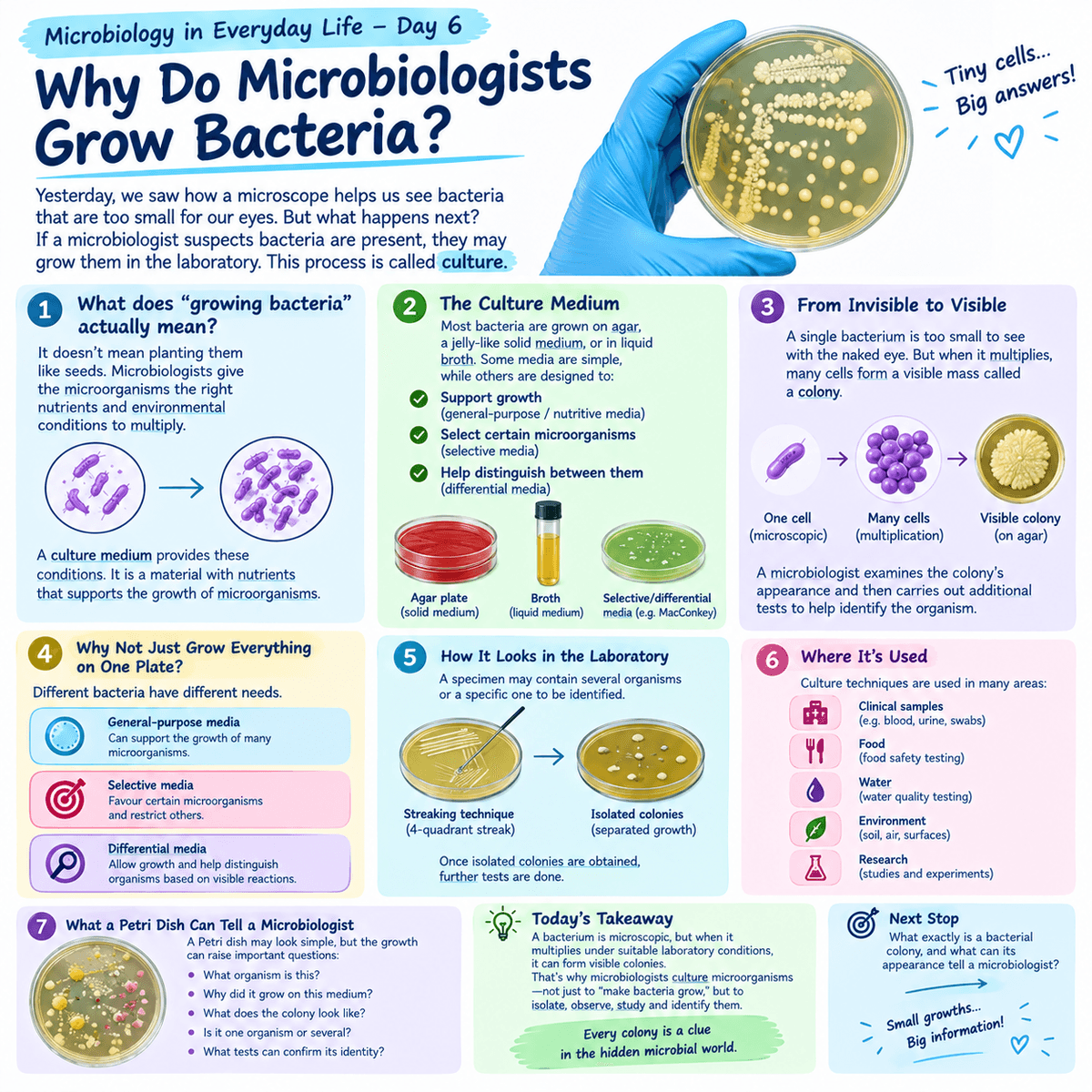
Microbiology in Everyday Life — Day 6
Why Do Microbiologists Grow Bacteria?
Yesterday, we looked at how a microscope helps microbiologists see organisms that are too small for our eyes.
But imagine this:
A sample is brought into a laboratory. The microbiologist suspects that bacteria may be present.
Looking at the sample under a microscope can provide useful clues, but sometimes the scientist needs to investigate further.
So what happens next?
The bacteria may be grown in the laboratory.
This process is called culture.
What does “growing bacteria” actually mean?
When microbiologists say they are growing bacteria, they are not talking about planting them like seeds.
They are providing the microorganisms with conditions that allow them to multiply.
Bacteria need suitable nutrients and environmental conditions to grow. In the laboratory, these requirements can be provided using a culture medium.
A culture medium is a material containing nutrients that supports the growth of microorganisms. Some media are designed simply to support growth, while others are specially designed to help select or distinguish particular microorganisms.
One common form is agar, a jelly-like solid medium that can be poured into a Petri dish.
And this is where the familiar laboratory image of bacteria growing on a plate comes from.
From an invisible cell to a visible colony
Remember how tiny an individual bacterium is?
One bacterium is far too small to see with your naked eyes.
But bacteria can multiply.
When many bacterial cells grow together in one location on a solid culture medium, they can form a visible mass called a colony.
That colony can often be seen without a microscope.
This is one of the fascinating things about microbiology:
Something that started as microscopic can eventually become visible because the cells multiplied.
A microbiologist can then examine characteristics of the colonies, such as their appearance, while carrying out additional laboratory tests to help identify the organism. CDC laboratory training specifically includes recognizing colony morphology as part of basic microbiological culture work.
Why not just grow everything on one plate?
Because different bacteria have different requirements.
Imagine trying to grow every type of plant using exactly the same soil, water and conditions.
Some might grow well. Others might not.
Microorganisms are similar.
That is why microbiologists use different types of culture media.
Some are general-purpose or nutritive media, which can support the growth of many microorganisms.
Others are selective media, designed to favour the growth of certain microorganisms while restricting others.
There are also differential media, which allow microorganisms to grow but help microbiologists distinguish them based on visible reactions.
So the culture medium is not just food.
It can also be part of the investigation.
What does this look like in real life?
Think about a clinical laboratory.
A specimen may contain several different microorganisms, or it may contain a particular organism that needs to be identified.
The laboratory may use an appropriate culture medium and isolation technique to obtain separate colonies.
One important technique is streaking a plate. By spreading the specimen across the surface of the agar in a systematic way, microbiologists can work toward obtaining individual, separated colonies. CDC laboratory training specifically teaches four-quadrant streaking for obtaining isolated colonies.
Once isolated colonies are obtained, further examination and testing can follow.
This is why a Petri dish can tell a story
A Petri dish may look simple.
Just a clear plate with some growth on it.
But to a microbiologist, the growth can raise important questions:
What organism is this?
Why did it grow on this medium?
What does the colony look like?
Is it one organism or several?
What laboratory tests can confirm its identity?
The colony is therefore not necessarily the final answer.
It is another piece of evidence.
And this happens beyond hospitals
Culture techniques are useful in many areas of microbiology.
Microbiologists may investigate microorganisms associated with food, water, clinical specimens, environmental samples and research laboratories.
The purpose can differ, but the basic idea remains:
Give microorganisms suitable conditions, observe what grows, and investigate what that growth means.
Today's takeaway
A bacterium is microscopic, but when bacteria multiply under suitable laboratory conditions, they can form visible colonies.
That is why microbiologists culture microorganisms.
Not simply to “make bacteria grow,” but to isolate, observe, study and identify them.
So the next time you see a Petri dish with little spots growing on it, remember:
Those spots may represent millions of microscopic cells and each colony can provide a clue about what is happening in the invisible microbial world.
Next stop: What exactly is a bacterial colony, and what can its appearance tell a microbiologist?
