 Writers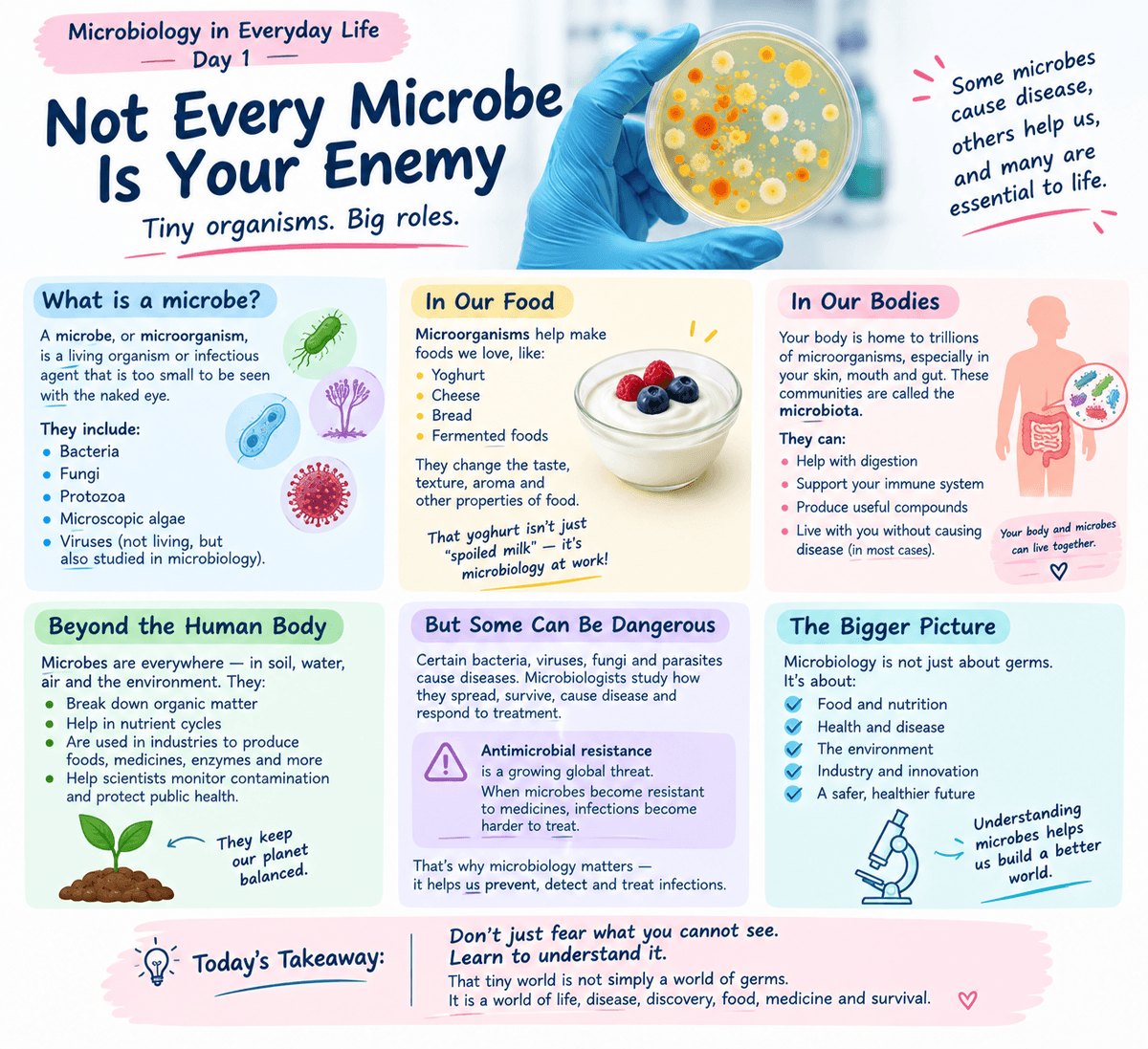
MICROBIOLOGY IN EVERYDAY LIFE — DAY 1
Not Every Microbe Is Your Enemy
When most people hear the word microbe, they immediately think of disease.
Bacteria? Germs.
Fungi? Infection.
Viruses? Sickness.
Parasites? Definitely something to stay away from.
And honestly, I understand why we think this way. We are constantly told to wash our hands because of germs, cook food properly because of microorganisms, and take precautions to prevent infections.
But there is something interesting about microbiology that many people never get to hear:
Not every microbe wants to make you sick.
In fact, life as we know it would be very different without microorganisms.
So, what exactly is a microbe?
A microbe, or microorganism, is a living organism or infectious agent that is too small to be seen clearly with the naked eye.
The microbial world includes bacteria, fungi, protozoa and microscopic algae, while viruses are also studied extensively in microbiology even though they are not considered living organisms in the same way as cellular microorganisms.
They are incredibly diverse.
Some can cause disease. Others are harmless. Some are actually useful to us.
And that is where microbiology becomes fascinating.
Look at your food.
Have you ever wondered how milk becomes yoghurt?
Or how some foods develop their characteristic flavours through fermentation?
Microorganisms are involved in many of these processes.
Certain bacteria and yeasts can break down substances in food and produce compounds that change its taste, texture, aroma and other properties.
So that yoghurt sitting in your refrigerator isn't simply “spoiled milk.”
There is microbiology happening behind it.
Now look at your own body.
Your body is home to enormous communities of microorganisms.
They live on your skin and in places such as your mouth and gastrointestinal tract. Together, these communities are part of what scientists call the microbiota.
Some of these microorganisms can coexist with us without causing disease, and some contribute to important biological processes.
This doesn't mean every bacterium inside the human body is beneficial or that microorganisms should simply be ignored.
It means the relationship between humans and microbes is much more complicated than “microbes = bad.”
And microbiology goes far beyond the human body.
Microorganisms help break down organic matter in the environment.
They participate in nutrient cycles.
They are used in industries to produce foods, medicines, enzymes and other useful products.
Scientists also study microorganisms to understand disease, develop treatments, monitor contamination and protect public health.
So when a microbiologist enters a laboratory and starts working with a tiny sample, there may be much more going on than meets the eye.
That tiny sample could help answer a question about an infection.
It could reveal contamination in food or water.
It could help determine which antibiotic may work against a bacterial infection.
Or it could teach us something completely new about the microbial world.
But yes, some microbes can be dangerous.
This is the part we should never forget.
Certain bacteria, viruses, fungi and parasites cause diseases, and microbiologists spend a great deal of time studying how these organisms spread, survive, cause disease and respond to treatment.
Antimicrobial resistance is one example of why this knowledge matters. When microorganisms become resistant to medicines, infections can become much harder to treat. WHO considers antimicrobial resistance a major global health threat.
So microbiology isn't about teaching people to fear microbes.
It is about understanding them.
Because once you understand the microbial world, you begin to see that the story isn't simply:
“Microbes are bad.”
The real story is much bigger.
Some microbes cause disease.
Some help us.
Some are essential to ecosystems and industries.
And some are still being discovered and studied.
That is the beauty of microbiology.
The organisms we cannot see may be influencing our lives every single day.
TODAY'S MICROBIOLOGY TAKEAWAY
Don't just fear what you cannot see. Learn to understand it.
That tiny world is not simply a world of germs.
It is a world of life, disease, discovery, food, medicine and survival.
