 Writers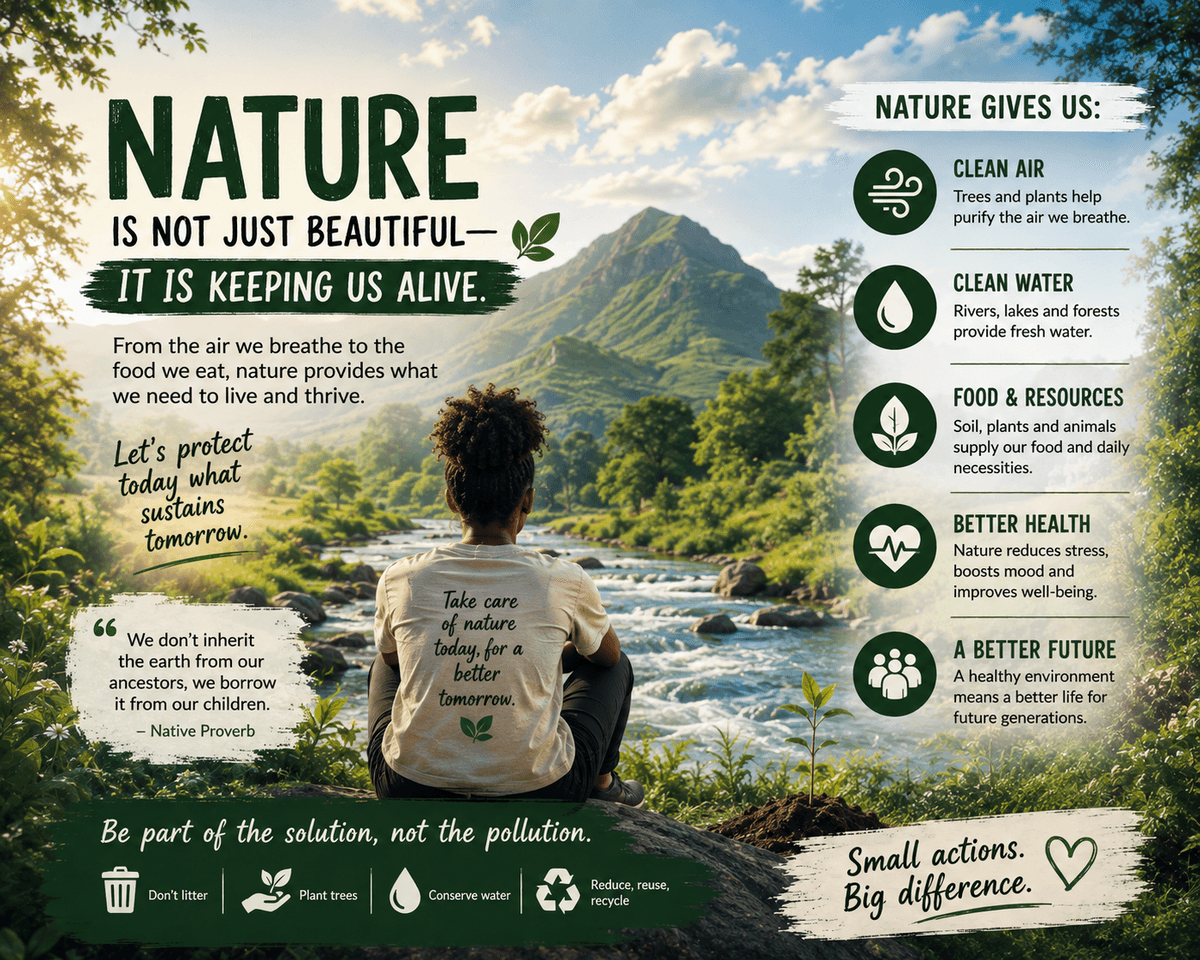
NATURE IS NOT JUST BEAUTIFUL IT IS KEEPING US ALIVE
Sometimes we only notice nature when we want to escape.
We go to the beach when we need a break.
We visit a park when we want to relax.
We take pictures of sunsets.
We admire flowers.
We enjoy the sound of rain.
Then we return to our busy lives and forget about it.
But nature is doing far more for us than giving us beautiful pictures.
Nature is part of the reason we are able to live.
Think about the things we use every single day.
The water we drink.
The food we eat.
The air we breathe.
The soil that produces crops.
Some of the medicines we depend on.
These things are connected to the natural world.
The World Health Organization notes that human health depends on a functioning natural environment because nature provides essentials such as clean air, fresh water, healthy soils, food and medicines.
That means environmental protection isn't simply an issue for scientists, environmental organisations or people who enjoy planting trees.
It is a health issue.
And perhaps this is where our relationship with nature needs to change.
We often behave as though nature belongs to us.
We cut down trees without thinking about what disappears with them.
We throw waste into waterways because the water will carry it away.
We destroy green spaces because we want to construct something else.
We use resources as though they are unlimited.
Then we are surprised when environmental problems eventually find their way back into our lives.
But nature has a way of reminding us that everything is connected.
When ecosystems are damaged, the consequences don't simply remain in the forest or ocean.
They can affect food production, water quality, climate, livelihoods and human health. WHO highlights these connections and notes that biodiversity supports food security, medicines, disease regulation and other conditions necessary for healthy communities.
Even something as ordinary as bees illustrates this connection.
We may see a bee flying around and think, “It's just an insect.”
But pollinators are involved in the production of many crops we depend on. WHO reports that more than 75% of global food crops rely on pollinators.
Suddenly, that tiny creature doesn't seem so insignificant.
The same applies to trees.
A tree can look like nothing more than a tree standing quietly by the roadside.
But forests provide habitats for enormous numbers of species, help regulate climate and contribute to the natural systems on which people depend.
And then there is something else we sometimes overlook:
Nature can also affect how we feel.
There is a reason sitting somewhere quiet surrounded by trees can feel different from sitting in a crowded, noisy environment.
WHO reports that exposure to natural environments is associated with benefits including reduced stress, improved mood, physical activity and social interaction.
Nature doesn't replace medical treatment when someone is sick.
But it can be part of a healthier environment.
Sometimes we don't need another complicated solution.
We need to step outside.
Walk.
Feel the sunlight.
Look at the trees.
Sit somewhere quiet.
Breathe.
Pay attention.
We have become so accustomed to concrete, traffic, notifications and screens that silence can feel strange.
Yet nature has been around long before our phones started demanding our attention every few minutes.
Perhaps that is one reason being around it can feel refreshing.
But enjoying nature is only one side of the conversation.
We also have to protect it.
And protecting nature doesn't always begin with something dramatic.
It can begin with how we handle our waste.
With refusing to throw plastic into drainage channels.
With planting and caring for trees.
With protecting water sources.
With using resources responsibly.
With teaching children why their environment matters.
With supporting practices that don't unnecessarily destroy ecosystems.
We don't have to solve every environmental problem individually.
But we can stop pretending that our small actions don't matter.
A bottle thrown on the ground may seem insignificant.
One polluted stream may seem insignificant.
One tree cut down may seem insignificant.
But millions of small actions eventually become a large environmental problem.
The opposite is also true.
Millions of responsible choices can create meaningful change.
Perhaps we should stop asking only:
“What can nature give me?”
And begin asking:
“What am I giving back to nature?”
Because we are not visitors on this planet.
We are participants in its systems.
The food on our plates, the water in our cups, the air around us and many of the resources we depend on are connected to a natural world that existed before us and, hopefully, will continue after us.
We don't need to romanticise nature to understand its importance.
We simply need to recognise the truth:
When we damage the systems that sustain life, we eventually create problems for ourselves.
Taking care of nature is therefore not only about saving trees, animals or beautiful landscapes.
It is also about protecting people.
Protecting our water.
Protecting our food systems.
Protecting our health.
Protecting future generations.
So the next time you see a tree, don't only see something beautiful.
Remember that it is part of a much bigger system.
The next time you see a river, don't only see water.
Remember that communities and ecosystems depend on clean water.
And the next time you walk through a green space, don't think of it as empty land waiting to be developed.
Sometimes what looks empty to us is actually full of life.
Nature is not simply our background.
It is part of our home.
And perhaps the best time to start treating it like one is now.